

























































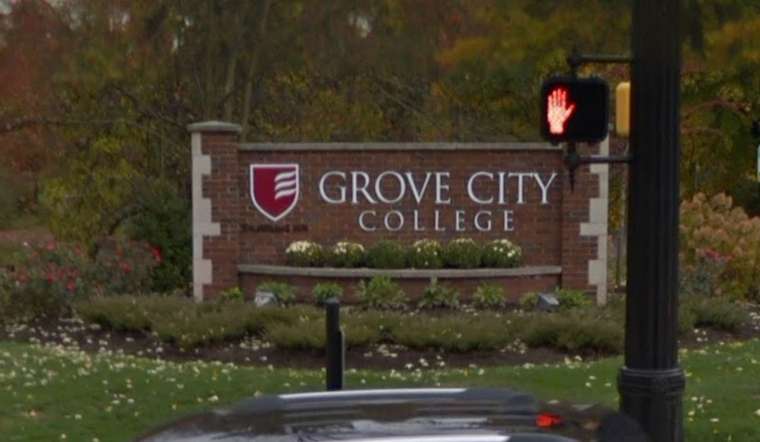
Grove City College just closed out its most successful fundraising year in school history, pulling in $75 million over the past twelve months and immediately using that momentum to ask donors for tens of millions more. The Mercer County school, which famously refuses all federal funding, says the haul will go toward increased financial aid, expanded athletic facilities, upgraded student living spaces and other campus programs.
The $75 million figure marks a 42.5 percent jump over the $52.6 million raised in the 2024–25 fiscal year, which was itself a school record at the time, according to Grove City College. The college is also transitioning into Phase II of its Impact 150 capital campaign, a multi-year fundraising initiative launched to coincide with the school's 150th anniversary, as reported by ButlerRadio.com.
On the heels of the record-setting year, the college expanded its Impact 150 goal by an additional $55 million, money explicitly earmarked for need- and merit-based student financial aid. That expansion builds on the campaign's original $185 million target, according to the college's own accounting of the fund drive.
What Phase II Will Actually Build
Phase II priorities include a major renovation of Lincoln and Hopeman halls, two men's dormitories built in 1941, along with upgraded student living spaces and expanded athletic facilities. Campaign organizers have structured the project in three phases specifically to limit disruption to campus life while the work gets done.
That construction push follows what the college already delivered during Phase I. That earlier stage generated more than $90 million for student financial aid and funded a $48 million renovation that turned the 90-year-old Rockwell Hall, once the campus's primary science building, into the Smith Hall of Science and Technology, according to reporting from Business Journal Daily.
A College Built on Refusing Federal Money
Grove City College is widely recognized as the largest higher education institution in the country to completely decline federal funding, a stance that hardened after the 1984 U.S. Supreme Court decision in Grove City College v. Bell, which held that accepting student federal grants would trigger Title IX administrative oversight, per Pittsburgh Quarterly. That means every dollar of student aid at the school comes from tuition and private donors rather than government grants or loans.
More than 70 percent of Grove City College students receive financial aid funded entirely through private institutional and donor-sponsored scholarships, the same outlet reports. The model helps explain why undergraduate tuition for the 2025–26 academic year sits at $21,700, which the Princeton Review notes is less than half the national average for private four-year liberal arts colleges.
New President, Sesquicentennial Milestone
The fundraising surge arrives as Grove City College settles into a new era of leadership. Bradley J. Lingo, a 2000 alumnus of the college and former dean of Regent University School of Law, took over as president in July 2025 and was formally inaugurated as the school's 10th president in March 2026, succeeding Paul J. McNulty, who retired after leading the college since 2014.
The timing also lines up with the school's founding story. Isaac Ketler started Grove City College in April 1876 with just 13 students paying $4 in tuition, and the Impact 150 campaign was built specifically to coincide with the college's 2026 sesquicentennial anniversary, according to the college's archives.
The college points to outcomes as part of its pitch to donors: it reports that 95 percent of graduates are employed or enrolled in graduate school within six months of finishing their degree, and a 2025 institutional report estimated the college's annual regional economic impact at $176 million. Exactly when construction will break ground on the Lincoln and Hopeman Hall renovations, and whether the expanded $55 million campaign goal will affect future tuition rates, remain open questions the college has not yet addressed publicly.


