

























































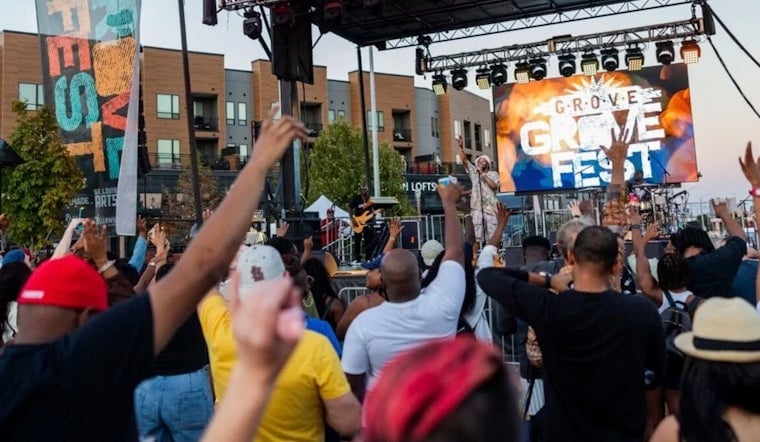
GroveFest, the street festival that has packed Manchester Avenue with music, art, food and as many as 50,000 attendees for two decades, will not take place this year. Park Central Development, the community development organization that produces the event, is instead shifting GroveFest to a biannual, every-other-year format, according to a report from St. Louis Magazine.
The nonprofit did not disclose specific reasons for skipping this year's festival, but St. Louis Magazine reports that Park Central Development said in an email it is stepping back to reorganize GroveFest and ensure it continues to serve the organization's goals. St. Louis Board of Aldermen member Michael Browning, who represents Ward 9 covering Forest Park Southeast and The Grove, was more direct about the pressures behind the decision, saying that GroveFest is expensive to run and that events like it are increasingly costly to stage given the vendors, security and other trappings required.
Browning framed the move as temporary rather than a shutdown, saying GroveFest's cancellation is more of a see-you-next-year than a farewell as the festival moves to a biannual schedule. The scale of what organizers have had to manage helps explain the cost pressure: the same report's outlet notes GroveFest brought together local businesses, local artists and high-profile musical acts, with past headliners including Unknown Mortal Orchestra in 2025 and Mannie Fresh, who headlined a 2023 edition held in New Orleans. A 2022 funding request from Park Central Development sought $30,000 in dedicated event funding while projecting 30,000 attendees that year, illustrating just how much sponsor grants, vendor fees and district tax dollars have had to cover to keep the festival running.
A Festival Built Into The Grove's Identity
GroveFest traces back to an inaugural celebration in August 2006, when the event launched as a 12-hour street party along Manchester Avenue, according to Restoration St. Louis. It has typically taken place in October and grown into a signature draw for the district, blending art, food, music and what organizers describe as the neighborhood's energy. The financial backbone for that programming comes from The Grove Community Improvement District, established in 2009 to levy special local sales taxes and assessments for public safety, street beautification and marketing along the corridor, with administration handled by Park Central Development, per the Regional Arts Commission of St. Louis. That district generates roughly $250,000 annually through sales taxes and special assessments to fund security, cleaning and promotion along the one-mile Manchester Avenue stretch, according to a 2020 report from the U.S. Department of Housing and Urban Development.
Park Central Development is led by Executive Director Abdul-Kaba Abdullah, who has headed the organization since before 2018 and oversees administrative services for multiple special taxing districts across the city. The organization's reach extends beyond The Grove: even while pausing GroveFest, Park Central Development kept producing other regional street events in 2026, partnering with the Euclid South CID to host the third annual Central West End Jazz & Blues Festival, a free six-hour event Hoodline covered earlier this month.
What Fills the Gap This Fall
The Grove won't be without programming this fall. A bar crawl is planned for early October 2026, alongside other neighborhood events that month, and Urban Chestnut Brewing Company's Grove Brewery & Bierhall at 4104 Manchester Ave. will hold its annual Oktoberfest as usual, giving the corridor a smaller-scale draw in GroveFest's absence.
The pause also lands amid a broader shift in The Grove's identity. In May 2024, the Missouri Arts Council designated the neighborhood a Missouri Creative District, recognizing its concentration of live music venues, performance spaces and more than 110 public and interior murals, per the Regional Arts Commission of St. Louis. At the same time, August 2026 reporting from the Riverfront Times documented changing commercial dynamics along the corridor, noting that while The Grove historically served as St. Louis's primary LGBTQ+ nightlife hub, it is now experiencing demographic shifts, business turnover and rising housing costs.
For now, Park Central Development's message is that GroveFest is on hold, not gone. Organizers are betting that a lighter, every-other-year schedule can keep the festival financially sustainable while The Grove itself continues to change around it, with a return expected in 2027.



