

























































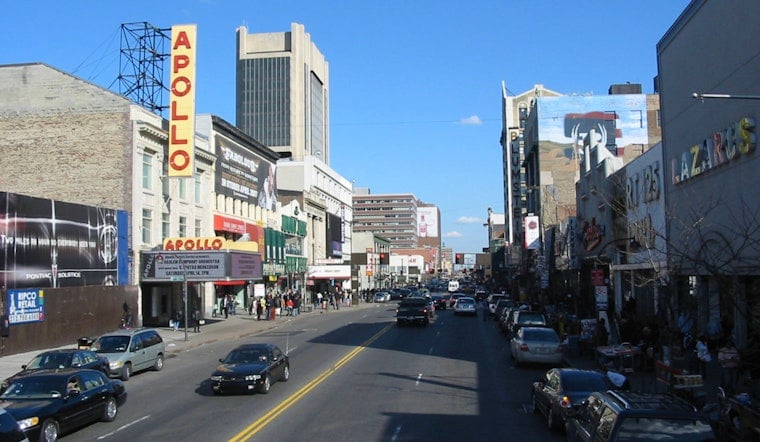
Harlem is turning its history into a shopping guide, using murals, storefront art and cultural landmarks to pull more visitors toward local businesses along 125th Street. The strategy connects the neighborhood’s Black cultural legacy with a very modern goal: getting people to linger, explore and spend money beyond the biggest attractions.
At the center of the effort is the Harlem Main Street Passport, a 14-panel wayfinding mural completed in June and paired with 62 street banners and a QR code linking to an interactive map. The 125th Street Business Improvement District received a $50,000 public realm grant as part of a broader $1.5 million Manhattan funding push, according to amNewYork.
The project has been in the works for years. An earlier survey posted by the 125th Street BID asked residents, workers and visitors to help shape a wayfinding system built around a neighborhood emblem, QR codes, connections to local businesses and cultural destinations, plus rewards for exploring Harlem.
The visual campaign does not stop at the mural. Artist Paul Deo created a window splash for Levels Barbershop, while artist Antonia Badon designed a Harlem Renaissance-themed window display for Settepani featuring historic figures riding the A train; the map also offers discounts from 16 participating businesses and institutions, as detailed by amNewYork.
That approach lines up with how the city defines public realm investment. The NYC Department of Small Business Services says its grants can support creative streetscape projects involving public art, lighting, wayfinding, district marketing and other improvements on active commercial corridors.
Harlem’s Cultural Anchors Are Expanding
The timing gives the initiative plenty to point toward. The Studio Museum in Harlem is now open at 144 West 125th Street, where its new building is serving as a major cultural anchor and drawing visitors directly onto the corridor.
The Apollo is also adding cultural capacity nearby. Its redevelopment of the former Victoria Theater includes two black-box theaters with 99 and 199 seats, while the historic Apollo Theater remains closed for renovation and is expected to reopen later in 2026, according to The Apollo.
That mix gives Harlem something more useful than a single landmark photo-op: a route. A visitor can follow the mural, scan the map, stop at a restaurant or barbershop, and continue toward museums, theaters, churches and neighborhood retailers instead of treating 125th Street as a place to pass through.
The commercial test will be whether the art produces repeat foot traffic rather than just compliments. Harlem’s history is already the attraction; the new bet is that better wayfinding and a little more visual energy can turn that attention into revenue for the businesses that keep the corridor alive.





