

























































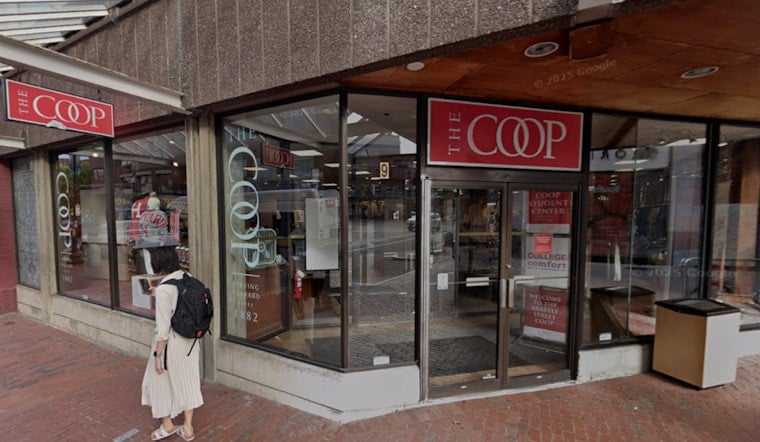
The Harvard Cooperative Society, the 144-year-old member-owned institution known to generations of students simply as the Coop, has opened its first new store in years inside the Atlas Hotel on Western Avenue in Allston — a compact space stocked with curated books, vinyl records, and products from Harvard student startups rather than the towering shelves of textbooks that once defined the brand. The move marks a deliberate break from the Coop's traditional retail identity as it tries to find relevance in a Harvard Square where rents are steep and shopping habits have shifted.
According to The Boston Globe, the Coop is using the Allston location as a prototype for its future, with the co-op planning to open a second, larger new store — 12,000 square feet inside the Google building in Kendall Square — in early 2027. Coop chief executive Jodi Goldstein told the Globe the new format represents where the organization is headed, and that the sprawling Harvard Square flagship will eventually be repurposed for community gatherings, coworking space, retail, and other uses still being worked out.
Goldstein, who became CEO in 2024 after leading Harvard Innovation Labs for a decade, is running the Coop alongside colleague Adrian Gill more like a startup than a legacy bookstore, per the same Globe report. Gill told the paper that the Coop is using retail as a way to bring people together, and the new stores are built around that idea: movable fixtures, space for author talks, DJ sets, and chef events, alongside a vinyl collection curated with the local shop Vinyl Index and travel titles curated with Monocle.
A Heritage Wall and a Polaroid Nod to Cambridge History
The Allston store also leans into the Coop's own past and Cambridge's broader innovation lore. Per the Globe, the Coop built a heritage wall displaying pieces from the Harvard athletic archives, including an 1885 baseball trophy and a baseball cap from 1902, and it invites customers to hang Polaroid selfies on a wall — a nod to Polaroid founder Edwin Land, who started his camera company in Cambridge, the article notes.
The organization has also launched student-focused initiatives and collaborates with Storyfave, an AI-powered storytelling platform, and SXD, a sustainable fashion-tech startup, as part of its push to expand community programming and literary events. The Coop is now measuring success less by sales per square foot and more by customer dwell time, event attendance, and whether shoppers see the store as a destination in its own right, according to the same account.
Can a Cooperative Compete With Big Retail?
Not everyone is convinced the strategy will work. Retail consultant Todd J. Drowlette questioned whether the Coop can compete with larger retailers while running a more curated, smaller inventory, the Globe reported. Jessica Richards, a retail trend forecaster and former Hudson's Bay department store group executive, offered a more optimistic read, telling the paper that regional department stores and legacy retailers have an opportunity to thrive by emphasizing their own histories rather than competing head-on with big-box scale.
Denise Jillson, quoted in the same Globe piece, called the Coop's planned changes transformational for Harvard Square, where the co-op has been a fixture for generations. The Coop has ambitious expansion plans beyond Harvard Square altogether, though it has not detailed how many additional locations might follow the Allston and Kendall Square stores.
A Co-op Built on Bulk Coal and Textbooks
The Coop's roots go back to 1882, when Harvard students pooled money to buy coal and wood in bulk, later expanding the arrangement to bulk textbook purchases. It was formally incorporated as a consumer cooperative under Massachusetts law in 1903, according to background compiled by the University of Toronto Press, making it one of North America's oldest consumer cooperatives. The Coop expanded to serve MIT students in 1916, and today it is owned by roughly 80,000 members — Harvard and MIT students, faculty, and alumni — who pay an annual membership fee of just $1, a rate that has not increased since the organization's founding, per the Globe's reporting.
Crucially, the Coop has no financial relationship with either Harvard or MIT, despite the shared names. Since 1995, its day-to-day bookstore and retail operations have been run by Barnes & Noble College following a period of financial losses, according to historical reporting from The Brown Daily Herald — while the cooperative entity itself has remained member-owned and has retained ownership of its real estate, including the historic brick flagship building the Coop constructed at 1400 Massachusetts Avenue in 1925.
From Rebate Checks to Instant Discounts
The Coop has repeatedly retooled its member benefits and physical footprint to keep pace with changing retail habits. In 2014, it scrapped its long-running annual cash rebate check — which had averaged roughly 8.5% of a member's yearly purchases — in favor of an instant 10% discount at checkout, a change Harvard Magazine reported came after focus groups showed students preferred immediate savings over a once-a-year check.
The Coop also temporarily closed its main store in 2020 for multi-million-dollar renovations, consolidating operations from its former Palmer Street annex into the flagship building when it reopened in 2021. That renovation created the kind of flexible layout space now being used for author talks and community events, according to Cambridge Day. Longtime CEO Jerry Murphy, who joined the Coop in 1991 and oversaw those renovations, retired in September 2024 after more than three decades at the helm, clearing the way for Goldstein's arrival.
Competing With an Expanding Independent Rival
The Coop's repositioning comes as its Cambridge neighbor and rival, the independent Harvard Book Store, is expanding rather than shrinking its physical footprint. Founded in 1932 and unaffiliated with either Harvard University or the Coop, Harvard Book Store announced in June that it plans to open a second, 3,500-square-foot store across the Charles River in Boston's historic Blackstone Block, as Hoodline previously reported. That expansion underscores just how differently two of Harvard Square's best-known booksellers are betting on the future of physical retail.
Underpinning both strategies is a commercial real estate market that leaves little room for retailers to stand still. Retail space across Harvard Square and prime Boston corridors carried low single-digit vacancy rates and asking rents ranging from $40 to more than $100 per square foot in mid-2026, according to a market report from Cornovus Capital, a dynamic that is pushing large stores toward experiential concepts rather than traditional sales floors. For the Coop, that pressure is now reshaping not just its Harvard Square flagship but the entire footprint of a cooperative that started with a handful of students splitting the cost of firewood.





