

























































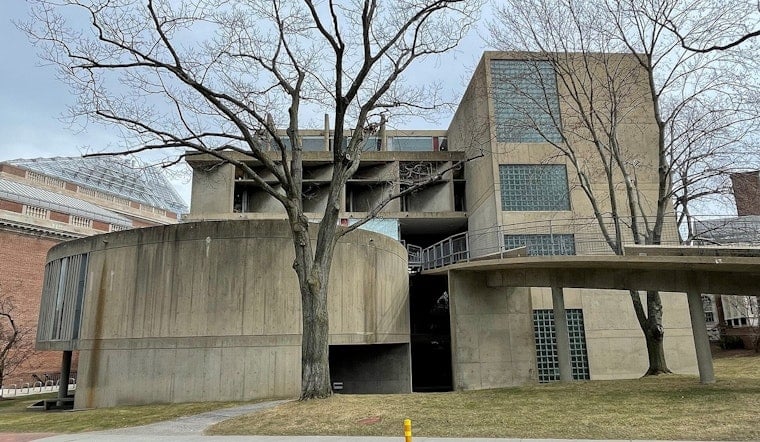
Eleven films adapted from the writing of Graham Greene are unspooling at the Harvard Film Archive this summer, a retrospective built around a novelist who spent his life obsessed with cinema even as he split his own work into two rival camps. The series, titled The Cold Heart Is More Precious Than Diamonds: The Cinema of Graham Greene, runs through September 19 at the Carpenter Center for the Visual Arts, 24 Quincy Street in Cambridge, and includes a new 35mm print of The Third Man among its highlights.
The retrospective takes its title from a line in Greene's 1948 Catholic-themed novel The Heart of the Matter, a fitting choice given how thoroughly the writer's fiction and film work were entangled, according to The Boston Globe. Greene, an English novelist who lived from 1904 to 1991, had a strong affinity for film, and his writing has been adapted into three dozen films over the decades, per the Globe's reporting. Only 11 of those made the cut for the Harvard Film Archive's summer slate.
A Critic Whose Reviews Once Sank a Magazine
Before Hollywood came calling for his novels, Greene reviewed films during the 1930s for outlets including The Spectator and Night and Day. That criticism nearly ended his career before it began: his 1937 review of nine-year-old Shirley Temple triggered a £3,500 libel judgment that forced Night and Day to fold, according to Mental Floss. The fallout sent Greene traveling to Mexico, where he gathered material that would become The Power and the Glory — the novel later adapted into John Ford's 1947 film The Fugitive, starring Henry Fonda, which screens at the archive on September 7.
Ford's version softened Greene's morally compromised whiskey priest into a more straightforward heroic martyr to satisfy Hollywood's Production Code, according to Cineaste Magazine. That kind of sanding-down of Greene's moral ambiguity recurs across the series, the Globe notes, with British productions generally hewing closer to the writer's darker instincts than their American counterparts.
The Carol Reed Trilogy Anchors the Series
No director worked with Greene more, or more successfully, than Carol Reed, who has three films in the series: The Fallen Idol (1948), The Third Man (1949), and Our Man in Havana (1959). The Fallen Idol, screening August 21 and September 4, stars Ralph Richardson as an embassy butler and Bobby Henrey as an ambassador's young son, and its plot turns on an accidental death, a love affair, and a police investigation, per the Globe's account. The Fallen Idol gets a second screening the same evening as the second Third Man screening.
The Third Man, which took the Grand Prix at the 1949 Cannes Film Festival according to The Independent, screens September 4, 5, 6, and 19 in a new 35mm print. Greene wrote the screenplay himself, Orson Welles played the black-market racketeer Harry Lime, and Robert Krasker shot the film's celebrated black-and-white cinematography. Our Man in Havana closes out the trilogy on August 29.
Entertainments, Wartime Propaganda, and a Notable Omission
Until the late 1950s, Greene explicitly split his output into serious novels grappling with weighty religious and moral themes and faster-paced genre thrillers he dismissively labeled entertainments, a distinction detailed by The Millions. Four films in the Harvard series were adapted from those self-described entertainments, including This Gun for Hire, the 1942 American noir starring Alan Ladd and Veronica Lake that was adapted from Greene's novel originally published in the UK as A Gun for Sale; it screens August 22. Ministry of Fear, Fritz Lang's 1944 adaptation, screens August 22 and 30, while Confidential Agent, released in 1945 and screening August 24, was a film Greene himself considered the only good movie made from one of his books by an American director, per the Globe.
Wartime material also figures prominently. Greene wrote the story idea behind Went the Day Well?, the 1942 Alberto Cavalcanti film depicting an English village occupied by Nazi paratroopers disguised as British soldiers; it screens August 31. Brighton Rock, adapted by Greene and Terence Rattigan and released in 1948, screens August 21 and September 5, with Richard Attenborough as the murderous teenage thug Pinkie. Notably, the series omits the 2010 remake of Brighton Rock starring Andrea Riseborough, as well as both film versions of The Quiet American — the 1958 adaptation starring Audie Murphy and the 2002 version starring Brendan Fraser — and the second adaptation of The End of the Affair, the 1999 Neil Jordan film starring Ralph Fiennes and Julianne Moore.
Rounding Out the Retrospective
Two later adaptations fill out the calendar. The Heart of the Matter, the 1953 film version starring Trevor Howard and Maria Schell, screens August 28. Travels With My Aunt, George Cukor's 1972 comedy, closes the series on September 19. Housed on the lower level of the Carpenter Center — the only building in North America designed by Swiss-French architect Le Corbusier, per the venue's own materials — the Harvard Film Archive has operated since 1979 as a division of Harvard Library, preserving more than 40,000 film prints, audiovisual materials, and ephemera.
Regular admission runs $10 for the general public and $8 for seniors and non-Harvard students, with free entry for valid Harvard ID holders; tickets are available online or at the Carpenter Center box office 30 minutes before showtime. Hoodline previously named the archive among Cambridge's top cinemas, a reputation this Greene retrospective looks poised to reinforce for local filmgoers weighing which of the 11 titles to catch before the run ends September 19.





