

























































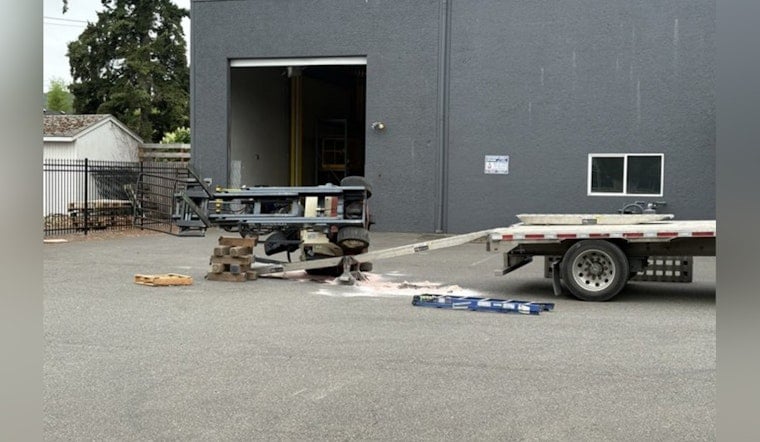
Seattle firefighters converged on the 200 block of S Lucile St in Georgetown Wednesday afternoon after a HazMat call sent crews scrambling to the industrial corridor, with the department urging the public to steer clear of the immediate area while the response unfolds.
The Seattle Fire Dept. posted the alert from its official account, seattlefire, shortly after 5 pm, telling residents that a hazmat response was underway on the block and that the public should avoid it. The department did not specify in its post what chemical or material triggered the response, and as of this writing, officials have not confirmed whether anyone was injured or what exactly sparked the call.
The block sits deep in Georgetown's industrial core, an area zoned for heavy commercial and manufacturing use under the city's General Industrial 2 designation, which permits operations up to 85 feet tall, according to a filing from the Commercial Brokers Association. That zoning has made the neighborhood one of Seattle's oldest and most enduring manufacturing hubs, and it helps explain why hazardous materials calls tend to originate there rather than on residential streets.
A Corridor Built Around Hazardous Materials
Among the notable commercial occupants on the 200 block of S Lucile St is Dakota Lithium Batteries, headquartered at 225 S Lucile St, which manufactures and distributes lithium iron phosphate batteries. Those products fall under federal Department of Transportation hazardous materials transportation standards, per Dakota Lithium's own safety documentation, meaning the batteries are subject to strict packaging and fire-safety rules whenever they are stored, handled, or shipped.
Fixed industrial facilities like the ones lining this stretch of Georgetown represent the single most frequent type of location for hazardous materials dispatches citywide, according to the Seattle Hazard Identification and Vulnerability Analysis compiled by the Seattle Office of Emergency Management. That same analysis found the Seattle Fire Department logged 1,243 hazardous materials dispatches between 1995 and 2017, including 44 that involved active fires with a hazardous chemical component.
Specialized Units Dispatched From Belltown
Responses of this kind typically draw Seattle Fire's HazMat 1 unit, a specialized team created in 1980 under the department's Special Operations division to handle chemical spills, toxic gas releases, and industrial contamination, according to the City of Seattle. HazMat 1 operates alongside Decontamination Unit 1, both based out of Fire Station 2 in Belltown, deploying chemical detection equipment and atmospheric monitoring tools during citywide hazardous releases, per SFD Live.
The stakes of any chemical release in this particular stretch of Georgetown are heightened by its location. The 200 block of S Lucile St drains into the Lower Duwamish Waterway basin, a federal Superfund site added to the EPA National Priorities List in 2001 and to the Washington Hazardous Sites List in 2002 because of industrial chemical contamination, according to the Washington State Department of Ecology. The EPA and the state have overseen cleanup efforts along the 5.5-mile industrial stretch of the river for decades.
Regulatory Requirements for Chemical Handlers
Washington's Department of Labor & Industries requires facilities that store dangerous substances to maintain written emergency plans, container labeling, and specialized protective gear for potential releases, under state rules outlined in WAC 296-843. Separately, businesses generating state-designated dangerous waste are required to immediately report unscheduled chemical releases to state regulators and local emergency management officials under Washington State Department of Ecology regulations found in WAC 173-303.
S Lucile St functions as a key east-west connector linking Airport Way S, Highway 99, and Interstate 5, making any block closure along the corridor disruptive for freight traffic and nearby businesses, according to the Commercial Brokers Association. Georgetown's street grid is built to accommodate heavy commercial vehicle movement between the Port of Seattle and the regional freeway system, so a shutdown on even a short stretch can ripple outward.
Wednesday's call adds to a string of hazmat responses Seattle Fire crews have handled across the city in recent months, including a liquid nitrogen leak near the University of Washington campus and a mystery odor that emptied a Seattle University building. The exact substance involved in the S Lucile St response, its source, and whether anyone was hurt remain unconfirmed. Seattle Fire has advised the public to call 911 for emergencies as the investigation continues.



