

























































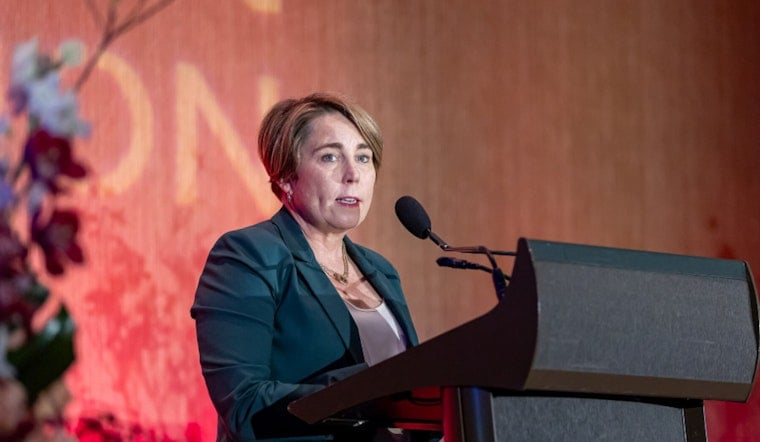
Governor Maura Healey announced more than $24 million in workforce and talent development funding for Massachusetts industries in fiscal year 2027, with the money drawn from a state trust fund that is automatically replenished by a slice of the Commonwealth's sports betting tax revenue. The Healey-Driscoll administration says the investments will expand employer-connected training programs, apprenticeships, and career pathways across the state.
As reported by Boston 25 News, the Workforce Investment Trust Fund was created by the Massachusetts Legislature and is administered by the Executive Office of Economic Development. The fund partners with the Workforce Skills Cabinet, the Executive Office of Labor and Workforce Development, the Executive Office of Education, and the Executive Office of Health and Human Services to steer money toward low-income communities and youth. Grant recipients and specific award amounts will be announced in 2027.
Where the Money Actually Comes From
The trust fund's steady stream of cash traces directly back to the 2022 Massachusetts Sports Wagering Act, signed by former Governor Charlie Baker, which authorized retail sports betting in January 2023 and mobile wagering that March, according to the Massachusetts Budget and Policy Center. Under Chapter 23N, Section 18 of the Massachusetts General Laws, the fund automatically receives 17.5 percent of all sports wagering tax revenue collected by the state, with those dollars continuously spent rather than reverting to the General Fund at year's end.
State law splits sports betting tax collections five ways: 45 percent to the General Fund, 27.5 percent to Gaming Local Aid, 17.5 percent to the Workforce Investment Trust Fund, 9 percent to a Public Health Trust Fund aimed at problem gambling, and 1 percent to a Youth Development and Achievement Fund, per the Massachusetts Gaming Commission. Category 3 mobile and online operators pay a 20 percent tax rate on taxable revenue, while Category 1 retail sportsbooks at physical casinos are taxed at 15 percent. The commission's data shows the Commonwealth has collected roughly $490.96 million in total sports wagering taxes and assessments since legal betting launched in early 2023 through July 2026, with July alone generating about $65.56 million in taxable sports wagering revenue.
Three Priorities Guiding the Fiscal 2027 Spending
The Workforce Investment Trust Fund has three strategic priorities for fiscal year 2027: attracting and retaining talent in key industries, supporting global talent, and opening career pathways for all, according to Boston 25 News. Employer-connected workforce programs will expand through the funding, and the investments will support employer-driven training, internships, apprenticeships and career pathways.
Governor Healey said in a statement that Massachusetts' greatest competitive advantage has always been its people. Economic Development Secretary Eric Paley said the Commonwealth's economic success depends on developing, attracting and retaining world-class talent. Lieutenant Governor Kim Driscoll said the investments strengthen partnerships between employers, educators and community organizations, while Senate President Karen E. Spilka said every Massachusetts resident deserves a pathway to a well-paying job.
Recent Programs Already Tapping the Fund
The administration has already used the trust fund to launch targeted initiatives ahead of this latest announcement. In July, quasi-public agency Commonwealth Corporation launched the Massachusetts Advancing Pathways for International Talent, or MAP-IT, Initiative — a grant program funded through the trust fund to help work-authorized immigrants align foreign degrees and credentials with state workforce opportunities. Commonwealth Corporation also issued a request for proposals this year for a Re-Entry Workforce Development Demonstration Program, using trust fund dollars to finance job training and support services for formerly incarcerated individuals.
The fiscal 2027 announcement follows a pattern established in the administration's FY2026 budget proposal, which designated $7.5 million from the trust fund alongside House 1 funding to support community-led workforce programs and to transition the state's Advanced Manufacturing Training Program onto the fund, according to Mass.gov. Witf initiatives will help employers recruit and retain international talent, and the fund's investments are meant to help Massachusetts residents access skills, training and opportunities while helping employers obtain the workforce needed to grow, innovate and create jobs.
A Growing Piece of a Bigger Gambling Revenue Picture
Combined cumulative tax collections from commercial casino gaming and sports betting in Massachusetts have crossed $2.99 billion since the start of legal casino operations through July 2026, per reporting from Focus Gaming News. That scale underscores why the trust fund has become a recurring off-budget tool for the Healey-Driscoll administration, which has repeatedly leaned on it for workforce announcements over the past year — including $7.4M in job-training grants announced last October and a $70 million vocational education expansion announced in May.
Witf funds will expand employer-connected trainings and programs preparing Massachusetts residents for in-demand industries, and the investments will build paths for residents to advance their careers. The administration has not yet detailed which organizations will receive fiscal 2027 grants, with those specifics expected to follow next year.





