

























































Henry Ford's 56-room Dearborn mansion has sat mostly closed to the public for years, but the estate's powerhouse, garage and grand home are now on track to reopen for tours and private events in 2027. The property along the Rouge River includes a hydroelectric powerhouse where Ford once ran generators alongside his friend Thomas Edison, an in-ground turntable for cars in the garage, and an underground tunnel where Ford tinkered on an experimental X engine.
Fair Lane Estate hosted a press tour of the grounds yesterday, giving reporters a look at the restoration's progress, as reported by the Detroit Free Press. Devon O'Reilly, who became president and CEO of the nonprofit Fair Lane Estate in June 2025 to guide the final phases of restoration, told the paper that renovations have cost roughly $15 million to $18 million, funded mostly through private donations. The nonprofit, formally known as Henry Ford Estate Inc., took over stewardship of the property from the University of Michigan in 2013, according to background compiled by Lord Cultural Resources.
A House Built for Tinkering
The estate encompasses Henry and Clara Ford's home along with its powerhouse and garage, according to the Free Press's reporting. The 31,000-square-foot house has three levels and once housed an elevator that, in its original hydro-powered form, took 20 minutes to travel from top to bottom. Henry and Clara Ford lived at Fair Lane from 1915 until his death in 1947 and her death in 1950, after which the home was transferred to Ford Motor Co. and later became the company's archives.
A 300-foot underground utility tunnel links the main residence to the powerhouse, carrying steam and electrical lines while doubling as a private passage where Ford kept an experimental workshop, according to the Michigan Economic Development Corporation. It was there, per the Free Press, that Ford designed his X engine. He also experimented with making plastics from soybeans elsewhere on the property. The garage still preserves an outlet once used to charge Clara Ford's electric vehicle, and the powerhouse includes an in-ground turntable that once rotated cars for storage.
Edison's Cornerstone and a Self-Sufficient Estate
Thomas Edison personally laid the cornerstone for the powerhouse, which harnessed the dammed Rouge River to generate hydroelectric power not just for the estate but for roughly 2,000 nearby Dearborn homes, according to the National Park Service, which designated Fair Lane a National Historic Landmark in November 1966. The federal designation cited the property's association with Henry Ford under Criterion 2 and its Prairie Style landscape architecture under Criterion 4. Fair Lane was added to the National Register of Historic Places that same year, per the Free Press.
Austin Eighmey, senior director of Fair Lane's restoration and historic resources department, said the goal has been to restore the property to its historic condition. Leading the construction is Austin Giesy, senior project manager, who previously worked on the rehabilitation of Ford's Michigan Central Station and on Detroit's Belle Isle Aquarium, according to the Free Press's account of the press tour.
Jensen's Wild Landscape Meets Clara's Rose Garden
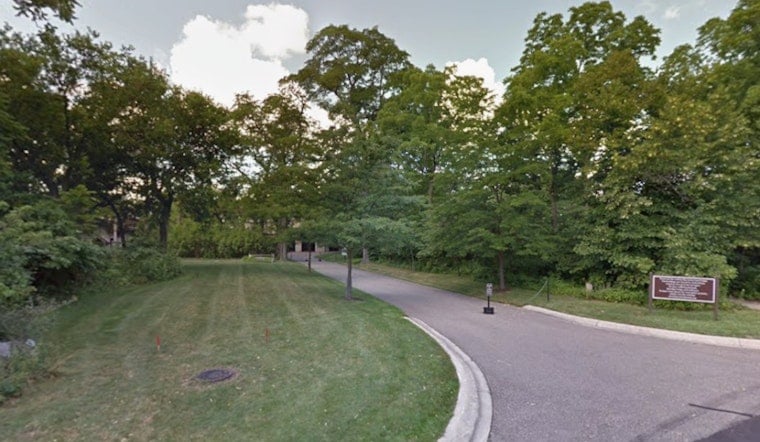
Chicago landscape architect Jens Jensen designed Fair Lane's grounds between 1914 and 1920, creating a Prairie Style landscape with native Midwestern plant trails, curved forest approach roads and naturalistic views along the Rouge River, according to the National Park Service. Jensen treated Fair Lane as something of a mid-career laboratory for the ecological design ideas that would define his career. Clara Ford took a very different approach with her own corner of the estate, personally commissioning a formal 2.5-acre Rose Garden that grew to roughly 12,000 rose bushes across 350 varieties, complete with a pergola, tea pavilion and gazebo, according to Best Attractions. She personally cultivated the gardens surrounding the estate throughout her time there.
The home's design has its own tangled history. Marion Mahony Griffin, one of the first licensed female architects in the United States, drew initial Prairie Style designs for the residence in 1912, but a dispute over contractors led the Fords to dismiss her firm mid-project. Pittsburgh architect William H. Van Tine ultimately completed the home in a blend of Scottish Baronial and Prairie styles by 1915, per the Michigan Economic Development Corporation.
From University Landmark to Nonprofit Restoration
Fair Lane originally encompassed 1,300 acres before Ford Motor Co. donated 210 acres of the estate along with a $6.5 million grant to the University of Michigan in December 1956, establishing the UM-Dearborn campus in 1957, according to the Cultural Landscape Foundation. The university maintained the estate house as a conference center and historical site for more than five decades before handing it off to the dedicated nonprofit in 2013. The property today sits near both UM-Dearborn and Henry Ford College, and is separate from Greenfield Village, Ford World Headquarters and the Rouge plants.
The State of Michigan recognized the restoration's craftsmanship with the 2021 Governor's Award for Historic Preservation, citing the meticulous recreation of the property's late-1910s interior and exterior appearance along with the project's role in training historic preservation artisans. Restorers relied on original archival photographs and receipts to rebuild finishes, stonework and missing period furniture, per the Michigan Economic Development Corporation.
What Opens First
For now, the indoor structures remain closed while restoration continues, but Fair Lane's gardens and grounds are already open to the public daily, free of charge, from 8 a.m. to 8 p.m., allowing visitors to walk Jensen's restored trails and take in the river views ahead of the full reopening. Once the 2027 reopening arrives, Fair Lane plans to offer tours of the house and other estate areas, while also renting out the music and pool rooms inside the house as well as the garage and upstairs powerhouse spaces for private events, according to the Free Press.





