

























































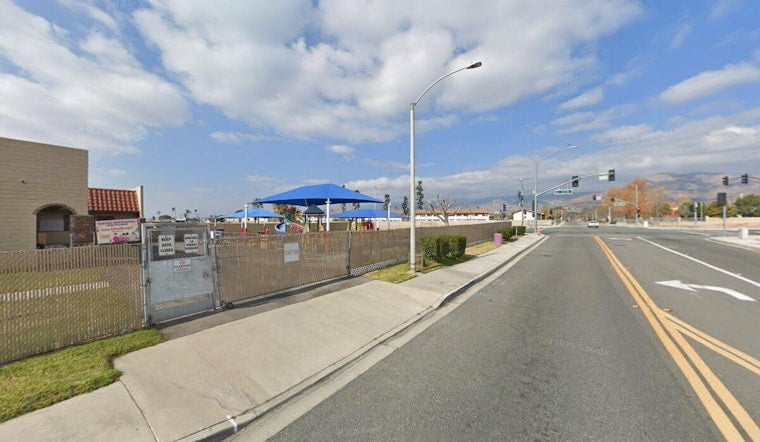
A Highland warehouse project with loading docks facing a Head Start preschool entrance just 25 feet away won a three-year permit extension from city commissioners in July, over objections from more than 50 residents and school district officials who say the developments threaten children's health and safety. A second warehouse proposed across the street from Indian Springs High School received the same extension. Both now head to an October 13 Highland City Council appeal hearing that will test whether local leaders will impose stricter protections than state law currently requires.
The Highland Planning Commission voted unanimously on July 21 to grant the three-year extensions for Conditional Use Permits 23-003 and 22-011, both sought by developer Patriot Partners, despite testimony from more than 20 public speakers opposing the move, according to IE Community News. As reported by the San Bernardino Sun, the first warehouse is proposed for 2.86 acres on Fifth Street near Central Avenue and would total 53,665 square feet with five loading docks, while the second is planned for 2.83 acres on Sixth Street just west of Del Rosa Drive, spanning 47,889 square feet with six loading docks. The two sites sit roughly two miles apart.
Loading Docks Steps From a Preschool Door
The Fifth Street warehouse borders Highland Head Start Preschool to the west, and its loading docks face the preschool directly — with the facility's entrance sitting about 25 feet from the warehouse, per the Sun's reporting. Warehouse trucks would use a Fifth Street driveway located near multi-family housing and very close to the Head Start site. The second warehouse, meanwhile, is next door to multi-family housing and would send trucks down Sixth Street to reach the facility, with truck traffic described as posing safety hazards to students, families, pedestrians and bicyclists.
Indian Springs High School, located in San Bernardino, is surrounded on three sides by Highland's official city boundary, putting it in close proximity to the Sixth Street project despite sitting in a different city. Thomas Pace, facilities planning and development director for the San Bernardino City Unified School District, sent a letter to the Highland City Council on July 21 opposing the permit extensions, writing that the district's documented public health and transportation concerns warrant careful consideration before extending the entitlements.
A State Law That Doesn't Quite Reach These Projects
California's so-called Good Neighbor law, authored by state Sen. Eloise Gómez Reyes and formally known as Assembly Bill 98, took effect in 2026 and requires distance buffers of at least several hundred feet between certain warehouses and schools. But the law's design mandates apply only to facilities of 250,000 square feet or larger, according to CalMatters. Both Highland projects fall well under that threshold, meaning the buffer requirements did not apply when the warehouses were originally approved and do not bind the current extensions either.
After AB 98 was signed into law in September 2024, Reyes publicly stressed that the state's setback requirements were meant as a floor, not a ceiling, and she explicitly encouraged local cities to adopt stricter municipal buffer ordinances, per the Precinct Reporter Group News. The city of Highland originally granted initial entitlement approvals for the Sixth Street warehouse under Conditional Use Permit 22-011 back on May 16, 2023. Because those approvals predate the current extension request, city staff determined under California Environmental Quality Act guidelines that no updated environmental review was required this time, according to filings on CEQAnet.
Residents Say the Neighborhood Can't Simply Move
The People's Collective for Environmental Justice has filed appeals against both planning commission decisions, arguing the two warehouses sit too close to schools and should not receive extensions on permits originally issued three years ago. At the July 21 hearing, 49-year Highland resident Janet Seaton testified that the affected neighborhood is predominantly Black, Latino and elderly, and that low-income residents cannot easily relocate away from incoming industrial hazards, IE Community News reported.
That testimony echoes a broader pattern documented across the region. A regional analysis from the Center for Community Action and Environmental Justice found that more than 300 warehouses across the Inland Empire sit within 1,000 feet of 139 local schools, while over 600 warehouses are located within 1,500 feet of school sites. California Air Resources Board data shows the adjacent San Bernardino and Muscoy area alone contains 68 schools and 38 licensed daycare facilities inside a designated high cumulative air pollution exposure zone.
Health Researchers Point to Diesel Truck Traffic
A July 2024 study led by researchers at George Washington University found that communities situated near logistics warehouses face a 20% increase in traffic-related nitrogen dioxide pollution compared to non-adjacent areas. That finding lands against an already grim regional backdrop: the American Lung Association's 2024 State of the Air report ranked the San Bernardino and Riverside metro region as having the worst ozone pollution in the country, a burden driven heavily by regional freight movement and diesel truck traffic, according to data compiled in an ArcGIS StoryMaps analysis.
The concern isn't new to San Bernardino County, which Hoodline previously reported contains more than 850 warehouses exceeding 100,000 square feet, a density tied to the county ranking highest in the nation for local pollution dissatisfaction two years running. With the Highland City Council set to hear the consolidated appeals on October 13, the case has become a real-world test of whether local officials will use their own authority to impose buffers stricter than what state law currently demands.





