

























































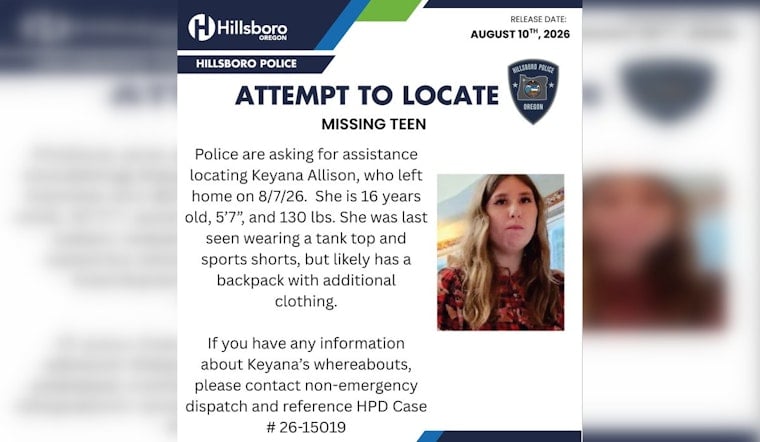
Hillsboro Police are asking the public for help finding 16-year-old Keyana Allison, who has been missing since last Friday after leaving behind a note describing feelings of depression and thoughts of death. Police describe her as a missing and endangered juvenile experiencing a mental health crisis, and say she turned off her phone at 5:30 p.m. on August 7 after leaving her home in Hillsboro, Oregon.
According to the Hillsboro Police Dept, Allison left a note stating that she was mentally drained and had thoughts of death, and that she is struggling with depression. She is described as a white female, 5 feet 7 inches tall, weighing about 130 pounds, with light brown hair and brown eyes. She was last seen wearing a tank top and sport shorts, and may have had a backpack with her, per the same bulletin.
Community organizations have amplified the search since the case became public. Posts shared by family and community groups, including the Hillsboro Girls Softball Association where Allison previously played, indicate that before turning off her phone she left a birthday card for her father expressing depression and thoughts of self-harm, according to posts on Facebook.
How to Report Information
Anyone with information about Allison's whereabouts is asked to call Hillsboro's non-emergency police dispatch line at 503-629-0111, or 911 if there is an immediate emergency. That non-emergency line is operated by the Washington County Consolidated Communications Agency, which runs a central 911 and non-emergency call center based in Hillsboro, according to the Washington County Consolidated Communications Agency. The case has been assigned HPD Case #53-2026-15019, with Officer Katrina Agarycheva and analyst Pat Brady listed as agency contacts on the department's bulletin.
The Hillsboro Police Department, which handles emergency and non-emergency calls for a city of more than 100,000 residents, maintains dedicated Youth Services and Law Enforcement Analyst teams within its Investigations Division to support juvenile and complex cases, according to the City of Hillsboro. Oregon law adds legal weight to how quickly departments must act: under Oregon Revised Statutes § 146.177, agencies are required to have written policies ensuring missing minors are investigated as soon as possible using all available resources, per the Oregon State Legislature.
State Systems Track Missing Youth Statewide
The Oregon State Police also maintains a statewide Missing Children/Adults Clearinghouse under ORS 181A.300, which enters missing persons into the Law Enforcement Data System and the National Crime Information Center while coordinating Endangered Missing Person Alerts for those believed to be in imminent danger, according to Oregon.gov. It remains unclear whether such an alert has been issued for Allison. There is also no required waiting period before filing a missing person report in Oregon, and law enforcement agencies advise reporting immediately whenever someone is believed to be endangered, according to Oregon's Vanished.
Context on Missing and At-Risk Teens
National data offers some reassurance alongside the urgency. The National Center for Missing & Exploited Children assisted in 32,167 missing children cases in 2025, with more than 90 percent of missing youth recovered safely, the organization reported. Among missing youth classified as endangered runaways, data compiled by The Missing Child Project shows 74 percent are between 15 and 17 years old, and 87 percent exhibit one or more compounding risk factors such as mental health distress, a pattern consistent with the circumstances described in Allison's case.
Crisis Resources for Youth and Families
Oregon youth experiencing emotional distress can reach YouthLine, a free peer-to-peer support line operated by Lines for Life, by calling 877-968-8491 anytime or texting teen2teen to 839863 to speak with trained teen volunteers between 4 p.m. and 10 p.m. daily. Anyone in Oregon experiencing a mental health crisis or suicidal thoughts can also call or text the 988 Suicide & Crisis Lifeline for free, confidential support around the clock, according to the Oregon Health Authority.





