

























































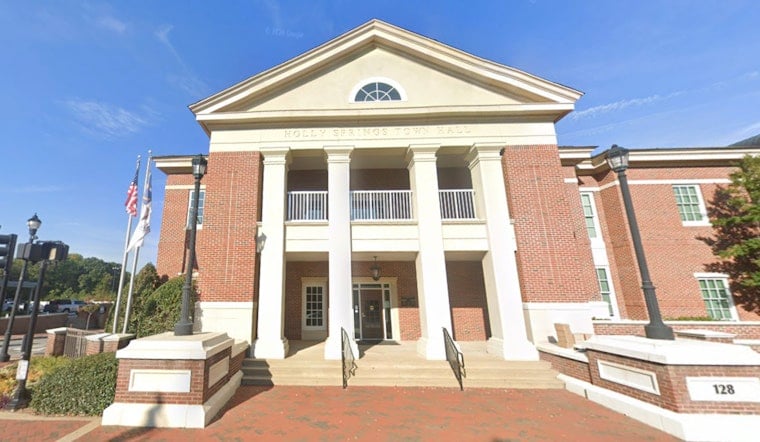
Holly Springs leaders and residents sparred this week over how fast the town should keep building as its population balloons, with a Town Council meeting on Tuesday exposing deep frustration over roads and sewer lines that critics say are already stretched thin. At the center of the fight is a 32-acre plot off Avent Ferry Road, where town leaders deferred a rezoning vote that would have allowed dozens of new homes and a commercial business, citing pedestrian safety concerns along the corridor.
Resident Adam Sullivan, who lives near the roughly 30-acre plot of land in question, told reporters that the community is feeling the effects of overdevelopment without needed infrastructure, according to WRAL. Sullivan said he fears a nearby project, the recently rezoned Meridian at Sunset Commons apartment complex, could worsen existing traffic troubles on nearby roads. Development opponents like Sullivan believe more homes could lead to more issues without adequate infrastructure to support them, the station reports.
The tension isn't limited to one plot of land. Holly Springs Mayor Mike Kondratick said the council must help the town catch up on infrastructure while development continues, acknowledging that growth has outpaced the pipes and pavement meant to serve it. Fuquay and Apex are experiencing similar infrastructure-related development pressures, per the same account, as southern Wake County absorbs a wave of housing demand driven by recent business and economic booms.
A Rezoning Deadlock on Avent Ferry Road
The 32.3-acre proposal at 2420 Avent Ferry Road never got a clean recommendation from the town's Planning Board in the first place. Board members deadlocked in a 3-3 vote on July 28, sending the application to the Town Council without guidance after members raised traffic and safety concerns tied to its proposed commercial component, according to Holly Springs Update. The application seeks to convert rural residential land into 53 single-family homes and as much as 16,000 square feet of commercial space.
That deadlock helps explain why the Town Council opted to defer its own vote rather than push the matter through immediately. It also mirrors a pattern seen elsewhere along the same corridor, where the council approved the 107-home, age-restricted Courtyards at Holly Grove subdivision across from Holly Grove Middle School in November 2025, but only after requiring the developer to widen road frontage and realign Capeside Avenue to match state long-range transportation plans.
Meridian At Sunset Commons Shows the Council's Playbook
The Meridian at Sunset Commons project illustrates how Holly Springs leaders have tried to thread the needle between growth and capacity. The council voted 3-1 in July to rezone 30.6 acres at 4950 Optimist Farm Road for up to 450 apartments at as many as 15 dwelling units per acre, after a motion to deny the project failed for lack of a second. But the development agreement includes conditions that legally prohibit issuing building permits until two existing pump stations are upgraded and a new Eastern Regional Pump Station is constructed, Holly Springs Update reported.
That strategy of approving rezonings on paper while withholding permits until utilities catch up reflects a broader financial push. In March, the North Carolina Local Government Commission approved $135 million in revenue bonds for Holly Springs to expand and rehabilitate the Utley Creek Water Reclamation Facility, according to the NC Department of State Treasurer. The project will boost wastewater treatment capacity from 6 million to 8 million gallons per day, though the bond proceeds are expected to push utility bills up between 9% and 15% through fiscal year 2031.
Growth Numbers Tell the Story
The scale of Holly Springs' transformation is stark. The town's population grew nearly 30% from 24,661 residents in 2010 to 48,674 in 2024, even as single-family building permit approvals dropped to under 300 in 2025, compared with a 10-year annual average of 600, per the Treasurer's office data. Town Manager Randy Harrington noted in the FY 2026-27 budget message that property taxes generate 43.1% of General Fund revenues, underscoring how closely town finances are tied to continued residential growth.
That growth has been fueled in part by major commercial investment. Genentech announced in January that it is doubling its investment in its Holly Springs manufacturing facility to $2 billion, expanding a planned 700,000-square-foot weight-loss drug manufacturing site expected to support more than 500 permanent jobs, according to Endpoints News. The facility broke ground in August 2025 and is scheduled to open in 2029, alongside regional investments from FUJIFILM Diosynth Biotechnologies, Amgen, and CSL Seqirus.
Roads, Data Centers, and a Downtown Rethink
Town officials have also moved to slow down other high-demand land uses. In June, the Holly Springs Town Council enacted a temporary moratorium of up to 12 months on approving new data centers and cryptocurrency mining facilities while staff study the strain those uses place on water, power, and traffic systems, the Town of Holly Springs announced. State law prevents municipalities from banning data centers outright, so the town is instead using the pause to evaluate its zoning rules through spring 2027.
Road capacity along Avent Ferry Road itself is getting attention from two directions at once. The town and the North Carolina Department of Transportation hosted a public design meeting in June to unveil a $20.2 million project widening the road to four median-divided lanes with sidewalks and signalized school crosswalks between Ralph Stephens Road and Holly Meadow Drive, with right-of-way acquisition set to begin in 2027 and construction targeted for 2029. Meanwhile, the town launched design workshops this month for a very different vision downtown: a pedestrian-friendly “Festival Street” that would convert a two-lane segment of Avent Ferry Road between West Ballentine and Center streets into an open-air plaza capable of closing to vehicle traffic for markets.
A Town Built on a Sewer Line
The current growing pains trace back nearly four decades. Holly Springs was a rural community of just 908 residents in 1990, and it wasn't until the town built its first municipal sewer system in 1987 that rapid residential expansion took off, according to the Exchange Project. Between 1990 and 2000 alone, the population grew nearly tenfold, from 908 to 9,192, setting the stage for the sprawling suburb of nearly 50,000 that exists today.
Holly Springs Town Council member Sarah Larson said discussions about improving communication and community engagement with residents will continue at a workshop planned for this fall. For now, the debate that played out Tuesday over the Avent Ferry Road rezoning shows no sign of resolving quickly, as neighbors like Sullivan wait to see whether infrastructure investments can truly catch up with a town that keeps adding rooftops faster than pipes and pavement can follow.





