

























































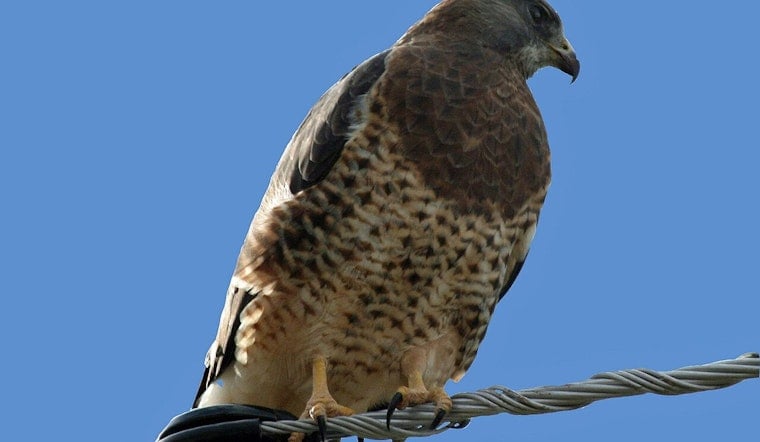
A petition filed by California's homebuilding lobby aims to strip the Swainson's hawk of its threatened-species status, a move that would eliminate mandatory habitat mitigation fees developers currently pay across the bird's Central Valley range. The California Building Industry Association's request, submitted on June 10, marks the first attempt in 17 years to remove a species from protection under the California Endangered Species Act, according to the California Fish and Game Commission.
The California Fish and Game Commission formally logged receipt of the petition on July 14 and referred it to the California Department of Fish and Wildlife, which must now determine whether the science behind the request is strong enough to justify a full status review, according to SFGate. As reported by Action News Now, the commission is expected to review the petition by September 8, with the Department of Fish and Wildlife slated to present its initial evaluation and recommendation at the commission's October 13-16 meeting.
A Bird's Dramatic Comeback, On Paper
The homebuilders' case leans heavily on a study published in Ornithological Applications that estimated California's Swainson's hawk population grew 13.9% annually between 2005 and 2018, reaching 18,810 breeding pairs statewide by the end of that period, per the same study cited in BioOne Complete. That figure towers over the Department of Fish and Wildlife's own 2016 status review, which counted just 1,800 breeding pairs and led state wildlife officials at the time to recommend against delisting, SFGate reports.
The discrepancy between those two numbers is significant enough that researchers themselves admitted in their report they could not fully explain the sudden jump, according to SFGate. It is a gap regulators will have to reconcile as they weigh whether the petition offers enough scientific grounding to move forward.
The hawk's history makes the debate especially fraught. An estimated 17,000 breeding pairs roamed California before the 1950s, but the population collapsed to just 375 pairs by 1979 as agricultural conversion and urban sprawl wiped out nesting trees and foraging fields, according to The Natomas Basin Conservancy. That crash prompted the state Fish and Game Commission to classify the species as threatened in 1983, a designation the hawk has held for more than four decades, per Action News Now.
What Delisting Would Actually Change
Swainson's hawks nest in the Central Valley between March and September before setting off on a 12,000- to 14,000-mile migration to winter in Argentina and Brazil, according to the City of Elk Grove. Core breeding populations in Yolo, Solano, Sacramento, and San Joaquin counties depend on open, low-crop fields where the birds hunt rodents such as mice and voles, helping with pest control in agricultural areas, Action News Now notes.
If the species loses its threatened status, developers would no longer be required under the California Environmental Quality Act to analyze and mitigate habitat destruction, ending the mandatory conservation easement purchases homebuilders currently use to offset lost foraging land, according to Bay City News reporting relayed via a Facebook post from Fairfield CA Responsible Growth. The building industry association has argued that hawk protections are slowing development and that private and public landowners need regulatory relief for housing projects within the species' range, per an association statement cited by Action News Now. The association has also said delisting would not adversely affect hawk populations in the north state.
Environmental advocates counter that Solano County agricultural land slated for California Forever, the venture-backed proposed city development, provides vital nesting and foraging habitat for the hawks, and that Solano County holds a significant share of the state's core breeding population, according to the Bay City News account. Existing protections have also produced friction on a much smaller scale: they recently delayed planning approval for a micro-winery in Napa County after the Department of Fish and Wildlife overturned a local finding of no environmental impact and required a formal biological survey for nesting hawks, the same report states.
Population Growth Hasn't Reached Everywhere
Even researchers behind the population-growth study caution that the recovery is uneven. Despite statewide gains through 2018, Swainson's hawks remain virtually extirpated from historical habitats in Southern California, and the study's authors warned that expanding vineyards and tree-nut orchards threaten the foraging grounds the birds still have left, according to BioOne Complete. Permanent orchards and vineyards prevent the raptors from hunting rodents the way open alfalfa fields do, the research found, and hawk density has been strongly linked to alfalfa cultivation and crop diversity in the Central Valley.
The Department of Fish and Wildlife has said all native species bring balance to the ecosystem, per a spokesperson quoted by Action News Now. If the petition moves forward, the department will evaluate whether it contains sufficient scientific information to indicate that action may be warranted, and a formal status review would then stretch 12 to 18 months before peer reviewers weigh in on the findings.
The fight over the hawk's status echoes a fresher local flashpoint: opponents of a proposed 9,356-unit Sacramento County development raised the same foraging-habitat concerns earlier this year when the county pulled its Upper Westside vote. For Oroville-based miniature watercolor artist Diana Wyles, the debate is personal rather than procedural. Wyles, who draws inspiration from California wildlife, said she once stopped her car after spotting a Swainson's hawk in Butte County near Feather Falls Casino on Lower Wyandotte, and has also seen the birds at the Sacramento National Wildlife Refuge in Willows.
Wyles said her art aims to draw attention to wildlife and help save it, and she argued that habitat should remain near the hawks so the birds are not displaced. Whether state regulators agree that the species has recovered enough to lose that habitat protection will not be clear until the Department of Fish and Wildlife delivers its recommendation this October.





_RWD.jpg)