

























































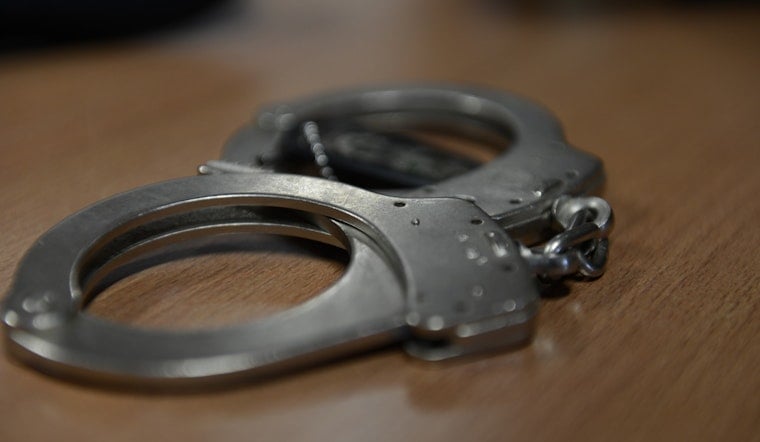
A man was arrested Wednesday after an X-ray screening at a Senate office building flagged a sharp object in his bag, which officers later determined was a homemade sword. A follow-up search also turned up brass knuckles among his belongings, and the man is now facing charges including assault on a police officer, possession of a prohibited weapon, and resisting arrest.
According to FOX 5 DC, officers were alerted when the administrative X-ray monitor flagged the sharp object in the man's bag during screening, prompting a secondary hand search that confirmed the homemade sword and uncovered the brass knuckles. A U.S. Capitol Police arrest log put the interception at approximately 1:33 p.m. on August 12, 2026. Administrative X-ray screenings are mandatory for all visitors entering Congressional office buildings.
Officer Struck During Attempted Mental Health Transfer
Per police, the man resisted officers when they moved to detain him, pulling his arm away as they attempted to take him into custody. He became combative while officers were preparing to transfer him to a local psychiatric emergency center for a mental health evaluation, and he struck an officer during that process, according to the incident log. He was ultimately taken to a hospital for a mental health evaluation rather than the district's dedicated crisis center.
The D.C. Department of Behavioral Health operates the Comprehensive Psychiatric Emergency Program, known as CPEP, at 1905 E Street SE as a 24-hour evaluation and triage center for adults facing psychiatric crises. D.C. law allows police to transport individuals in acute mental distress directly to that facility, which appears to have been the officers' original plan before the confrontation escalated.
Crime scene personnel responded to process the scene after the man was taken into custody, and officers searched his belongings once he was detained. Investigators tried to interview him afterward, but the man declined to speak with them.
Federal and District Law Both in Play
Carrying or having readily accessible dangerous weapons, bladed items, or firearms on Capitol grounds or inside Congressional office buildings is a federal crime under 40 U.S.C. § 5104(e), punishable by fines and imprisonment, according to Medvin Law. Separately, D.C. Code § 22-4514 classifies brass knuckles as a prohibited weapon outright, making simple possession an independent criminal offense in the District, per Scrofano Law, PC. Unlike utility tools that might have a legitimate use, brass knuckles are per se illegal under District municipal law.
The Capitol Police Board strengthened its prohibited items policy in July 2025, giving officers explicit discretion to confiscate dangerous items at Congressional building checkpoints, according to U.S. Capitol Police. That same month, officers intercepted a driver near Congressional staff parking areas after spotting a bow and arrow, knives, and an empty holster inside the vehicle, showing that bladed and non-firearm weapons regularly draw the same scrutiny as guns.
Part of a Wider Pattern at Senate Buildings
This is not the first Senate office building security scare Hoodline has covered this summer. In July, a Heritage Foundation aide was arrested at Russell after X-ray screening detected a loaded firearm magazine and illicit substances in his briefcase. Weeks earlier, Capitol Police also arrested a driver near a Capitol barricade after finding a firearm during a lockdown of the north side of the campus.
The arrests come amid a documented surge in security concerns across the Capitol Complex. U.S. Capitol Police investigated 14,938 threat assessment cases in 2025 involving concerning statements and behaviors directed at Members of Congress and the Capitol Complex, a nearly 58 percent increase from 2024, according to FOX 5 DC's earlier reporting on the trend. The force comprises roughly 2,700 officers and staff who screen approximately 1.4 million visitors annually across House and Senate buildings, underscoring how routine checkpoint screening remains the primary filter for catching prohibited items before they reach Congressional offices.



