

























































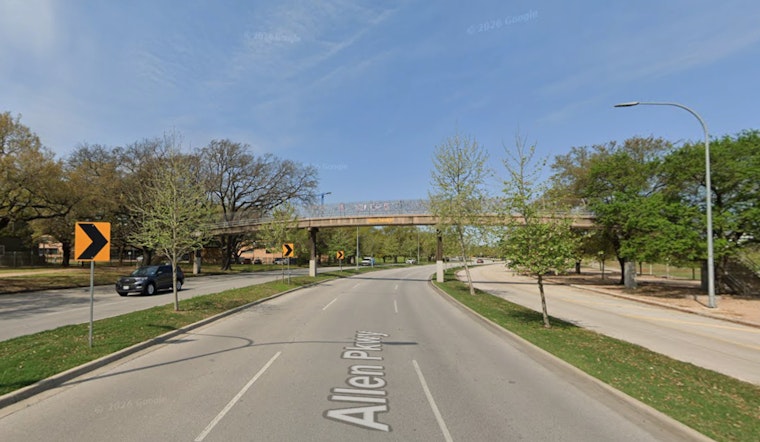
Hundreds of padlocks once clipped to the chain-link fencing of Houston's Allen Parkway pedestrian bridge were headed for the landfill after city crews cut them loose with blowtorches. Photographer and filmmaker Chris Piñon grabbed as many as he could, charred metal and all, and now he's trying to find the people who left them there in the first place.
Piñon is a photographer and filmmaker who has made it his mission to reconnect hundreds of people with pieces of their love stories, as reported by Click2Houston. The bridge spanning Allen Parkway has become known to some Houstonians as the love lock bridge, a spot where couples have long attached padlocks as symbols of their relationships. When the city began removing the locks to protect the fencing, Piñon collected them directly off the structure while crews were cutting, according to footage posted to YouTube by Houston City Beat, leaving many of the recovered locks scorched from the torch work.
Documenting Love Stories Instead of Creating Them
Piñon has said his role is to document love stories rather than create them, per the Click2Houston report, and he carefully recorded the locks and the messages attached to them before they could be lost for good. That documentation became the backbone of a short film he made about the story behind Houston's love lock bridge, titled “An Analog Moment - An Introduction to the Heavy Burden of Love on Houston's Love Lock Bridges.” The film was submitted to the Houston Latino Film Festival, according to a post on Facebook.
Piñon also turned the salvaged locks into a full art installation, showing photos of romance alongside an eight-foot replica of the Allen Parkway chain-link love-lock fence in a piece called “The Heavy Burden of Love: An Exploration of What Love Leaves Behind.” The installation ran at Sabine Street Studios, part of Houston's Sawyer Yards arts campus, from March 27 to May 10, 2025, according to Sawyer Yards.
A Bridge With a View, and a Weight Problem
The pedestrian bridge over Allen Parkway links inner-loop neighborhoods to Eleanor Tinsley Park and Buffalo Bayou Park while offering unobstructed views of downtown Houston's skyline, per KPRC. It isn't the only local structure carrying the tradition — couples also place padlocks on the nearby Rosemont Pedestrian Bridge, a 780-foot concrete-and-steel span over Memorial Drive and Buffalo Bayou that opened in March 2011 through a partnership involving Houston Parks and Recreation, TIRZ #5, and the Buffalo Bayou Partnership, according to the City of Houston. Not far from the Allen Parkway bridge stands “Tolerance,” a 2011 public art installation of seven kneeling, see-through mesh letter sculptures by Spanish artist Jaume Plensa along Buffalo Bayou Park, as noted by Swamplot.
Cities have wrestled with the same dilemma for years. Municipal public works departments generally treat padlocks as structural liabilities, since concentrated weight can sag bridge cables and moisture retention accelerates corrosion on wire fencing, according to 99% Invisible. Paris became the starkest example of that tension: municipal workers removed roughly 700,000 padlocks weighing 45 metric tons from the Pont des Arts in June 2015, after a wire fence panel had already collapsed under their weight the year before, per The Guardian.
A Tradition With Deep Roots
The custom of clipping padlocks to bridges traces back over a century to World War I, in Vrnjačka Banja, Serbia, where a schoolteacher named Nada was heartbroken after her soldier fiancé, Relja, left her for another woman. The Bridge of Love, or “Most Ljubavi,” became the site of the original ritual, a story later memorialized in Serbian poet Desanka Maksimović's poem “Prayer for Love.” The custom went largely dormant for decades before Italian author Federico Moccia's 2006 novel “Ho Voglia di Te” reignited it worldwide, depicting young lovers attaching a padlock to Rome's Milvian Bridge, according to the Houston Chronicle. The novel's 2007 film adaptation is credited with inspiring teenagers across Europe and North America to copy the gesture, eventually spreading the practice to bridges like the one over Allen Parkway.
How to Help Piñon Track Down Lock Owners
Piñon has already saved hundreds of locks from ending up in the landfill, but matching charred metal to the couples who left it behind is a slower task. Anyone interested in helping find lock owners, or who recognizes a lock that may be their own, can reach Piñon on Instagram at @chris.pinon or search for Chris Piñon Media Studios on the platform. People can also email him directly at [email protected] to share details about their own love lock story.





