

























































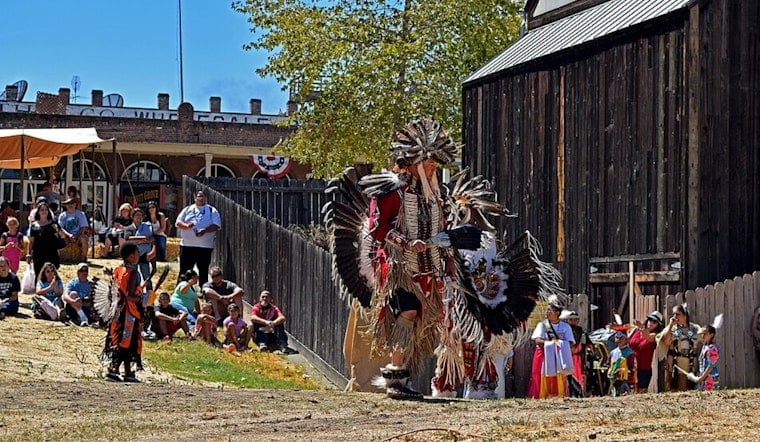
Hundreds of Native American dancers from across the country will gather at the Barona Indian Reservation in Lakeside for the 54th Annual Barona Powwow, competing in traditional and contemporary categories for more than $75,000 in cash prizes. The three-day celebration of dance, drumming, art, and food takes place at the Barona Sports Complex, located at 1095 Barona Road, about one mile north of Barona Resort & Casino on Wildcat Canyon Road, with free admission and free parking throughout.
According to The San Diego Union-Tribune, the schedule includes grand entries at 2 PM and 8 PM on August 5 and 6, hand drum contests, singing, and gourd dancing at 12:30 PM and 6 PM on September 5 and 6. A separate grand entry is set for 8 PM on September 4, alongside gourd dancing at 6 PM that same evening, and a 49-drum contest will follow the Saturday evening session on September 5. Dancers will perform styles including the Fancy Shawl dance and Grass Dance, and early risers can join a 5K fun run starting at 7 AM on September 5. Vendors on site will sell arts, crafts, and handmade jewelry, along with Native American food, including Indian fry bread tacos, per the Union-Tribune's report.
A Tribe Rebuilt From Displacement
The powwow's host, the Barona Band of Mission Indians, traces its modern homeland to a forced relocation nearly a century ago. The Barona Indian Reservation was established in 1932 after Kumeyaay families were pushed off the Capitan Grande Reservation when the City of San Diego acquired that land to build the El Capitan Reservoir, according to SDSU News. Tribal members pooled their compensation from that displacement to buy the former Barona Ranch, and the split of the original Capitan Grande Band gave rise to both the Barona and Viejas bands.
Today the Barona Band operates as a federally recognized sovereign nation governed by an elected seven-person tribal council serving four-year terms, representing an enrolled membership of roughly 500 tribal members, per 500 Nations. The 5,900-acre reservation in East San Diego County runs its own municipal infrastructure separate from surrounding county utilities, including a fire station, charter school, gas station, church, community center and wastewater treatment facility, according to Destination Native America. Tribal elders worked with noted San Diego architect Irving J. Gill after the 1932 relocation to build the reservation's church, dedicated in August 1934 and still active today as Saint Kateri Tekakwitha Parish, per BKT Parish.
Gaming Revenue Fueled Modern Growth
The tribe's economic self-sufficiency has roots in a 1982 court ruling, Barona Group v. Duffy, which addressed high-stakes bingo and helped clear a legal path toward opening the Barona Resort & Casino in 1994. That gaming foundation has funded the reservation's civic services and cultural institutions, including the Barona Cultural Center & Museum, which houses more than 3,000 artifacts dating back thousands of years. In May 2019, the museum won the Institute of Museum and Library Services National Medal for Museum and Library Service, becoming the first Native American museum in California to receive the nation's highest honor for museums, according to a PR Newswire release at the time.
The tribe has also invested in preserving the 'Iipay Aa language, the traditional Yuman tongue spoken by Kumeyaay bands in northern San Diego County. Building on linguistic research begun in the 1980s by linguist Margaret Langdon, the Barona Band developed the 'Iipay Aa Tiipay Aa Uumal dictionary, translated as “More Than Words,” to document Kumeyaay dialects for future generations, as reported by ICT.
Youth Dancers and Public Safety on Sovereign Land
Some of the dancers competing at Barona likely trained through regional youth programs like the Soaring Eagles Dance Group, established in San Diego in 2008 to give Native American youth in grades K-12 free weekly instruction in powwow dancing, regalia culture and traditional etiquette. The group was formed to bring together urban Native youth living throughout San Diego County for gatherings such as Barona's.
Public safety on the reservation and in surrounding East County communities is coordinated through the San Diego County Sheriff's Department's Lakeside Substation, which opened in May 2015 and assigns a dedicated Special Purpose Deputy to the Barona Reservation. The substation covers 85 square miles, including unincorporated Lakeside and El Cajon. For powwow attendees, the combination of free admission, free parking, and a full slate of competitive dance and drum categories makes the event one of the region's most accessible windows into Kumeyaay culture and the tribe's decades-long path toward self-governance.





