

























































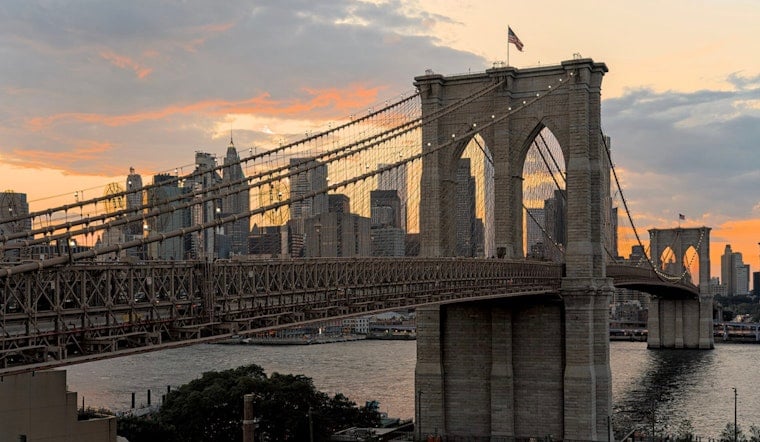
Roughly 42 vendors were counted spread across the Brooklyn Bridge on a recent day, hawking $5 hats, $1 NYC magnets and fruit cups to tourists streaming across the span — and most of them, according to licensed sellers working the same stretch, aren't supposed to be there at all. Among the crowd are disabled military veterans holding legitimate city permits who say they're now being squeezed out of a walkway they have a legal right to work.
The scene, detailed in a New York Post report by Steven Vago and Zoe Hussain, describes several unlicensed vendors fleeing as two NYPD officers patrolled, only for the sellers to return once officers moved on. One 48-year-old licensed ice cream vendor and disabled veteran who goes by Sammy, who works near City Hall, said illegal vendors arrive at the crack of dawn to claim the best spots before licensed sellers can even set up.
Sammy told the Post that police are not allowed to bother the illegal vendors, and that when they are ticketed, the fines run only $20 to $50 — a cost of doing business for sellers who Sammy estimated pull in about $1,000 a day illegally. He said illegal vendors returned to the bridge around October 2025, and that the chaos has since escalated. “The illegal vendors cause chaos and cost the city money,” Sammy said, according to the Post, blaming Mayor Zohran Mamdani, who has been in office for eight months, for not doing enough to stop it.
A Legal Right Undermined by Ticketing Gaps
The tension traces back to New York State General Business Law Section 35, which has granted physically disabled U.S. military veterans special statutory rights to hawk goods on public streets since 1894, when the exemption was created for disabled Civil War veterans, according to the New York State Legislature. That right has long collided with municipal rules, and it collides now with a 2024 ban that New York City's Department of Transportation imposed prohibiting all street vending on pedestrian walkways and bike lanes across city-owned bridges, a measure then-Mayor Eric Adams put in place in January 2024 to relieve severe overcrowding on the 1.14-mile promenade, per the NYC Department of Transportation.
One licensed vendor, a 41-year-old disabled veteran and Marine discharged from the Corps in 2008, told the Post he was informed by the city that he could no longer vend on the bridge because of a national security issue, even though he holds a disabled-veteran license. He said illegal vendors are not being removed while he and other licensed sellers are being pushed off, and that the NYPD harasses him and confiscates his merchandise while leaving unlicensed sellers' goods untouched. He called vending his livelihood and asked simply for equal enforcement.
That vendor estimated there are now about 120 vendors on the bridge, up from roughly 60 to 80 before a prior round of removals, and said the number of unlicensed sellers alone sometimes tops 100. Licensed merchants outside City Hall, including disabled veterans, have reported that unlicensed vendors are pushing them out and preventing them from making a living, the same report notes.
Turf Fights Turn Violent
The overcrowding has spilled into physical confrontations. Sammy suffered scratches on his arms on August 16 after breaking up a fight between mango sellers, and he told the Post he was separately attacked by a woman and five other men during another altercation. Sammy said the district attorney releases arrested illegal vendors, a claim that reflects his own frustration with how enforcement plays out after arrests are made.
Even young sellers have joined the informal economy on the bridge: an 11-year-old girl sold a $1 bottle of water while her mother sold mangos nearby, according to the Post's reporting. Illegal vendors have also been blamed for contributing to the closure of some souvenir shops, the outlet reported.
A Recurring Problem Despite the Ban
This isn't the first time the bridge's illegal vending problem has resurfaced since the 2024 ban took effect. Reporters confirmed in August 2025 that dozens of unlicensed vendors had already returned, setting up more than 30 stalls selling merchandise and food despite the active prohibition, according to the Brooklyn Eagle. Municipal officials confirmed at the time that the ban remained in force but noted that day-to-day enforcement on the elevated walkway falls to the NYPD.
The bridge's popularity makes it an obvious draw for sellers working outside the law. The span carries an average of 28,845 pedestrians and 5,504 cyclists daily, according to 2024 traffic data from the city's Department of Transportation, a volume of foot traffic that spikes further on weekends and during tourist season.
A Permit System Squeezed for Decades
Part of what pushes vendors into unlicensed territory is a permit system that has barely budged in nearly half a century. Non-veteran general merchandise vendor licenses in the city have been capped at 853 permits since 1979, with the waiting list closed since 2006, according to the Street Vendor Project, leaving veteran status as one of the few remaining legal paths to a permit.
City agencies have taken some steps to expand legal access for veterans specifically. The Department of Consumer and Worker Protection adopted updated rules in October 2025 clarifying that disabled veterans holding valid mobile food vendor licenses from the Department of Health are eligible to apply for Specialized Vending Licenses to work in restricted zones. Separately, the city's health department reopened its mobile food vending supervisory license waiting list in March 2026, reserving 300 new spots specifically for veterans and people with disabilities, according to the Norwood News.
Enforcement data, meanwhile, shows a mixed picture. The NYPD issued 564 criminal summonses for vending-related offenses in the first quarter of 2026, up from 504 during the same period a year earlier, with 189 of those tickets issued specifically for vending without a license, according to Documented. Civil enforcement has also climbed sharply since the Department of Sanitation took over primary oversight from DCWP in 2023, with DSNY issuing 4,144 vendor tickets in 2024 — more than double the 1,535 issued the year before, per City Limits.
City Hall has also moved on the infrastructure side of the problem. Mayor Mamdani announced in March 2026 an immediate redesign of the Manhattan entrance to the Brooklyn Bridge near City Hall, doubling the width of pedestrian crosswalks and separating bicycle and pedestrian lanes ahead of the 2026 World Cup, according to NYC.gov. Whether that redesign, or any of the recent permit expansions, will resolve the standoff playing out daily on the bridge — between vendors who say they're following the rules and getting punished for it, and those who aren't and largely aren't — remains to be seen.





