

























































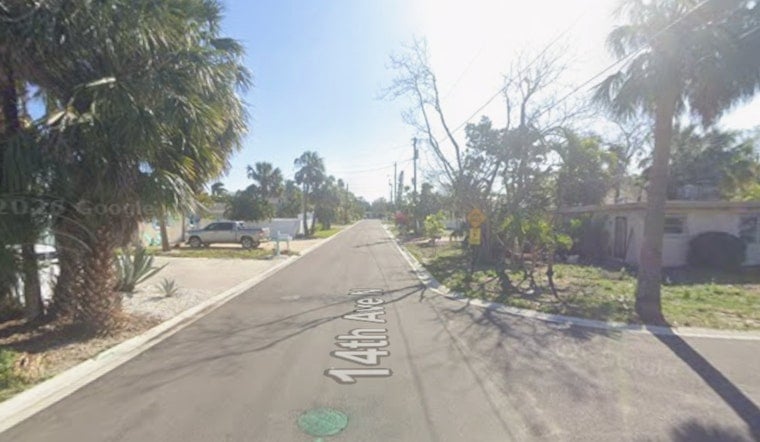
Fourteen-year-old Eli Scheinoha was riding an e-bike near 14th Avenue North in Indian Rocks Beach while on vacation with his father when he collided with a car. He flew over the vehicle's hood and landed mostly on his left knee and his helmet, and first responders rushed him to Johns Hopkins All Children's Hospital as a trauma alert for a leg injury.
His father, Shawn Scheinoha, believes the helmet made all the difference and said it saved his son's life, according to FOX 13 Tampa Bay. The outlet reports Eli's crash is part of a fast-growing pattern of pediatric e-bike injuries in Pinellas County, one that local doctors and bike shop staff say they are watching with alarm.
A Surge in Trauma Calls at a St. Petersburg Hospital
Johns Hopkins All Children's Hospital received 84 trauma calls involving e-bike crashes during just the first eight months of 2026, per the station's report. Dr. Patrick Mularoni, a pediatric emergency medicine physician at the hospital, said doctors are increasingly seeing children in the preteen years riding e-bikes, and pediatric doctors more broadly have reported that kids are getting into these crashes at younger ages. Some e-bikes, Mularoni noted, can reach speeds comparable to motor vehicles under certain conditions.
That clinical concern lines up with national research. A June 2026 report from the American College of Surgeons found that pediatric e-bike crash injuries increasingly resemble high-speed motor vehicle collision trauma, with pediatric trauma centers now citing e-bikes as a leading mechanism of injury among school-aged children. Nationally, the U.S. Consumer Product Safety Commission has estimated 155,200 emergency department-treated e-bike injuries between 2017 and 2024, along with 310 reported fatalities, according to Johns Hopkins Medicine.
Why Standard Bike Helmets May Fall Short
Head, face, and neck injuries accounted for 32.4 percent of all e-bike emergency room visits in 2024 and 2025, the largest share of any body region, per a July 2026 analysis of federal emergency department data published by Axios. Standard U.S. bike helmets are certified under federal standards created in 1999, tested for falls around 14 to 15 mph, well below the speeds many e-bikes reach today.
That gap is why Anne Fidanzato, manager of ABC Bicycles, a bike store in St. Petersburg, is researching helmets that meet the Dutch NTA 8776 standard, a benchmark designed specifically for e-bikes traveling up to 28 mph. That standard requires helmets to absorb higher-velocity impacts and provide roughly 10 percent more coverage around the temples and rear of the head than standard CPSC-tested helmets, according to Upway. Fidanzato is exploring stocking these helmets and is considering bringing compliant models into the shop, though she said she is unsure when they would actually arrive.
Florida's Patchwork of Age and Speed Rules
Florida requires e-bike riders age 16 and younger to wear helmets, but the state's age rules for who can legally operate certain e-bikes are more complicated. Under Florida Statute § 316.20655, Class 3 e-bikes, which provide motor assistance up to 28 mph, carry a minimum operating age of 16, while Class 1 and Class 2 e-bikes capped at 20 mph have no statewide minimum age requirement at all, according to Velotric.
That regulatory gap has widened since Governor Ron DeSantis vetoed CS/SB 382 in June 2026, a bipartisan bill the state legislature had passed unanimously that would have set a statewide 10 mph e-bike speed limit within 50 feet of pedestrians on sidewalks and mandated statewide crash reporting, as Hoodline reported in its coverage of Orlando's pediatric e-bike surge. DeSantis cited concerns that enforcing nonmoving traffic violations would lead to enhanced local police surveillance, per Ebike Oracle.
With no uniform statewide sidewalk speed limit in place, the debate has shifted to the county level. The Pinellas County Board of County Commissioners held a workshop this month to explore local e-bike regulations following 11 countywide electric-assisted vehicle fatalities in 2025 and growing concerns over reckless youth riding, according to WUSF. County officials noted that Florida law limits local authority mostly to setting sidewalk speed limits, ID requirements, and age restrictions.
Enforcement complications extend beyond age limits. The Pinellas County Sheriff's Office warned last September that youth are frequently modifying legal e-bikes or riding unregistered electric dirt bikes, such as Surron or Altis models that lack pedals, which can exceed 28 mph and operate illegally on public roads and sidewalks. Vehicles without functional pedals are legally classified as motor vehicles requiring a driver's license and registration, a distinction that has proven difficult to enforce against young riders.
Eli's crash echoes a pattern showing up in pediatric trauma units statewide. Hoodline has previously reported on a similar case in which a car struck two kids on an e-bike in northwest Miami-Dade, and on Jacksonville's Wolfson Children's Hospital, which treated 97 children for traumatic e-bike and e-scooter injuries in just the first six months of 2026, nearly matching its total for all of 2025, with roughly two-thirds of those injured youth suffering head trauma, according to First Coast News. National healthcare data from Truveta released in August 2026 showed emergency room visits for e-bike and e-scooter injuries among children under 18 rose 7.5-fold compared to 2023 levels, the steepest increase of any age group.
For the Scheinoha family, the statistics are now personal. Eli is recovering from his leg injury, and his father continues to point to the helmet as the reason his son is still here to tell the story.





