

























































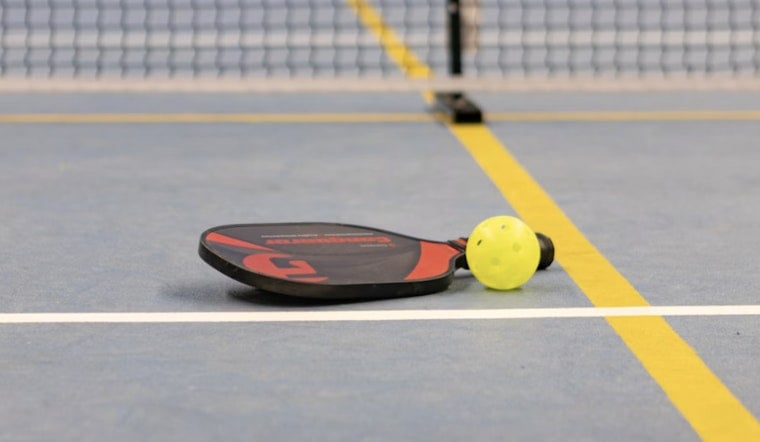
Seattle's pickleball scene just got a serious upgrade. A new 20-court indoor facility called Pickle at the Palms has opened in the Interbay neighborhood, and organizers say it's the largest indoor pickleball venue the city has ever seen.
According to FOX 13 Seattle, the facility brings together community, coffee, and competition under one roof, with FOX 13 sports reporter Lauren Helmbrecht covering the opening. The two-level building spans roughly 54,000 square feet at 3435 15th Ave. W, and unlike many indoor pickleball spots carved out of old warehouses, it was constructed specifically for the sport from the ground up, according to My Ballard.
The project was developed by a local sports icon with deep Seattle athletic ties: Olympic rowing silver medalist and Seattle Storm co-owner Ginny Gilder. Per Seattle magazine, Gilder built the facility alongside her daughter, interior designer Sierra Keeler, and son-in-law Kyle Schraeder, who now serves as general manager.
A Former Homeless Shelter Site Transforms
The Interbay property has a recent and notable history. Before construction began, the site was home to Salmon Bay Village, a city-sanctioned safe parking lot for RVs and tiny homes operated by the Low Income Housing Institute, which housed roughly 50 residents before its lease expired in May 2025, KING 5 reports. Construction on the pickleball facility began that July after the land was cleared, the same report notes.
The complex now sits within a fast-growing Interbay athletic corridor. It's located adjacent to the BECU Storm Center for Basketball Performance, joining nearby facilities for Ballard FC and Interbay Golf Center as part of what's becoming a centralized sports destination for the region, according to the same KING 5 account.
High-Tech Courts and Hospitality Perks
Every court at Pickle at the Palms is outfitted with PlaySight camera technology and video replay screens, letting players break down their shot technique and download match footage straight to their phones, per the earlier My Ballard report. It's the same system used by professional franchises like the Seattle Storm.
Beyond the courts, the facility features an all-day café run by local eatery Mainstay Provisions, court-view social lounges, a pro shop, and private showers. Custom acoustic engineering was built in to cut court noise by more than 50 percent, addressing a common complaint about the sport's signature pop. A 200-foot exterior mural by Seattle artist Sam Wood wraps the building's façade, and the venue runs primarily on a pay-to-play pricing model rather than requiring unlimited monthly memberships, keeping court time accessible without a long-term commitment.
Washington's Long Pickleball Pedigree
The opening lands in a state that treats pickleball as more than a passing fad. The sport was invented in 1965 on Bainbridge Island, and Washington made it the official state sport in March 2022 under Senate Bill 5615, according to a press release from Sen. John Lovick. Governor Jay Inslee signed the bill at the sport's original Bainbridge Island court.
That enthusiasm has kept building. In 2026, the Washington State Legislature authorized an official pickleball specialty license plate after a multi-year push by the Seattle Metro Pickleball Association, which gathered more than 3,800 resident signatures, according to UW Magazine. The specialty plates carry an initial fee of $157.25 that supports state programs.
Private Courts Open Amid Public Court Fights
The rise of high-end private venues like Pickle at the Palms comes against a backdrop of tension over Seattle's public court supply. Back in Hoodline's coverage of a pickleball uprising, the Seattle Metro Pickleball Association petitioned against a city proposal to eliminate 36 outdoor courts across seven public locations, a plan that drew significant pushback from local players. That fight over shared public courts stands in contrast to the fee-based, amenity-heavy model now taking root in Interbay.
Pickle at the Palms joins a wave of large indoor pickleball complexes opening across the region this year, following venues like a 16-court facility with on-site dining in Cedar Park. For Seattle players, though, the Interbay opening marks the arrival of the city's biggest indoor option yet, one built from scratch on a site that, just over a year ago, was serving a very different community need.



