

























































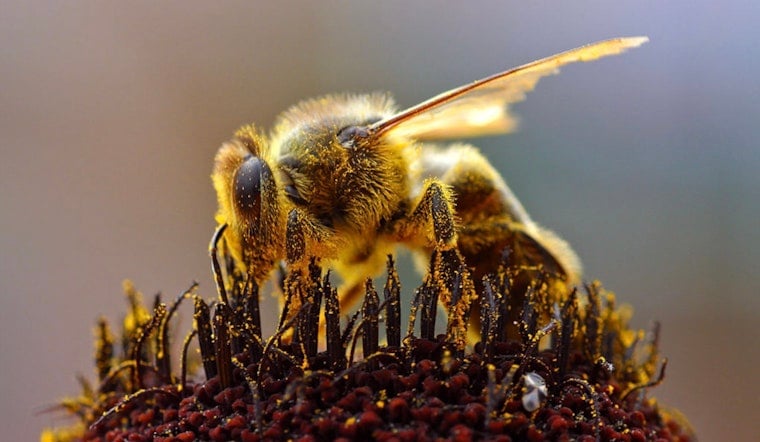
An Ithaca cemetery is sitting atop an underground metropolis of an estimated 5.5 million wild bees, researchers say — and that may be the largest known aggregation of ground-nesting bees ever documented. The insects are not honeybees packed into a single hive, but solitary regular mining bees, with each female digging and provisioning her own burrow. The discovery turns a quiet patch of East Lawn Cemetery into a remarkable pollination site near Cornell University.
The estimate ranges from roughly 3 million to 8 million bees, with 5.5 million as the midpoint, according to Spectrum News. Researchers believe the aggregation could be the largest in the world, although they are more cautious in the peer-reviewed literature, where it ranks among the biggest thoroughly documented sites.
The species is Andrena regularis, also known as the regular mining bee. Unlike honeybees, these native pollinators do not maintain a queen, hive, or honey stores to defend, and the species is not known for stinging people, according to the Cornell Chronicle.
How Researchers Counted Millions Of Bees
The population estimate came from a 2023 field study that used 10 small emergence traps across the cemetery. The traps collected 3,251 insects from 16 species between March 30 and May 16, 2023, and researchers then extrapolated the bee density across about 6,000 square meters of nesting ground. The peer-reviewed study was published in Apidologie.
Each female mining bee lives alone in an underground nest, laying eggs in brood cells stocked with pollen and nectar. The adults emerge in spring, with males appearing first and females following days later, a schedule that lines up with the early bloom of apples, fruit trees, and wildflowers.
Ground-nesting bees are far more common than the hive-building image most people associate with bees. The Xerces Society says roughly 70% of native bee species nest in the ground, often in loose, well-drained soil, and warns that habitat loss, pesticides, and disturbance can threaten those nesting areas.
East Lawn appears to offer an unusually good combination of conditions. Historical records show regular mining bees at the cemetery as far back as the early 1900s, while the cemetery itself dates to 1878; nearby Cornell Orchards supplies abundant spring flowers, and the site has sandy soil that the bees prefer.
The discovery began with a routine walk in 2022, when Cornell lab technician Rachel Fordyce noticed bees across the grounds, collected a few in a jar, and brought them to entomology professor Bryan Danforth. That small observation eventually led to the research project and a closer look at cemeteries as potential refuges for biodiversity, as Spectrum News reported.
Researchers Want The Bees Left Alone
Danforth's team is now working to document and protect other nesting aggregations, rather than treating the Ithaca site as a one-off curiosity. Through Project GNBee, members of the public can submit observations of ground-nesting bees and help researchers map sites that may deserve protection.
For homeowners, cemetery managers, and other land stewards, the conservation message is fairly simple: preserve patches of bare or lightly vegetated soil, protect early-blooming flowers, and avoid pesticides around active nesting areas. In a state better known for its apple orchards, the cemetery's millions of small underground neighbors are quietly helping keep that spring economy blooming.





