

























































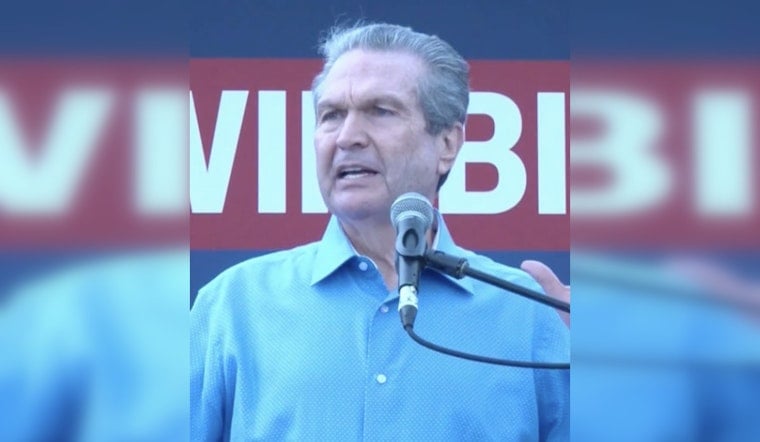
Georgia Republican Rick Jackson raised nearly twice as much money as Democrat Keisha Lance Bottoms in the latest campaign finance reporting period, according to filings covering the stretch through July 31, 2026. Jackson's campaign pulled in $6.1 million during the period, while Bottoms collected $3.1 million from May through July, leaving each candidate with sharply different cash positions heading toward November.
Cash on Hand Tells a Bigger Story
The gap widens further when it comes to money still in the bank. As reported by FOX 5 Atlanta, Jackson's campaign reported a little more than $4 million on hand at the end of July, compared with just over $770,000 for Bottoms. Jackson's filing covered a shorter period beginning in early June, while Bottoms' filing spanned the full May-through-July window, per the same reporting.
The fundraising numbers mark a notable shift for Jackson, the billionaire CEO of Alpharetta-based Jackson Healthcare, who spent more than $100 million of his own money to win the Republican nomination through the primary and a June 16 runoff. According to Capitol Beat, Jackson received no new personal cash or loan infusions into his campaign during the general election reporting period, suggesting he has pivoted from self-funding to relying on outside donors and party support.
Leadership Committees Bring In Millions More
That donor reliance shows up most dramatically outside the traditional campaign accounts. Under Georgia's 2021 leadership committee law, official party nominees for governor can set up dedicated committees exempt from the state's standard $8,400 per-donor contribution cap, letting them raise unlimited sums from individuals and corporations, the Atlanta Journal-Constitution has explained. The Republican Governors Association poured $10 million into Jackson's leadership committee, called For All Georgians Inc., between mid-June and late July, and the committee reported total receipts of roughly $13 million in outside money, according to the Atlanta Journal-Constitution.
Bottoms has her own leadership committee support, though on a smaller scale. The Democratic Governors Association contributed over $1.6 million to back her campaign during the same stretch, per the AJC's reporting. Capitol Beat notes that Bottoms, who previously served as Atlanta's mayor and as a senior advisor in the Biden White House, collected $2.3 million of her individual campaign contributions from out-of-state donors, compared with nearly $200,000 in out-of-state individual donations for Jackson — a sharp geographic contrast in the two campaigns' donor bases.
Jackson Once Sued Over the Very Law He Now Uses
The irony of Jackson's current fundraising strategy is not lost on observers of the race. In February, Jackson filed a federal lawsuit against then-primary rival Lt. Gov. Burt Jones challenging Georgia's leadership committee law, and won a temporary restraining order barring Jones' committee from raising or spending funds during the primary. CBS News reported that federal judge Thomas Thrash issued the order citing First Amendment concerns. Jackson went on to win the June 16 GOP runoff with 53 percent of the vote against Jones, despite Jones having carried Donald Trump's endorsement in the primary, before Jackson himself received Trump's backing in late July, according to Newsweek. Bottoms, meanwhile, secured the Democratic nomination outright in May with more than 56 percent of the vote.
Healthcare Fight Looms Behind the Numbers
The fundraising disparity comes as healthcare emerges as a defining issue in the race. Bottoms has pledged to expand Medicaid under the Affordable Care Act and eliminate the Georgia Pathways program, while Jackson opposes full Medicaid expansion and instead advocates for a fixed federal block grant aimed at reducing commercial insurance costs, the AJC reports. Georgia remains one of ten states that has not fully expanded Medicaid.
Jackson's own business history has become fodder for attacks on that front. Jackson Healthcare was the second-largest creditor to bankrupt Jackson Hospital in Montgomery, Alabama, before Jackson's investment group issued the facility a $35 million loan carrying interest rates up to 19 percent — a transaction now drawing criticism from Democratic opponents, according to the Alabama Political Reporter. The Alabama hospital's financial distress stemmed partly from the state's refusal to expand Medicaid, the outlet noted.
Polling suggests the stakes on healthcare messaging are high. An August University of Georgia poll commissioned by the Georgia Health Initiative found that more than 75 percent of likely Georgia voters say a gubernatorial candidate's stance on healthcare will influence their vote in November, CBS News reported on the nonpartisan survey of more than 1,000 likely voters.
An Open Seat With Historic Stakes
Incumbent Republican Gov. Brian Kemp is term-limited and cannot seek reelection, leaving an open seat in a state where Democrats have not won the governorship since Roy Barnes in 1998, according to Ballotpedia. Republicans have held every statewide executive office in Georgia since 2022, making the fundraising gap and the campaigns' contrasting donor bases central storylines as independent analysts continue to rate the race a toss-up heading into fall.





.png)