

























































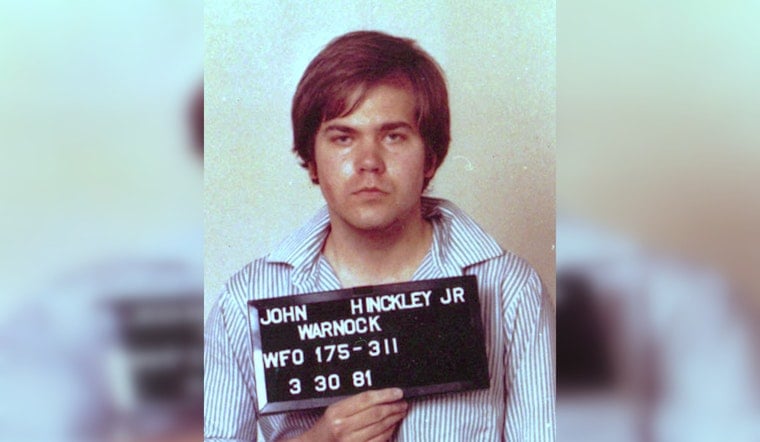
John Hinckley Jr., now 71 years old, has broken his relative public silence to reflect on the delusion that once drove him to try to kill a sitting U.S. president. In a new podcast interview, Hinckley said that after shooting President Ronald Reagan outside a Washington, D.C., hotel in 1981, he expected actress Jodie Foster to join him wherever he ended up once things settled down.
The remarks came during an August interview on The Mark Joseph Show, hosted by Mark Joseph, as first reported by New York Daily News reporter Brian Niemietz. Hinckley described himself as delusional at the time of the shooting and said he thought he would end up with Foster after the attack. Decades later, he told Joseph that his interest in the actress is no longer a priority, though he added that he hoped Foster has a good life and said he wished her well.
A Delusion That Nearly Killed a President
Hinckley fired six shots outside the Hilton Hotel in Washington, D.C., on March 30, 1981, wounding Reagan, who was hospitalized for 12 days after being shot in the chest, according to the same Daily News report. Hinckley also shot two law enforcement officials during the attack and critically wounded White House Press Secretary James Brady, who was struck in the head.
A jury found Hinckley not guilty by reason of insanity in 1982, concluding he was mentally unstable at the time of the shooting. That acquittal reshaped federal criminal law: Congress responded with the Insanity Defense Reform Act of 1984, which eliminated the volitional prong of the federal insanity defense and shifted the burden of proof onto defendants, according to Wikipedia. The reform reportedly influenced roughly 80 percent of state-level insanity-defense changes enacted between 1978 and 1990.
Brady's Death Ruled a Homicide, But No New Charges
James Brady never fully recovered from his wounds. He used a wheelchair for the rest of his life and became a prominent gun-control advocate before dying in August 2014 at age 73 — 33 years after the shooting. A Virginia medical examiner officially ruled his death a homicide resulting from the 1981 gunshot wounds, as reported by CBS News at the time.
Despite that homicide ruling, the U.S. Attorney's Office for the District of Columbia announced in January 2015 that it would not pursue murder charges against Hinckley over Brady's death. Federal prosecutors reviewed the finalized autopsy findings but concluded that legal barriers stemming from Hinckley's 1982 acquittal, including double jeopardy protections, prevented a new prosecution, according to the U.S. Department of Justice. Brady's name later became attached to landmark federal legislation when President Bill Clinton signed the Brady Handgun Violence Prevention Act into law in November 1993, establishing mandatory background checks for handgun purchases through the National Instant Criminal Background Check System.
From Institutionalization to Unconditional Freedom
Hinckley was institutionalized at St. Elizabeths Hospital until 2016, after which he lived under conditional court supervision in Williamsburg, Virginia. In September 2021, U.S. District Court Judge Paul L. Friedman ruled that Hinckley had shown no signs of active mental illness since the mid-1980s and was no longer a danger to society, granting him complete unconditional release effective June 2022, according to reporting cited in the case's court record.
After gaining his freedom, Hinckley launched a music career, uploading original folk songs to YouTube and Spotify. But several scheduled live performances, including shows in New York, Connecticut, and Chicago, were canceled by venues that were not receptive to hosting his performances, citing public safety concerns and backlash, according to the Williamsburg Yorktown Daily.
Foster's Decades of Silence Versus Hinckley's Public Life
The contrast between Hinckley's recent openness and Jodie Foster's approach to the subject could not be starker. Foster has addressed the shooting publicly only once, in a December 1982 Esquire essay titled Why Me?, and has otherwise refused to answer media questions about Hinckley for decades. She reportedly canceled a 1991 Today Show appearance after learning producers planned to mention Hinckley in her introduction, according to Famous Trials.
In his interview with Joseph, Hinckley also said he does not really watch Foster's movies these days. The attack that once tied their names together also left lasting injuries on the officers who protected Reagan that day: Secret Service Agent Timothy McCarthy was shot in the abdomen after diving in front of the president, while D.C. Police Officer Thomas Delahanty was shot in the neck and suffered permanent nerve damage that forced his retirement from the force, according to the William J. Clinton Presidential Library and Museum.
Hinckley used a .22-caliber revolver loaded with six Devastator explosive-tip bullets during the attack, though only the round that struck Brady exploded on impact, per the Ronald Reagan Presidential Library & Museum. The bullet that hit Reagan, the 40th president of the United States, ricocheted off his limousine before entering his left lung.





.png)