

























































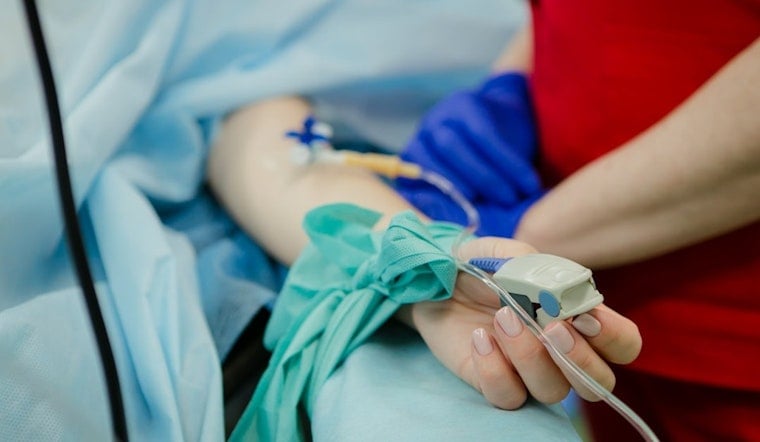
Kiya Thompson grew up in Kansas City, and she is now urging her hometown to help save her 5-year-old daughter's life. Noelle Thompson has Chediak-Higashi syndrome, an extremely rare genetic disorder that has affected fewer than 500 diagnosed people, and Kiya Thompson says she is not expected to survive childhood without a bone marrow donor.
Thompson, once a nurse at the University of Kansas Health System, told KCTV that Kansas City is still home for her, even though her family of four — she, her husband Justin, Noelle, and 3-year-old son Lucca — now lives on the East Coast, where Justin serves in the U.S. Army. The family learned in May 2025 that both children had inherited the same devastating condition, according to FOX 5 DC. Kiya and Justin had endured three miscarriages before Noelle and Lucca arrived and were celebrated as the couple's miracle babies, the outlet reported.
Chediak-Higashi syndrome damages immune system cells and causes infections, and it is often terminal. Noelle first showed signs of trouble at 9 months old, when she developed ulcers, according to the seed reporting; she later experienced eye difficulties, bruising, and frequent illness. The disorder stems from mutations in the LYST gene, which disrupt lysosomal trafficking throughout the body and produce giant, dysfunctional granules inside white blood cells, according to StatPearls.
A Ticking Clock Without a Transplant
Without a stem cell or bone marrow transplant, most patients with classic Chediak-Higashi syndrome die before age 10, primarily from overwhelming infections or a hyperinflammatory complication called the accelerated phase, per research published on PMC. That accelerated phase, also known as hemophagocytic lymphohistiocytosis, can cause multiorgan damage and rapid clinical decline. Research on pediatric patients who received transplants has reported notably worse outcomes for children transplanted while already in the accelerated phase. A PubMed-indexed study by N. Amayiri and colleagues reported that 21 children with Chediak-Higashi syndrome were alive after transplantation, with overall survival of 72% at a median follow-up of 32 months.
Kiya Thompson said having two children with a one-in-a-million disorder brought sheer shock. Lucca has been recovering since receiving a lifesaving bone marrow donation from a man in Spain in November 2025, and he had his first hospital readmission after nine months without one, the seed reporting noted. Noelle has not been so fortunate — she has no matches, her mother said, despite a search of the national registry.
Why Finding a Match Is So Difficult
Dr. Wendy Introne, a staff clinician at the National Human Genome Research Institute who has studied Chediak-Higashi syndrome at the NIH for 25 years, helped establish bone marrow transplantation as the primary life-extending treatment for the disorder. Even so, after searching among 41 million registered donors worldwide, doctors found no match for Noelle.
The odds are steeper for some patients than others. Data from the National Marrow Donor Program shows White patients searching for an unrelated donor have a 79% likelihood of finding a match, compared with 29% to 60% for non-White and ethnically diverse patients, since human leukocyte antigen tissue types are inherited and vary widely across ethnic lineages. The U.S. registry maintains more than 9 million potential donors nationally, and global registries link together more than 43 million donors worldwide, according to the Health Resources and Services Administration. According to the Health Resources and Services Administration's Blood Stem Cell program, the U.S. registry contains more than 9 million donors. The Health Resources and Services Administration's Fiscal Year 2024 Annual Progress Report says the chance of finding a suitably matched unrelated donor through the U.S. registry varies by race and ethnicity.
What Donating Actually Involves
Kiya Thompson has been raising awareness through social media videos and in-person drives, hoping to expand the pool of potential donors before it is too late for her daughter. People between 18 and 35 can request a free mail-in cheek swab kit to join the registry, and the donation process itself, when a match is found, usually resembles a plasma or platelet donation that takes only a few hours and is non-surgical 90% of the time. Erica Sevilla said most donors feel back to normal within a day or two.
The National Marrow Donor Program covers all logistical and financial costs for marrow donors, including medical care, travel, lodging, and lost wage reimbursement, addressing a common misconception that donating is expensive or invasive, according to reporting relayed by the Benton County Enterprise. A GoFundMe has also been established to help the Thompson family with medical expenses as they continue their search.
A Cure for One Problem, Not All of Them
Even if Noelle finds a donor and undergoes a successful transplant, the road ahead will not be simple. Medical consensus indicates that while hematopoietic stem cell transplantation corrects the immune and blood abnormalities of Chediak-Higashi syndrome, it does not prevent progressive neurological decline — such as ataxia and peripheral neuropathy — later in life, according to the NCBI Bookshelf. Those neurological symptoms may persist after blood stem cell replacement.
Children's Mercy Kansas City lists a dedicated Marrow Transplant clinic and provides the contact number 816-302-6808.
For now, the Thompson family's focus remains on finding Noelle a match at all. Kiya Thompson continues to tell her daughter's story in hopes that someone, somewhere, will turn out to be the donor who can save her.





