

























































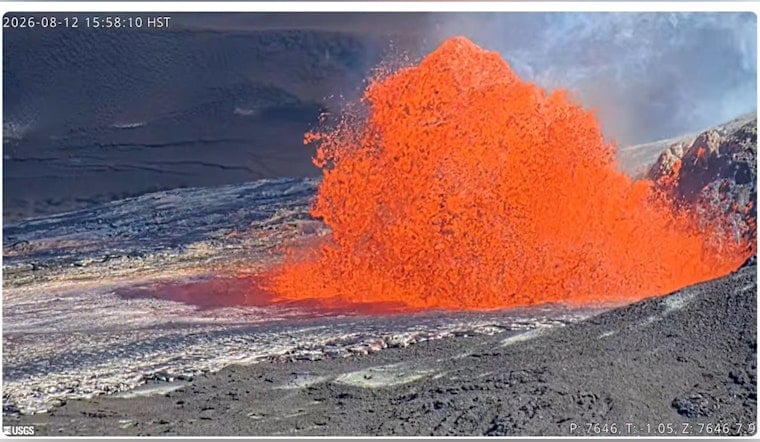
Lava fountaining returned to Kilauea's Halemaumau crater Wednesday afternoon, with Hawaiian Volcano Observatory scientists reporting that Episode 53 of the volcano's ongoing eruption began from the north vent at 3:45 p.m. and quickly reached about 100 feet in height. A volcanic gas plume rose roughly 6,000 feet above ground level as the episode got underway, with winds blowing from the northeast over the summit within Hawaii Volcanoes National Park.
The episode marks the 53rd fountaining event of the eruption that began December 23, 2024, following 52 previous episodes, according to the Honolulu Star-Advertiser. Scientists reported that volcanic gas emissions and volcanic material may be distributed southwest of Halemaumau, and lava activity has remained confined to the summit crater. The volcano's alert level is at Watch, with the aviation color code set to Orange.
The paper's report notes that hazards including volcanic ash, pumice, tephra, and Pele's hair are greatest within three miles of the vents, while vog will linger downwind and may cause respiratory or other problems for residents. This episode arrives as part of a record-setting eruption cycle: USGS Hawaiian Volcano Observatory scientists reported in May that the Halemaumau eruption has maintained a magma supply rate roughly 25 percent above Kilauea's long-term average, a pace that produced fountains exceeding 1,700 feet during Episode 43 in March.
A Cycle Already in the Record Books
Episode 53 follows a cycle that made history earlier this summer. On June 1, Episode 48 set an all-time record for the most lava fountaining episodes in a single eruption, surpassing the 47 episodes tallied during the 1983-1986 Puuoo eruption, as reported by Discover Magazine. USGS tracking shows each episode since the eruption began follows a distinct pattern: magma accumulation causes the summit ground to inflate, then the ground rapidly deflates once pressure vents through Halemaumau and fountaining begins, a mechanism that lets scientists forecast fountaining windows within days even though exact timing and fountain heights stay unpredictable.
The eruption itself capped an unusually dynamic stretch for Kilauea's magma system. Its start in December 2024 marked the volcano's third distinct eruption site that year, following activity in the Southwest Rift Zone in June and the East Rift Zone in September, a multi-zone feat not seen since 1974, per USGS.
Downwind Communities Face Familiar Precautions
Episodes like this one have repeatedly forced Hawaii County Civil Defense and the National Weather Service to advise residents in downwind communities such as Pahala and Naalehu to disconnect roof-to-tank rainwater catchment systems, protecting household water supplies from ash and Pele's hair contamination, as Hoodline's coverage of Episode 51 detailed last month. Many rural Big Island homes depend entirely on catchment systems for their water, making the advisory a recurring necessity rather than a one-time warning.
The Hawaii Department of Health has also cautioned that standard face masks, including N95, KN95, and surgical masks, do not protect against toxic sulfur dioxide gas, though they remain effective outdoors for filtering airborne ash and glass-strand Pele's hair. Vog forms when sulfur dioxide reacts with oxygen, sunlight, and moisture in the air, according to the department's December 2025 guidance.
Park Access and Aviation Safety Under Strain
Heavy tephra fall during high-fountaining episodes earlier this year forced National Park Service crews to clear as much as a foot of accumulated volcanic rock and glass from summit roadways, temporarily closing popular overlooks including Uekahuna. Tephra fallout can leave roads dangerously slick, according to the National Park Service.
The stakes of straying from marked areas near the summit were made clear in February, when a 33-year-old Hawaii resident died after rescue teams extracted him from steep, off-limits terrain inside Kilauea caldera during a pause between eruptive episodes. In March, USGS also updated its Volcano Observatory Notices for Aviation to an all-caps, machine-readable format aligned with International Civil Aviation Organization standards, allowing plume warnings to feed directly into airline flight planning systems during ash-producing episodes.
Longer-term research adds context to why Kilauea has become so active. A University of Hawaii at Manoa-led study published this year found that the deep mantle plume feeding Hawaiian volcanoes has warmed by roughly 250 degrees Celsius over the past 47 million years, a trend researchers link to the massive physical scale of Hawaiian shield volcanoes after examining olivine basalts across 16 volcanoes along the Hawaiian Ridge.





