

























































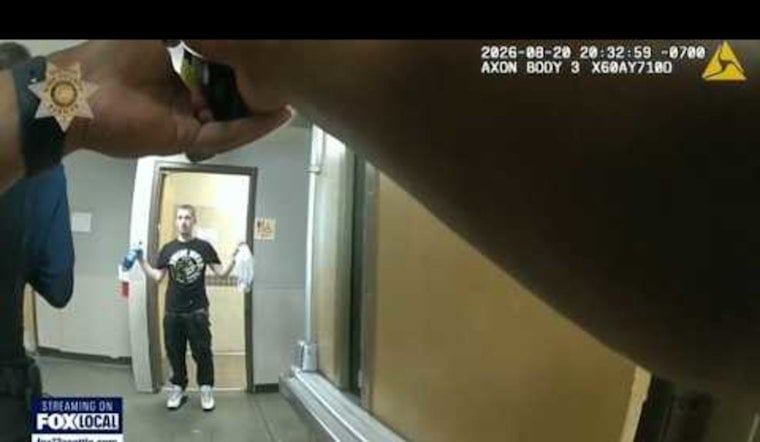
Multiple suspects tried to flee from King County deputies in a dangerous manner, but the King County Sheriff's Office Air Support Unit's helicopter tracked them from above, allowing ground officers to move in and make arrests without further risk to the community. The unit's Guardian 1 helicopter helped locate and apprehend the suspects using coordinated aerial surveillance, according to a recent update from the unit.
The King County Sheriff's Office Air Support Unit, which posts as KCSOAirsupport on social media, described the operation as a case of Guardian 1 assisting ground units in both finding and arresting the suspects after they attempted to flee. The unit is the official social media presence for King County's airborne law enforcement and rescue arm, based in Seattle, and it regularly provides aerial support and rescue services across the region.
How the Helicopter Changes the Chase
Guardian 1's ability to track fleeing suspects from the air lets ground officers back off from active, high-speed pursuits while deputies keep eyes on the target from overhead, according to Seattle Police Department footage documenting the tactic. That aerial vantage point gives deputies time to position spike strips or set up a perimeter, so an arrest can happen with less danger to bystanders and officers alike. The helicopter is outfitted with Forward Looking Infrared thermal sensors, a 30-million candlepower “NightSun” searchlight, and real-time microwave video downlinks that beam live footage to commanders on the ground, per King County government.
Since October 2024, Guardian 1 has flown as a $6 million Bell 407GXi helicopter equipped with Instrument Flight Rules technology, letting pilots operate through fog and heavy rain across western Washington, as reported by KOMO News. The unit is the only full-time rotary-wing law enforcement aviation operation in the state, flying six days a week out of Renton Municipal Airport since it was created in 1991, according to Helis.com. It also provides contract police services and specialty air support to more than 30 percent of the municipal cities within King County beyond the unincorporated areas it directly serves, per documentation submitted to the city of North Bend.
A Legal Landscape That Favors More Pursuits
This kind of aerial-assisted arrest has become more common since Washington's Initiative 2113 took effect in June 2024, lowering the legal bar for police pursuits from probable cause to a reasonable suspicion standard, according to Ballotpedia. Between 2021 and June 2024, while the stricter rule was still in place, the Washington State Patrol logged nearly 8,000 incidents of drivers refusing to stop when signaled by troopers, KING 5 reported. Under state law, attempting to elude a pursuing police vehicle while driving recklessly is a Class C felony, carrying up to five years in prison, a $10,000 fine, and mandatory license revocation, per RCW 46.61.024 as published by the Washington State Legislature.
The unit's reach isn't limited to highway pursuits. In August, Guardian 1 helped ground deputies establish perimeters in South King County after suspects abandoned their vehicles and fled on foot into residential neighborhoods, according to the West Seattle Blog. The federal government also chipped in more than $1 million in July to upgrade avionics, transmissions, and hoist systems across the unit's rescue fleet, funding announced through Rep. Kim Schrier's office.
A Recurring Pattern Across the County
This latest arrest fits a pattern Hoodline has tracked repeatedly this year. Guardian 1 swarmed White Center after a shooting in July, helped locate a tuber stranded overnight on the Green River in August, and backed deputies during a South Hill pursuit where a driver tried hiding underwater to evade capture. In each case, the same combination of thermal imaging and real-time video downlink gave ground units the ability to track suspects without engaging in a dangerous chase through populated streets.





