

























































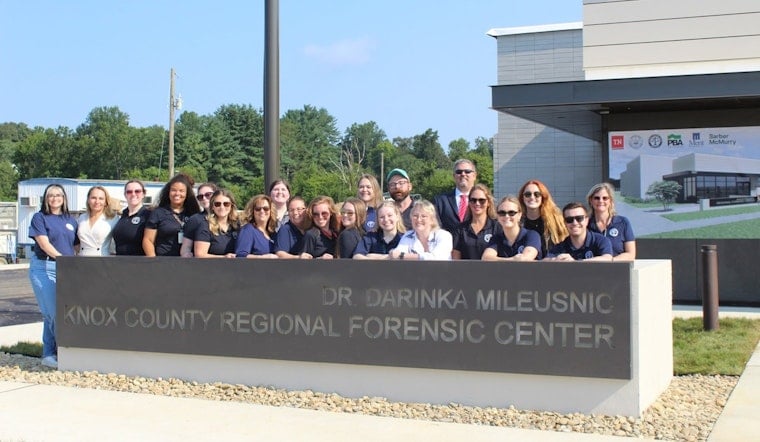
State and local leaders gathered Tuesday to dedicate Knox County's new $30 million forensic center to Dr. Darinka Mileusnic, the longtime chief medical examiner who has led the office through years of surging caseloads. The 33,000-square-foot facility, rising in the Karns Valley Business Park off Oak Ridge Highway in northwest Knoxville, is set to be complete by early September and will be the largest facility of its kind in Tennessee.
According to the Knox County Regional Forensic Center, Dr. Mileusnic studied medicine in Croatia and Chicago before becoming the center's long-serving chief medical examiner, and she is recognized internationally among her peers. Chris Thomas, the center's chief administrative officer, said the new building will help attract and retain the best forensic staff and support decades of growth, per the center's Facebook post announcing the dedication. Mayor Glenn Jacobs pushed for the new facility for years and met with Governor Bill Lee, Thomas, and Dr. Mileusnic to discuss funding for the project, the center said.
How the Money Came Together
The State of Tennessee approved $20 million from the American Rescue Plan Act for the project, with Knox County covering the remaining $10 million, the forensic center said in its dedication announcement. John Dunn, interim commissioner of the Tennessee Department of Health, said the center was needed because caseloads continue to grow and the region needs capacity for current and future demands, according to the same announcement.
That growth has been dramatic. The center's staff expanded from 30 members in 2018 to 43 today, and its annual caseload climbed from 1,900 cases that year to as many as 3,000 cases now, per the center. Workload growth is driven by population increase and the center's expanding role across eastern Tennessee, the announcement noted. Those figures track with reporting from WBIR, which found the center's caseload rose from roughly 1,900 cases in 2019 to 2,300 in 2020 and 2,800 in 2021, driven largely by the regional fentanyl crisis that repeatedly overwhelmed morgue cooler capacity at the current Bearden building.
The current facility at 2761 Sullins Street opened in December 2014 after the center outgrew its former space at the University of Tennessee Medical Center, WBIR reports. Knox County arranged to transfer that Sullins Street property back to the Industrial Development Board in exchange for the 15-acre Karns Valley parcel that now houses the new center, according to the same report.
Doubling Capacity for a Growing Region
The new building will almost double the office and laboratory size of the current facility, with twice as many autopsy stations, a CT scanner, a larger lobby, additional workstations, and an outdoor staff decompression area, the forensic center said. Staff are expected to move into the new facility in October. The center serves as the official medical examiner for Knox, Anderson, and Blount counties and performs autopsies for 23 counties across the region, operating 24 hours a day, 365 days a year.
The scale of that regional role shows up in the numbers. In 2025 alone, the center's 43-member staff conducted 2,010 autopsies and medical examinations and responded to 1,373 death scenes across its East Tennessee service area, the center reported in August. That workload has been shaped in part by the region's drug crisis: the center's 2025 Drug-Related Death Report, published in April, found drug-related fatalities dropped 8 percent in Knox County to 307 deaths and 13 percent in Anderson County to 46 deaths compared to 2024, though methamphetamine and synthetic opioids remained top contributors, per WBIR.
Earlier this year, the center also raised public health alerts after identifying cychlorphine, a novel synthetic opioid estimated to be up to 10 times more potent than fentanyl, in nearly 40 fatal overdose cases across East Tennessee — a discovery Hoodline covered when the center first linked the drug to 16 deaths. In September 2025, the Knox County Commission formally approved a five-year agreement designating the center as the official medical examiner for Blount County, expanding its administrative reach further.
A Legacy Beyond the Autopsy Table
The forensic center has also played a role in identifying cold case victims, work that includes a program honoring unclaimed veterans. The center used forensic genetic genealogical DNA testing in partnership with private labs to identify 2003 cold case victim Brian Sanderson and 1993 victim Elbert Louis Brown, cases Hoodline detailed in its Sanderson identification report.
Dr. Mileusnic has also pushed the center's public health work beyond criminal investigations. In a study spanning 2019 through 2023, she reported that of 185 autopsies performed on infants under one year old, 100 deaths were attributed directly to unsafe sleep environments across the counties the center serves, according to Oak Ridge Today. At the dedication, Dr. Mileusnic said families behind heartbreaking stories deserve answers, help, and guidance, per the center's announcement.
The center earned re-accreditation from the National Association of Medical Examiners in 2025, marking 15 consecutive years of maintaining the national standard for medicolegal death investigation. That distinction matters nationally: industry data from the same association indicates there are fewer than 800 practicing board-certified forensic pathologists in the United States, far below the estimated 1,200 needed to handle autopsy demand nationwide, according to a report published by ACS Publisher. A modern, expanded facility like the one now rising in Karns Valley is widely seen as a tool for recruiting and retaining those rare specialists in a competitive labor market.





