

























































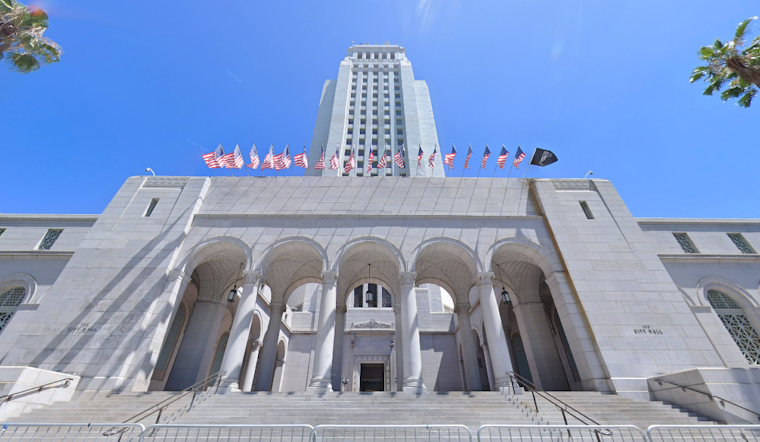
Disability and mobility advocates gathered outside Los Angeles City Hall this week, performing a symbolic “Willits Slide” to mark the 10th anniversary of a legal settlement that promised to fix the city's broken sidewalks and curb ramps — and to warn that the job is far from finished. The demonstration landed even as the city faces a backlog of more than 4,400 sidewalk repair requests and a shrinking budget for the bureau tasked with doing the work.
The event, held on the anniversary of the 2016 Willits v. City of Los Angeles settlement, was organized by a coalition that included Public Matters, FASTLinkDTLA, DTLA Mobility for All, Los Angeles Walks, and Communities Actively Living Independent and Free, according to BikinginLA. As reported by the Los Angeles Daily News, the demonstration doubled as both a celebration of progress made and a pointed reminder of how much remains undone across a city with more than 9,000 miles of public sidewalks, per the Los Angeles City Controller.
The original class-action lawsuit was filed on August 4, 2010, by the advocacy group Communities Actively Living Independent and Free alongside disabled residents Mark Willits, Judy Griffin, and Brent Pilgreen, according to the Civil Rights Litigation Clearinghouse. Disability rights advocates had claimed that damaged and non-navigable sidewalks were a major problem for pedestrians and others, and the case ended with a settlement reached in 2016 that legal advocates at the time recognized as the largest disability access agreement in U.S. history, according to Disability Rights Advocates, affecting an estimated class of 280,000 Los Angeles residents with mobility disabilities.
A $1.37 Billion Promise, A Decade Later
Under the settlement, Los Angeles agreed to spend $1.37 billion over 30 years to fix broken sidewalks, inaccessible curb ramps, and other pedestrian problems. The city has spent more than $370 million toward that commitment so far, per public works, and says it has met or exceeded its annual Willits spending obligation each year, the Daily News reports. The city council also vowed to repair all sidewalks in the city and approved a “fix and release” sidewalk repair policy as part of the Safe Sidewalks LA program that followed the settlement.
That policy gives adjacent property owners a 20-year warranty period after the city performs an initial repair, after which full maintenance responsibility and compliance certification revert back to the property owner, according to Western City Magazine. The arrangement reflects a decades-old tension in state law: California Streets and Highways Code Section 5610 assigns sidewalk maintenance duty to private property owners, while California Government Code Section 835 holds cities liable for injury claims if officials had prior notice of a dangerous condition, as previously reported by Hoodline.
Budget Cuts Collide With Repair Backlog
Los Angeles City Controller Kenneth Mejia said sidewalk repairs should be directed to areas with the greatest need, and criticized plans to prioritize repairs near Olympic venues ahead of the 2028 Games. Mejia said City Hall has not been prioritizing safe sidewalks and argued the city needs to overhaul its priorities to invest in fixing and maintaining sidewalks, according to the Daily News account of his remarks.
The financial pressure is real: the Bureau of Street Services saw a $61 million decline in its operating budget from fiscal 2024 to fiscal 2026, a 26 percent drop. That cut arrives against a backdrop Controller Mejia flagged earlier this year, when his office warned in a February report that decades of unstable budgeting and soaring legal payouts have left Los Angeles on perilous financial footing, forcing unpaid employee furloughs and the elimination of thousands of vacant municipal jobs, according to LAist.
Liability Payouts Keep Piling Up
Sidewalk-related injury claims have been a persistent drain on city coffers well before this year's warnings. A 2021 City Controller audit found that over the prior five fiscal years, the city received more than 1,700 injury claims and 1,020 lawsuits linked specifically to broken sidewalks, resulting in over $35 million in settlement payouts. Between fiscal years 2020 and 2023, the Bureau of Street Services alone generated $88.4 million in liability claim payouts, ranking as the third-highest source of municipal lawsuit costs behind the police and sanitation departments, according to Our Weekly.
According to Mejia's office, Los Angeles paid $110 million in sidewalk-related liability claims between July 1, 2019, and December 31, 2025 — about 10 percent of all city liability payouts during that span. The Los Angeles Controller's Office has since conducted an audit of city risk management practices aimed at reducing injuries and liability costs, and expects to release those findings in the coming months, the Daily News reports.
Advocates Say the Fight Isn't Over
Hilary Norton, executive director of FASTLinkDTLA — a nonprofit organization focused on reducing traffic in Los Angeles County that also encourages public transit, walking, biking, carpooling and on-demand transit — applauded the city's advances in sidewalk and curb accessibility. But Norton said much work remains to make Los Angeles sidewalks and curbs truly accessible, echoing the sentiment that carried through the anniversary demonstration.
Nine-time Paralympian Candace Cable, the first U.S. woman to medal at both the Summer and Winter Games, joined the event, which disability and mobility advocates say was meant to encourage officials to make sidewalks and curbs accessible for everyone. Damaged sidewalks and walkways pose problems for people who use wheelchairs, walkers and other mobility tools, a reality organizers said continues to shape daily life for tens of thousands of Angelenos.
The Los Angeles Department of Public Works said the city remains committed to accessible improvements for people with mobility disabilities, and urged residents to report public-right-of-way barriers through MyLA311. Oliver Hall, a spokesperson for the department, spoke to the scope of the challenge as the city balances the Willits obligations against tightening budgets and a repair backlog that, for now, still numbers in the thousands.





