

























































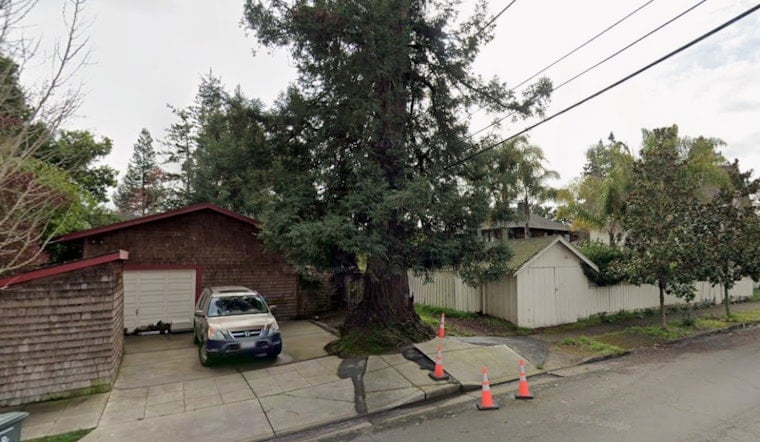
A 75-foot coast redwood known as Rosie has stood in Santa Rosa's McDonald Historic District for decades, its roots slowly heaving up a stretch of sidewalk on 13th Street. Now her fate rests with the city's Planning Commission, which will decide October 8 whether the tree comes down or stays standing after a neighborhood group appealed a city-approved permit to remove her.
The permit was approved in June by Santa Rosa city staffer Suzanne Hartman, who determined the tree had to be removed to properly repair and maintain the sidewalk, according to The Press Democrat. A group calling itself Friends of Rosie quickly appealed that decision, arguing that city staff had violated or selectively enforced city and state codes in granting the removal. Under Santa Rosa's tree ordinance, the appeal automatically stays the permit, meaning Rosie cannot be cut down while the case is pending, per eCode360.
The dispute traces back to 2023, when then-homeowner Barry Williams sought neighbors' help with the buckling sidewalk and the city later threatened to fine him over its condition, the Press Democrat reports. Friends of Rosie's appeal alleges that city staff failed to fix the sidewalk for four years after first declaring it a public hazard and code violation. Williams and his wife eventually sold the property to new homeowners after two years of negotiating with the city, according to the same reporting.
An Arborist Consensus Against Removal
Independent arborist evaluations have repeatedly found Rosie healthy. Merlin Schlumberger concluded the tree does not have structural deficiencies that would justify emergency removal and recommended evaluating alternative sidewalk solutions first, while arborist Arcangel Martinez recommended preserving the tree through site modifications and root-protection measures, according to the Press Democrat. Radio station KSRO reported this week that both independent evaluations recommended saving the healthy redwood rather than cutting it down.
Even the homeowners' own arborist reportedly found Rosie healthy and vigorous, effectively transporting water through its canopy, yet still recommended the tree be cut down. The new homeowners have concluded that alternative options would not solve the underlying problem long-term and have said they followed the city's process at every step, though they declined further comment to the Press Democrat while the appeal remains pending. The property has been listed for rent at $5,000 a month, per the same reporting.
Utility Lines and PG&E's Reversal
One early concern in the case involved overhead utility lines running near Rosie's trunk. Tom Murphy, a neighbor who became involved in the dispute in 2023 and has emerged as a leading advocate for the tree, said the lines sit 12 to 25 feet above the ground and run beside the trunk, while a homeowners' arborist assessment described utility lines passing through the canopy at about 45 feet. PG&E crews told Murphy that Rosie presented no immediate danger, and PG&E experts ultimately determined the tree posed no electrical danger, finding the wires alongside the trunk were heavily insulated low-voltage electricity, phone and internet lines. PG&E has since removed Rosie from its list of trees marked for removal, according to the Press Democrat.
A Wheelchair User's Unlikely Stand
Not everyone burdened by the broken sidewalk wants the tree gone. Kathleen Flanagan Childs, a wheelchair user living in the neighborhood, submitted a letter to city officials saying the root-lifted sidewalk is difficult for her to navigate, but she still opposes cutting down the tree and supports building a sidewalk bump-out instead, as reported by SFGATE. Her position echoes what Friends of Rosie has proposed to the city: a sidewalk bulb-out, a bridge over the roots, decomposed granite, or discontinuing the sidewalk altogether.
Santa Rosa officials have countered that a bulb-out could cause drainage issues and ponding, and city code does not authorize staff to require alternate sidewalk measures once a property owner seeks a tree-removal permit and the removal findings are met, per the Press Democrat. City arborist Misti Woods has said the severity of root-zone encroachment makes it difficult to determine whether sidewalk realignment is even feasible, since Rosie's root zone may prevent cutting roots to create space for realignment without harming the tree — and the root zone will keep growing even after any repair. Planning officials have described sidewalk repair without tree removal as only a temporary mitigation measure, while planning staffer Shelby Milanez has said the tree poses safety concerns for which the owners are responsible.
The Legal Tightrope Between Owner and City
The conflict sits at the intersection of two California legal obligations. State law under Streets and Highways Code Section 5610 makes property owners responsible for keeping sidewalks abutting their land safe, according to Stimmel Law. At the same time, California Government Code Section 835 allows cities to share liability for sidewalk injuries if they had notice of a dangerous condition and failed to fix it within a reasonable time, per Mehdipour Law. That dual exposure has put pressure on both the homeowners and the city to resolve the hazard, even as Santa Rosa's 36-year-old tree ordinance, enacted through Ordinance 2858 in 1990, protects heritage coast redwoods from removal absent storm damage, disease, or structural failure. The ordinance also prohibits unnecessary damage, careless treatment and arbitrary removal of trees, and recognizes their aesthetic benefits, windbreaks, summer shade and oxygen production.
Tom Murphy, who paid $1,033 in appeal fees and submitted a 50-page report to the Planning Commission, has been blunt about his view of the process. He said the permit approval was an illegal, unethical and immoral attempt to skirt the law and destroy a heritage monument. Friends of Rosie's appeal also alleges that Santa Rosa planners acknowledged a compliant alternative of rerouting the sidewalk around the tree rather than removing it.
Community Roots and a Wider Debate
Concrete was poured over Rosie's roots roughly 25 years ago, according to the Press Democrat, well before the current dispute began, and more than 250 neighbors have since signed a petition to save the tree. SFGATE reported that Friends of Rosie formed this spring and drew roughly 300 supporters altogether, including 60 formal letters sent directly to City Hall opposing the removal permit. Preservationists have also pointed out that many historic homes in the McDonald Historic District were originally framed with native redwood timber harvested around the same era Rosie took root, adding a layer of architectural symbolism to the fight, per SFGATE.
Rosie's supporters now extend beyond the Bay Area, the Press Democrat reports. Timothy Beatley, a University of Virginia professor who researches sustainable cities, has said large mature trees like Rosie moderate urban heat, sequester carbon, provide shade and cooling, and support habitat, and that cities increasingly turn to sidewalk bulb-outs to preserve trees while also calming traffic. Whether the Planning Commission will weigh those kinds of engineering compromises, or side with the city's staff-level determination, remains an open question heading into the October 8 hearing.



