

























































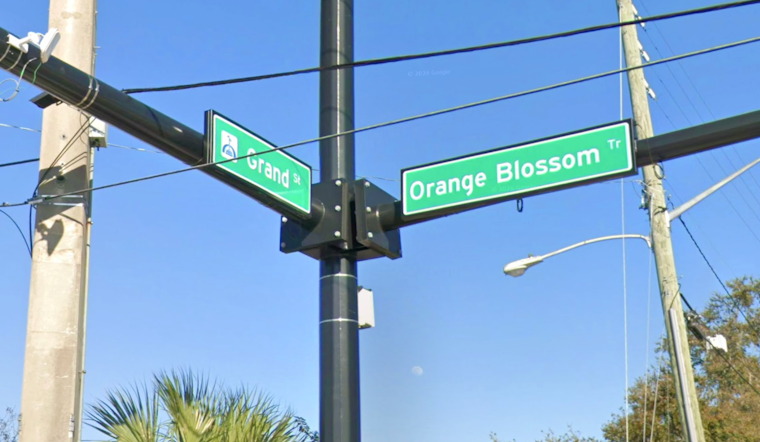
A 50-year-old Lake Mary man died just after midnight Wednesday after the pickup truck he was driving overturned on South Orange Blossom Trail near Grand Street in Orlando. The Florida Highway Patrol says he was taken to a hospital, where he was later pronounced dead. He had been driving a 2010 Dodge Ram pickup truck southbound on Orange Blossom Trail at the time of the crash.
According to WESH, troopers say the truck left the right side of the roadway and traveled onto the sidewalk before striking a traffic control sign and a concrete post. The vehicle then overturned, the station reports. Florida Highway Patrol has not said what caused the driver to leave the roadway, and the case remains under investigation.
Orange Blossom Trail's Troubled Safety Record
The stretch of highway where the crash happened sits along a corridor with a well-documented history of danger. Orange County's 2024 Vision Zero Action Plan named South Orange Blossom Trail, also known as U.S. Highway 441, the single most dangerous roadway corridor in the county, tallying 5,735 crashes and 265 people killed or seriously injured between 2018 and 2022, according to ClickOrlando.
Wednesday's crash marks the second fatal wreck on the corridor in just over two weeks. Hoodline previously reported on a deadly OBT crash near SR-417 that shut down the highway on July 20, when a driver ran a red light and struck a semi-truck.
Fatal single-vehicle crashes on the corridor aren't new, either. In July 2025, a 48-year-old driver was killed near Consulate Drive after losing control of his vehicle, sideswiping a box truck and striking the back of a semi-truck, according to WKMG.
Cities and County Push to Redesign the Corridor
Local agencies have been working to change that trajectory. The City of Orlando launched its USDOT-funded Connecting Residents on Safe Streets initiative, known as CROSS, in January 2025 to redesign six high-injury corridors, including a 1.65-mile stretch of Orange Blossom Trail, according to the City of Orlando.
Orange County has pursued its own fixes. The county completed 76 local traffic safety projects during the first year of its Accelerated Transportation Safety Program through July 2025, targeting high-risk arterial roads and pedestrian zones, per the Orange County Florida Newsroom.
Regional planners see the same pattern. MetroPlan Orlando's Regional Vision Zero framework found that High Injury Network corridors like U.S. 441 account for 47% of all people killed or seriously injured in crashes across Central Florida, according to MetroPlan Orlando.
How OBT's Fatalities Fit Into a Bigger Traffic Picture
Orange County recorded roughly 25,000 traffic crashes in 2025, resulting in about 18,900 injuries and between 162 and 168 deaths, an average of nearly 68 reported collisions a day, per HOV Law.
Statewide, Florida logged 366,300 crashes and 2,930 traffic fatalities in 2025, a 5.4% drop from the 3,098 fatalities recorded the year before, according to FindTheLawyers. Nationally, traffic deaths fell 3.8% in 2024 to 39,345, the first time the total dropped below 40,000 since 2020, per estimates from the National Highway Traffic Safety Administration.
Rollovers like Wednesday's remain especially dangerous for pickup drivers. Real-world crash research published in July found that while occupants of large pickup trucks benefit from the vehicle's mass, rollovers are among the most lethal single-vehicle crash types because of roof-crush dynamics and ejection risks, as reported by Jalopnik.
For now, Wednesday's crash adds another fatality to a corridor that state, county and city agencies have all flagged as one of Central Florida's most dangerous roads.





