

























































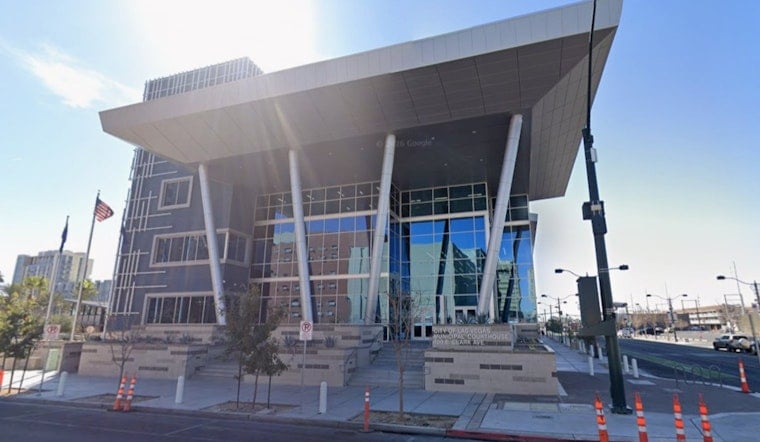
Joaneka Smith was pregnant and without stable housing in January when she faced a misdemeanor charge in Las Vegas Municipal Court. On Thursday, she stood among eight graduates of the court's first-ever Community Court class, her case dismissed, her job upgraded to a promotion, and a stroller and laptop in hand thanks to the program.
“I was pregnant; I was scared. I thought I was gonna go to jail,” Smith said, according to the Las Vegas Review-Journal. Instead of jail time, the court connected her with an apartment, food assistance, vital documents, tax literacy help and a stroller and laptop to help her care for her child. The city officially confirmed that Mayor Shelley Berkley and Municipal Court Chief Judge Kelly Giordani were set to attend the inaugural graduation ceremony, held Thursday at the Municipal Courthouse at 100 E. Clark Ave.
Community Court is a specialty program designed to help homeless people avoid falling back into the cycle of arrest and incarceration, offering eligibility to people facing charges tied to homelessness — things like trespassing, misuse of a bus stop or impeding traffic. The program has received more than 150 referrals since January and currently has 13 people working through its services, according to the same account. It runs anywhere from six months to a year, prioritizing defendants dealing with substance abuse issues and placing participants under a safe roof, including treatment facilities, while they work toward stability.
Graduates Share Jobs, Housing and a GED in Progress
The ceremony introduced five of the eight graduates in person. Trenton Brooks now holds two jobs, is working toward his GED diploma, and planned to obtain his driver's license Friday. Anthony Saldana, who now manages a restaurant, has secured both a job and a home. Oscar May, who lives with family, obtained a job and is now learning to budget his earnings and open a savings account as the program helps him find a place of his own.
Tiffany Taylor, a front desk agent at a Strip property, obtained housing, childcare, employment and assistance for her mother through the program. Rounding out the first graduating class were Amber Gowan, Amanda Keck and Madgela Swindell. Assistant Court Administrator Cassandra Diaz said the program connects individuals with services through an intensive process involving regular status checks, an approach that program overseer Anthony Ruggiero manages day to day.
City Leaders Frame the Program as a Test of Follow-Through
Berkley said the city should make sure graduates succeed and go on to make a difference in their own lives and in their community, per the Review-Journal's report. Giordani, the municipal court's chief judge, said the program helps judges understand participants' circumstances so they can better help them — a shift in approach from a courtroom focused purely on punishment to one weighing what put a defendant on the street in the first place.
That shift is backed by dedicated funding streams. Under Nevada Revised Statute 176.0613, the state assesses a mandatory $7 fee on most misdemeanor convictions, excluding metered parking tickets, specifically to fund specialty court programs like this one. Separately, Nevada Revised Statute 176A.500 gives judges explicit authority to extend a misdemeanor or gross misdemeanor defendant's probation by up to 12 months if that extra time is needed to finish a specialty court program. The Las Vegas City Council has also approved a $400,000 federal grant to help fund five specialty courts citywide, and Community Court joins six other specialty dockets the city already manages.
Growing Homeless Numbers Add Urgency
The graduation lands as Clark County grapples with a rising homeless population overall. Results from the county's January Point-in-Time census, released in July, found 8,859 people experiencing homelessness across Clark County — a 12% increase from 2024 — with 5,017 people, or 57%, living unsheltered in places not meant for habitation, according to the Las Vegas Review-Journal. At the same time, Clark County officials reported a nearly 25% drop in the chronically homeless population compared to 2024, a change News 3 Las Vegas attributed to expanded emergency shelter capacity and permanent supportive housing programs.
The jurisdictional lines matter here. Las Vegas Municipal Court, where this Community Court operates, handles misdemeanor cases occurring strictly within the city's municipal boundaries, while offenses committed in unincorporated Clark County or along the Las Vegas Strip fall under the separate Las Vegas Justice Court, according to the Las Vegas Defense Group. The Justice Court runs its own community court program and celebrated its own graduates back in January, a separate effort from the municipal program marking its first class Thursday.
A Financial Case That Predates the Program
The push toward diversion rather than jail has roots in years-old cost analysis. Civil rights advocates noted in a November 2019 policy analysis that Las Vegas Municipal Court spent roughly $2.5 million in fiscal year 2018-19 on court and detention proceedings tied to unhoused defendants, with municipal jail costing about $170.60 per inmate per night compared to $58 per night for permanent supportive housing, according to the Nevada Independent. That gap has fueled arguments for programs like Community Court, which aims to move people into housing and job training rather than repeat bookings.
Nevada's specialty court model isn't new — the City of Reno created its own Community Court session back in March 2019, held at the Downtown Reno Public Library to connect repeat nuisance offenders with social services, according to the Nevada Division of Public and Behavioral Health. Las Vegas has also drawn federal attention for the effort: Nevada U.S. Senator Catherine Cortez Masto submitted a $484,000 request in fiscal year 2027 community project funding to upgrade the Municipal Court's security infrastructure specifically to support expanded Community Court operations, according to her office.



