

























































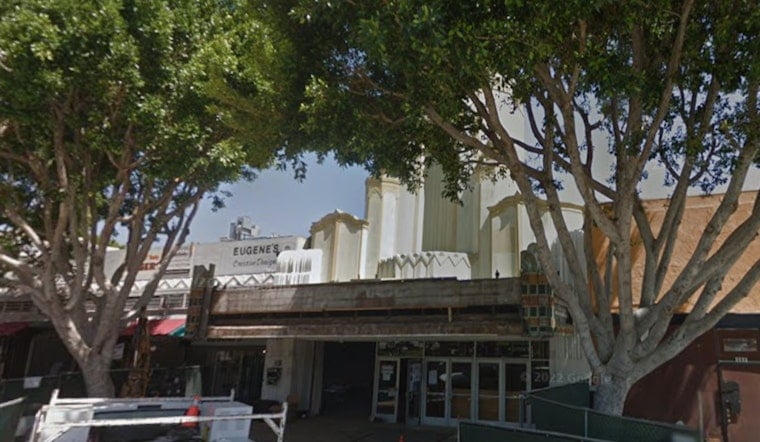
A nearly 100-year-old movie palace in Leimert Park is finally reopening its doors this week, capping off a $40 million restoration that outlasted foreclosure, fire, and years of stalled funding. The Vision Theatre at 3341 W. 43rd Place will host an official ribbon-cutting ceremony at 5 p.m. Thursday, complete with live music, dance performances, and a screening of the Academy Award-winning animated short Hair Love by Matthew A. Cherry.
City officials expected to attend include Mayor Karen Bass, Councilmember Heather Hutt, and other Los Angeles City Council members, along with representatives from the Los Angeles Department of Cultural Affairs, according to KTLA. Online registration for the ceremony has already closed, the outlet reports. A post on the Vision Theatre's Facebook page states that the celebration commemorates the completion of the theater's restoration and renovation and honors the partners who helped make it a world-class performing arts center, per the same report.
From Movie Palace to Municipal Landmark
The building has cycled through several identities since it first opened as the Leimert Theatre on April 21, 1932. Designed by the architectural firm Morgan, Walls & Clements — the same firm behind the Wiltern and El Capitan theatres — and proposed by developer Walter H. Leimert, the venue blended Art Deco and Spanish Colonial Revival styles, according to the Los Angeles Conservancy. It was originally built to seat 1,100 moviegoers, though seating was later reconfigured down to 729 seats to allow for broader spacing between rows for live performances, per Wikipedia.
Between 1968 and 1990, after its run as a first-run movie house, the building was owned by Jehovah's Witnesses and served as an assembly hall known as The Watchtower, the Conservancy notes. Actress Marla Gibbs then purchased the property in 1990 for more than $2.5 million, aiming to establish a Black cultural center and youth arts academy, and the theater was renamed in her honor. But per KTLA, the venue fell on hard times during the economic downturn of the early 1990s, and the Los Angeles Times reported that the strain following the 1992 Los Angeles civil unrest ultimately led to bank foreclosure in 1997. The City of Los Angeles took control of the property in 1999, according to events.com.
A Restoration Decades in the Making
The city's investment in the building has unfolded in phases. An $11 million Phase I renovation, completed in 2011 using Proposition K funds, restored the theater's front portico, lobbies, and upper event spaces, according to an LA City Clerk transmittal. That set the stage for the larger $40 million revitalization project that the Vision Theatre Performing Arts Center has now completed, per KTLA.
The restoration wasn't without a close call. On April 21, 2020 — the 88th anniversary of the theater's original opening — a greater-alarm fire destroyed an adjacent vacant commercial building, though more than 100 LAFD firefighters kept the blaze from spreading, according to the Los Angeles Fire Department. Damage to the Vision Theatre itself was largely confined to minor scorching on the exterior marquee. Inside, the theater's hand-painted ceiling mural by artist Anthony Heinsbergen underwent specialized conservation, plaster repair, stenciling, and metal leaf application as part of the restoration, per EverGreene, the conservation firm involved in the project.
New Management, New Chapter
The theater's next act comes with a new operating structure. In April 2025, the Los Angeles City Council authorized a five-year co-management agreement with the nonprofit WACO Theater Center, co-founded by Tina Knowles, at no cost to the city, according to another LA City Clerk transmittal. Under the agreement, WACO will direct artistic productions, youth arts education, and front-of-house operations, while the city's Department of Cultural Affairs continues to maintain the facility.
The reopening also arrives alongside a broader shift in the neighborhood's connectivity. The Vision Theatre sits adjacent to the Metro K Line's Leimert Park Station, which opened in October 2022 and features a concourse mosaic mural by artist Mickalene Thomas depicting the theater itself, according to Metro Art. Leimert Park Village, master-planned in 1927 across 600 acres by Walter H. Leimert, grew by the late 1960s into a premier hub for Black art, business, and community life in Los Angeles, per the Historical Marker Database — a legacy that the theater's reopening now folds back into.


