
























































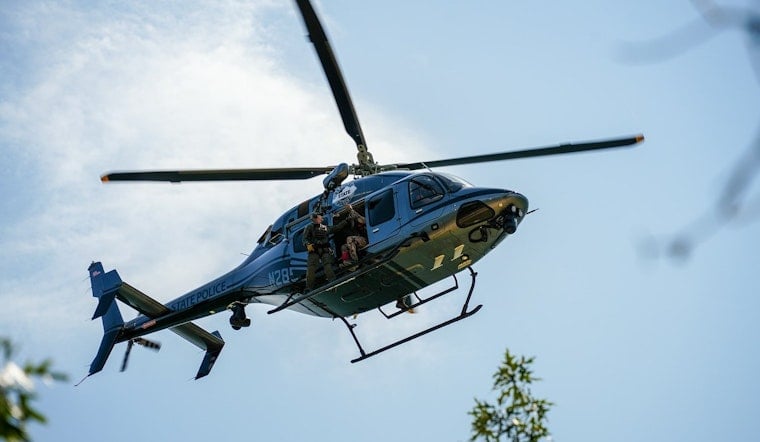
A Lexington man is facing a string of criminal charges after Kentucky State Police say he pointed a laser at a KSP helicopter as it flew back to Frankfort early Tuesday following a rescue mission at Red River Gorge. Troopers say the Bell 429 helicopter was targeted around 12:30 a.m. Aug. 25, prompting a police response.
According to Kentucky State Police, the aircraft was returning from a successful search-and-rescue operation at Red River Gorge when it was targeted. Pilots reported a moped near West Loudon Street, and KSP troopers working with Lexington Police Department officers responded to an alley near North Broadway Street, where they found 39-year-old Marcus R. Smith. As reported by KY State Police
on social media, the arrest involved KSP Post 12 troopers.
Smith now faces charges of Laser/Vision Interference, Tampering with Physical Evidence, No Operator's License for a Moped, Criminal Trespassing, No Registration, and Failure to Maintain Insurance, per the state police account. Investigators say potential federal charges are also pending, which would expose Smith to additional prosecution beyond the state case.
What Kentucky and Federal Law Say About Aiming Lasers at Aircraft
Kentucky law is direct on this point. Under Kentucky Revised Statutes § 183.887, it is illegal to knowingly direct light from a laser device or any other source at an aircraft if that light could interfere with a pilot's vision, according to Justia Law.
Federal law raises the stakes considerably. Knowingly aiming a laser pointer at an aircraft or its flight path is a felony under 18 U.S.C. § 39A, carrying up to five years in federal prison and a fine as high as $250,000, per the Federal Aviation Administration. The FAA can also impose separate civil penalties of up to $32,646 per violation.
A Familiar Pattern for KSP Aircrews
This is not the first time a KSP helicopter crew has been targeted mid-mission. In November 2025, a KSP helicopter searching for a missing child near Mayslick was struck by laser light, an incident that led to wanton-endangerment charges and a laser/vision-interference offense at the time. The recurrence underscores how vulnerable low-altitude, nighttime search-and-rescue flights can be to ground-level interference.
Kentucky lawmakers have also moved to strengthen protections for emergency responders more broadly. Under the state's HALO Act, which took effect in July 2026, a 25-foot safety buffer zone now applies around first responders performing official duties, with criminal penalties for anyone who interferes with or harasses emergency personnel, according to Kentucky Senate Republicans.
Laser Strikes Remain a Persistent National Hazard
Nationally, the numbers tell a mixed story. Pilots reported 10,994 laser strikes across the United States in 2025, a 14% drop from 12,840 incidents in 2024 and down further from a record 13,304 in 2023, based on FAA data. Even with that decline, the agency has documented 328 eye injuries nationwide tied to laser illumination since it began tracking such strikes in 2010, as noted by General Aviation News. Laser light entering a cockpit can cause temporary visual disturbances, flash blindness, glare, retinal damage, and disorientation, hazards that are especially dangerous during low-altitude nighttime operations like the one KSP's crew was completing early Tuesday.
Lexington's case echoes similar recent incidents in the region, including a Nashville chopper lasering case that also produced felony and evidence tampering charges. The KSP helicopter involved in this incident had just come from the Red River Gorge, where crews had been assisting with rescue efforts in the area.





