

























































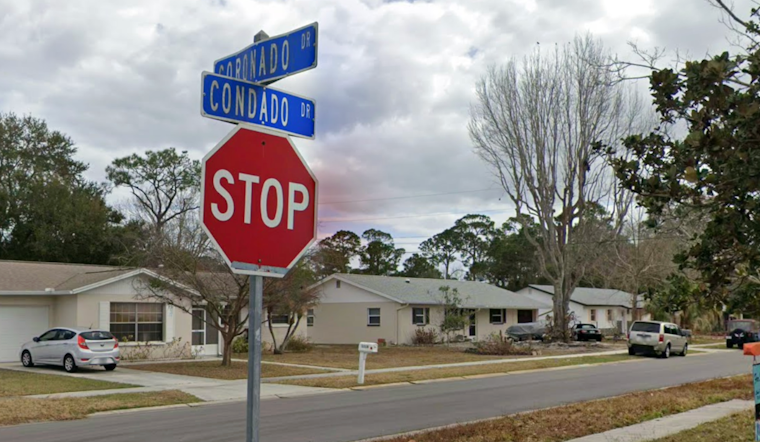
A 70-foot pine tree outside Curtis Romohr's Rockledge home exploded during last weekend's storm, sending a 30-pound log spiked with sharp wood blasting through a window and destroying the desk where he usually sits to watch bad weather roll in. Wood shards pierced multiple windows of the house on Condado Drive, and Romohr says he is thankful to be alive.
The lightning strike hit the pine tree directly on Saturday, August 22, shattering it into huge pieces that rocketed across the property, according to FOX 35 Orlando. The station reports the blast did not stop at the windows — it also fried the home's air conditioning unit, cable box and Wi-Fi system, leaving Romohr and his roommate to handle cleanup without air conditioning while they waited on technicians.
Romohr, who works as a professional landscaper and tree trimmer, has spent his career around trees but says this brush with one was unlike anything he had experienced. He and his roommate happened to leave the house to grab food shortly before the strike hit, a spontaneous decision that likely kept them out of the log's path. He told the station he had never been scared of lightning before, but that the close call left him rattled.
Why Trees Explode Under a Direct Hit
The violence of the blast comes down to basic physics. When lightning's electrical current surges through a tree, it superheats the sap and moisture inside within milliseconds, turning it to steam and building pressure that solid wood simply cannot contain, according to research cited by WTTW. That moisture is concentrated in a tree's cambium layer, which under a sudden electrical charge behaves something like a pipe bomb, turning the trunk into shrapnel.
Florida's Lightning Alley
Central Florida's Space Coast, including Brevard County, sits inside a corridor meteorologists call Lightning Alley, where Atlantic and Gulf sea breezes collide most summer afternoons and touch off intense thunderstorm clusters, per AccuWeather. Vaisala research has identified the Palm Bay–Melbourne metro area as one of the most lightning-prone metropolitan zones in the country. That tracks with statewide numbers: Vaisala Xweather's 2025 Annual Lightning Report found Florida recorded the highest lightning density of any state, at 305 lightning events per square mile, even as total U.S. strikes climbed 20 percent to 252 million.
Scientists at the University of Florida's International Center for Lightning Research and Testing have also linked rising global temperatures to increased atmospheric instability, which could mean more frequent lightning strikes across the state over time, according to WUFT News. That outlet's analysis found Florida saw a 27 percent increase in lightning strikes in just the first nine months of 2025 compared with the full-year total for 2024.
The Hidden Risk of Watching Storms From a Window
Romohr's habit of sitting near a window during storms is exactly the behavior the National Weather Service warns against. The agency's indoor safety guidelines urge residents to stay away from exterior windows, doors and electrical equipment during thunderstorms, cautioning that watching from a window exposes people to direct strikes and flying debris. The agency's national safety motto, “When Thunder Roars, Go Indoors,” is meant to remind people that indoor window areas remain hazardous even once they are inside.
The National Weather Service also notes that standard household surge protectors offer no defense against a direct strike, since lightning delivers millions of volts capable of bypassing ordinary protective strips. Current typically enters a home by jumping through utility lines, external wiring or nearby grounded structures, which explains how the strike outside Romohr's house managed to disable his air conditioning, cable box and Wi-Fi all at once.
Nationwide, lightning kills an average of 20 to 30 people and injures hundreds more each year, according to the National Oceanic and Atmospheric Administration, with Florida historically recording more lightning casualties than any other state. About 90 percent of strike victims survive, the agency notes, though many are left with long-term neurological or physical complications.
Romohr's home is the latest in a string of close calls reported across Central Florida this month. Hoodline has covered a Palm Coast mother's account of lightning striking inside her new home, and separately reported on a Winter Park family whose close-range strike triggered a heart device. A similar case last summer saw a lightning-struck tree fall on a truck in nearby Seminole County, sending a man to the hospital.





