

























































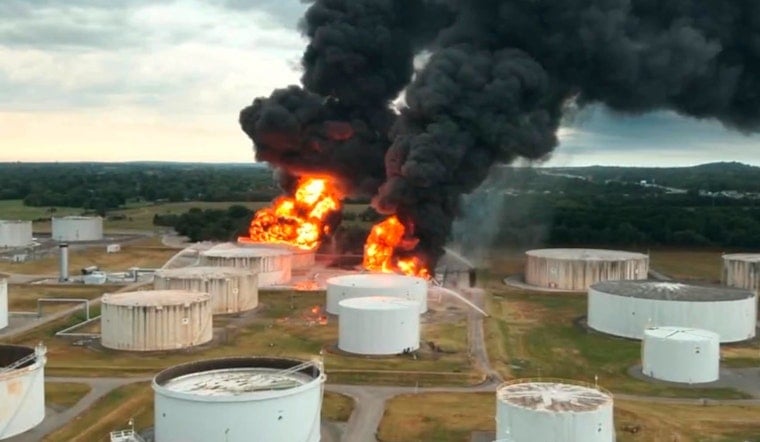
A lightning strike touched off a fire at Explorer Pipeline's storage terminal in Glenpool on Monday, igniting two tanks and prompting authorities to order a mandatory evacuation for residents on the east side of U.S. Highway 75 between West 126th Street and West 131st Street South. A community shelter was set up at Glenpool Church of Christ as fire crews worked to keep the flames from spreading further.
According to KTUL, emergency crews responded to a call about an explosion at the Explorer Pipeline facility near Highway 75 and West 126th Street, and two tanks remained on fire as of the station's report. Police said no other fires and no injuries had been reported. The Glenpool Police Department shut down West 126th Street at South Elwood Avenue and at Casper Street, and also closed 126th Street South between Casper Avenue and Elwood, while surrounding businesses and residences were evacuated.
Highway 75 itself remained open, per the station's report, though drivers were asked to avoid the affected area and to use caution if traveling through it. Alternate routes were available at West 121st Street South and South Elwood Avenue. Explorer Pipeline said additional fire response resources were en route, and the company reported that local fire departments and emergency response teams had responded to and secured the site.
A School District On Precautionary Lockdown
Glenpool Public Schools began sheltering in place as a precaution while the fire burned nearby, the same report noted. The shelter-in-place order adds another layer of urgency for a district that has already been at the center of highway-safety concerns along the Highway 75 corridor this year — concerns that led Oklahoma lawmakers to advance a school-zone speed crackdown establishing 45 mph reduced-speed zones near Glenpool schools on high-speed state highways.
Not The First Fire At This Tank Farm
Monday's blaze is not the first time lightning has caused serious trouble at this exact terminal. On June 12, 2006, a lightning strike ignited Tank 373 at the same Explorer Pipeline Glenpool site, destroying roughly 23,000 barrels of gasoline in an 11-hour fire that required extensive foam application and a mutual-aid response, according to Firehouse Magazine. Firefighters in that earlier incident kept adjacent tanks cool and transferred 3.9 million gallons of fuel out of the burning vessel to prevent a catastrophic tank collapse.
The Glenpool tank farm complex has a broader history of industrial fire hazards beyond Explorer Pipeline's own footprint. On April 7, 2003, an explosion and fire at the adjacent ConocoPhillips Glenpool South tank farm burned for 21 hours and forced school evacuations, and an investigation by the National Transportation Safety Board found that fuel overfilling had allowed hydrocarbon vapors to reach an ignition source.
A Massive Energy Hub With Deep Roots
The Explorer Pipeline breakout station in Glenpool covers 120 acres and operates under state environmental permits allowing a maximum throughput of 720,000 barrels per day across more than 30 storage tanks, according to the Oklahoma Department of Environmental Quality. Breakout stations like this one act as surge-control points, letting operators balance line pressure and product movement across interstate pipeline segments. Explorer Pipeline, headquartered in Tulsa, runs an 1,872-mile interstate system moving gasoline, diesel and jet fuel from Gulf Coast refineries to Midwestern points as far north as Hammond, Indiana.
Glenpool's role as an energy hub traces back more than a century, to the 1905 discovery of the Glenn Pool oil field, which at its peak produced more than 119,000 barrels a day and helped transform the Tulsa region into a global energy center, per the Glenpool Chamber of Commerce. The town was formally established the following year. That legacy is part of why a facility moving hundreds of thousands of barrels daily sits so close to homes, schools and a major highway corridor today.
Safety Measures And Ongoing Preparedness
State air quality permits updated in March 2024 require internal floating roof tanks and vapor combustion units at the Glenpool breakout station to limit volatile organic compound emissions during storage and transfer, per Oklahoma Department of Environmental Quality records. Internal floating decks sit directly on the surface of stored liquid product, a design meant to prevent the buildup of flammable vapor spaces that can ignite when lightning strikes.
Explorer Pipeline has also invested in emergency preparedness beyond its own equipment. The company regularly sponsors Glenpool firefighters to complete week-long industrial fire and hazard training at Texas A&M's Brayton Fire Training Field, covering specialized foam application, high-volume monitor operations and tank cooling tactics for large-scale petroleum fires.
Traffic Headaches Layer On Top Of Construction
The road closures around West 126th Street add to an already complicated traffic picture in Glenpool. Ongoing Oklahoma Department of Transportation construction along U.S. Highway 75 — including bridge work at 141st Street — has been causing lane restrictions and detours through the area since at least last August, as Hoodline has previously reported. Highway 75 remains the primary commercial and commuter corridor linking Glenpool to downtown Tulsa, meaning any disruption near the pipeline terminal ripples quickly through regional traffic.
KTUL said it would provide updates as more information becomes available. As of the station's report, it remained unclear whether the tanks involved Monday were equipped with the newer floating-deck or lightning-mitigation upgrades required under the 2024 state permits.





