

























































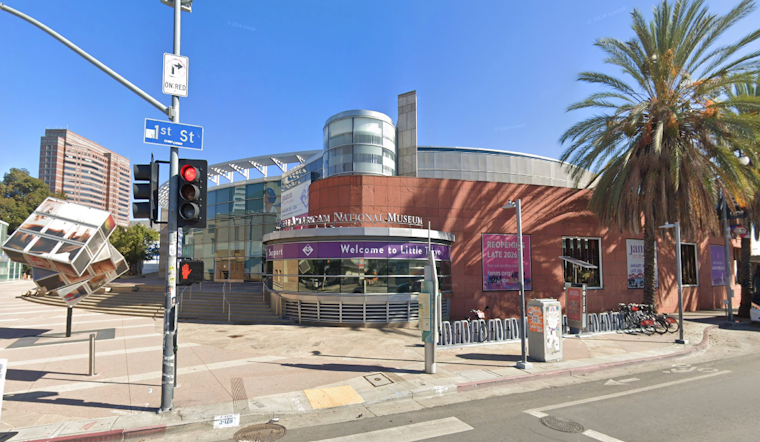
The Japanese American National Museum will reopen its renovated Pavilion in Little Tokyo on January 23, 2027, capping a three-year closure and a $108 million fundraising campaign that reshapes how the institution tells the story of Japanese American history. The museum will resume regular hours of 11 a.m. to 5 p.m. Tuesdays through Sundays, with extended hours until 8 p.m. on Fridays starting that same day.
The reopening date and scope of the renovation were detailed by MyNewsLA.com, which reported that the Pavilion has been closed since January 2024. During that closure, JANM kept a public presence in Little Tokyo through its adjacent National Center for the Preservation of Democracy, which opened in 2005 and offered civic programming while the main building sat shuttered, according to LAist.
A New Core Exhibition Spanning 160 Years
The renovation's centerpiece is a new core exhibition examining 160 years of Japanese American history, replacing the museum's longtime signature show, Common Ground: The Heart of Community, which ran continuously in the Pavilion for 25 years after the building's 1999 debut and chronicled 130 years of history from early Issei immigration through post-war resettlement, per the Densho Encyclopedia. The new exhibition will cover prewar immigration and community life, World War II incarceration, postwar resettlement, the campaign for redress, and the Asian American movement, the museum's reporting shows.
It will also introduce stories from the Tule Lake Segregation Center and explore Japanese American experiences tied to anti-Muslim sentiment following the September 11, 2001 terrorist attacks, attacks on immigrant communities, and the recent surge in anti-Asian hate. A restored barrack from the Heart Mountain incarceration camp in Wyoming will remain part of the exhibition. That structure was originally dismantled in Park County, Wyoming, and moved to Los Angeles in 1994 by 32 volunteers, according to the Rafu Shimpo.
The Camp Behind the Barrack
Heart Mountain Relocation Center housed more than 14,000 incarcerated Japanese Americans between 1942 and 1945, briefly becoming the third-largest populated community in Wyoming, per the National Endowment for the Humanities. It was one of ten inland concentration camps the federal government established after President Franklin D. Roosevelt signed Executive Order 9066 on February 19, 1942, authorizing the forced removal and incarceration of roughly 120,000 people of Japanese ancestry, about two-thirds of them American citizens, according to the National Archives.
The redress story the new exhibition will trace culminated in 1988, when President Ronald Reagan signed the Civil Liberties Act, granting a formal federal apology and $20,000 in tax-free restitution to each of the 82,219 surviving incarcerees, the Densho Encyclopedia notes. Norman Mineta, the former U.S. Secretary of Transportation and a former camp incarceree who co-sponsored that legislation in Congress, chaired JANM's Board of Trustees until his death on May 3, 2022, after which former Los Angeles County CEO William Fujioka took over board leadership, per the Pacific Citizen.
New Galleries and a Publicly Accessible Resource Center
The renovated Pavilion will feature new first-floor galleries housing In the Future We Call Now: Realities of Racism, Forging Democracy, alongside renovated second-floor galleries presenting Pictures of Belonging: Miki Hayakawa, Hisako Hibi, and Miné Okubo, per MyNewsLA.com's reporting. The Hirasaki National Resource Center, which will be publicly accessible, is set to feature art and design from the museum's permanent collection, archival viewing areas, and interactive StoryFiles technology.
The Kosasa Education Center will gain two new classrooms, and the broader renovation includes a new visitor entrance, upgrades to public spaces, and a new heating, ventilation and air conditioning system designed to help preserve JANM's collection of more than 160,000 artifacts. The original Pavilion, an 85,000-square-foot building, opened January 23, 1999, following a $45 million capital campaign and was designed by Japanese American architect Gyo Obata, who avoided wartime incarceration by enrolling in architecture school in St. Louis while his family was imprisoned at the Topaz camp in Utah, per the Densho Encyclopedia.
From a Wartime Temple to a $108 Million Campaign
JANM's roots run deeper than the Pavilion itself. The museum originally opened to the public in May 1992 inside Little Tokyo's historic 1925 Nishi Hongwanji Buddhist Temple, a building that served in 1942 as a processing and storage site for Japanese Americans forced into camps and in 1945 as a temporary hostel upon their return, according to the Densho Encyclopedia. The city of Los Angeles leased that former temple structure to the museum for $1 a year to help establish the institution.
The renovation was funded through JANM's Our Promise campaign, which raised $108 million from roughly 33,000 donors nationwide as of December 31, 2025, surpassing its expanded goal on the strength of major gifts including a $10 million grant from philanthropist MacKenzie Scott in 2021, according to The Philanthropist's Notebook. JANM launched the public phase of that campaign in August 2023 to fund the campus redesign and expand its endowment.
“Its reopening launches the museum into a new era that brings American stories to life and reflects the full richness of our shared history,” JANM President and CEO Ann Burroughs said, per MyNewsLA.com's reporting. Museum officials plan to announce preview events and opening celebration activities this fall, though specific dates have not yet been released.



