

























































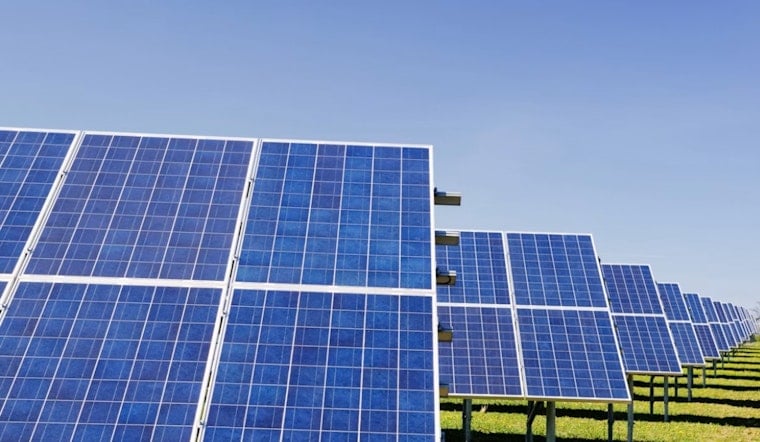
Beneath more than 2,200 solar panels rising eight feet above the soil at Chatfield Farms in Littleton, rows of tomatoes, cucumbers, peppers, and sunflowers are thriving in the dappled shade cast by Denver's newest clean-energy installation. The 1.2-megawatt array does double duty: it generates power for the surrounding gardens and schools while shielding crops from the punishing Colorado sun, and every pound of food it produces is given away to families who need it.
The site, known as the Chatfield Farms Solar Garden, sits on three growing acres and is producing hundreds of pounds of produce every week, according to Denver7. Lauren Hazlett, the solar garden's head grower, told the station that tomatoes, cucumbers, and peppers all benefit from a bit of shade in Colorado's high-intensity sun, and that the elevated panels let farmers plan their workday around when shadows fall across the beds.
“It's increasing food access for people who don't have access to it,” Hazlett said, per the same report. All of the food grown at the site — 100% of it — is donated to hunger relief organizations across the Denver metro area, the station notes.
A Living Laboratory Alongside the Crops
The solar garden isn't just a farm — it's an active research site. Josie Hart, associate director of sustainable agriculture at Denver Botanic Gardens and the person who oversees the installation, said many crops are actually outperforming their counterparts grown in full sun outdoors, the Denver7 report states. Hart works with the National Lab of the Rockies, which documents how different crops grow under shaded versus non-shaded conditions as part of the broader study of agrivoltaics — the practice of combining solar energy production with farming.
That research role has drawn national attention beyond Littleton. The National Renewable Energy Laboratory, also referred to as the Laboratory of the Rockies, partnered with Denver Botanic Gardens to collect long-term data on crop performance, soil moisture, microclimates, and panel efficiency at Chatfield Farms, using the site as a primary field station to shape agrivoltaic models nationwide, according to the National Lab of the Rockies. “As the world gets hotter and it's harder to grow crops, this kind of co-location of agriculture and energy solutions is going to become more and more important,” Hart said, per Denver7's reporting.
Panels Engineered to Dodge Hail and Share Power
The panels themselves are mounted eight feet high with single-axis tracking, letting tractors and other farm equipment pass directly underneath while allowing the array to rotate out of the way of severe weather like hail, according to The Colorado Sun. The array generates roughly 1 million kilowatt-hours annually. Denver7 reports that 20 percent of that power runs Chatfield Farms and part of Denver Botanic Gardens' operations, while the remaining 80 percent is donated to low-income families across Denver through Energy Outreach Colorado, which administers discounts on Xcel Energy electric bills for households needing energy assistance.
Separate reporting from the Colorado Sun offers a slightly different breakdown of that energy split, describing 250,000 kWh used locally — enough to let Chatfield Farms eliminate natural gas lines in favor of electric air-source heat pumps — and 750,000 kWh sent to the grid to subsidize bills for 150 income-qualified Denver Public Schools families. The two accounts describe the same underlying arrangement using different figures and framing, but agree that the bulk of the array's output flows toward assistance for families who need it.
Funded by a Voter-Approved Climate Tax
Denver taxpayers put $4.7 million toward building the array and its access roads through the city's voter-approved Climate Protection Fund sales tax, which Denver voters approved in 2020 to fund local clean energy and equity initiatives, with additional grant funding from the Colorado Department of Local Affairs, per the Colorado Sun. The project marks the 12th solar garden funded through Denver's Office of Climate Action, Sustainability and Resiliency, an office that has also installed solar canopies over Denver Public Schools parking facilities as part of its broader distributed-solar strategy.
Colorado Governor Jared Polis and Denver Mayor Mike Johnston held a joint ribbon-cutting ceremony at the site on September 25, 2024, formally opening it as what state and city leaders positioned as a flagship demonstration for regional clean energy policy, according to a statement from the Colorado Governor's Office.
State Law Backs the Dual-Use Farming Model
Colorado lawmakers have moved to encourage more projects like this one. Senate Bill 23-092, enacted in 2023, established a state agrivoltaics grant program run by the Colorado Department of Agriculture and created property tax exemptions for solar equipment used in dual agricultural operations, according to the Colorado Department of Agriculture. The legislation provided $1 million over its first two fiscal years to study agrivoltaic benefits and tradeoffs statewide.
Agrivoltaic systems can cut agricultural water consumption by up to 40 percent while boosting total land productivity by as much as 30 percent in semi-arid environments like Colorado, per the National Caucus of Environmental Legislators — a benefit tied to how elevated panel canopies slow the rapid evaporation caused by the state's high solar intensity and dry conditions.
Chatfield Farms itself spans 700 acres along Deer Creek in Jefferson County, functioning as both a native plant refuge and working farm managed in cooperation with the U.S. Army Corps of Engineers, with historical ranch structures dating back to the 1800s, according to Denver Botanic Gardens. Hoodline has previously reported that the 700-acre property contributes to the gardens' 1.5 million annual visitors.





