

























































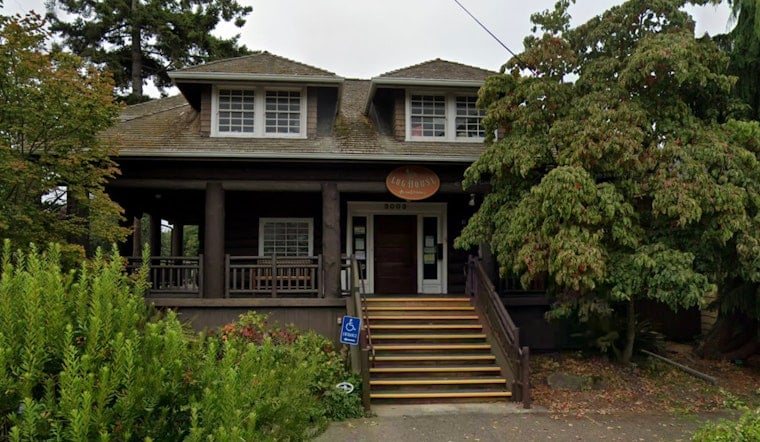
The Log House Museum in West Seattle cut the ribbon on a new permanent exhibit this week, inviting visitors to look past the familiar tale of the 1851 Denny Party landing and into a much wider sweep of Duwamish Peninsula history. Called “Beyond Alki,” the exhibit folds in native history, the 1978 wreck of the West Seattle Bridge, and even a corner devoted to a local record store owner, all inside a building that is itself a piece of the peninsula's past.
The grand-opening event included a ceremonial ribbon cutting and cake, as reported by West Seattle Blog. Kathy Duncan, president of the Southwest Seattle Historical Society board, discussed the sponsors that helped make Beyond Alki a reality and spoke to the exhibit's intended appeal to a wide variety of museum visitors, according to the outlet's coverage of the event. Elizabeth Rudrud, executive director of the Southwest Seattle Historical Society, framed the exhibit as a new way to discover West Seattle history.
A Museum Built From the Peninsula's Own Trees
The museum building itself predates the exhibit inside it by more than a century. It was originally built in 1903 to 1904 as a carriage house and outbuilding for the historic Fir Lodge, later known as the Alki Homestead Restaurant, using old-growth Douglas fir logs, per the Southwest Seattle Historical Society. The structure, now a designated City of Seattle Historic Landmark sitting one block from Alki Beach, was built from trees that grew on the peninsula before Euro-American settlement and originally housed horses along with living quarters.
The society that operates the museum was founded in 1984 by West Seattle real estate broker Elliott Couden to preserve heritage and advocate for communities across the entire Duwamish Peninsula, including West Seattle, White Center, and South Park, with help from South Seattle Community College. Beyond Alki represents the culmination of more than two years of interpretive planning, and the museum closed for two months to install new displays and landmark exterior signage ahead of the opening, the historical society notes.
From a Crashed Freighter to a Concrete Bust
Among the exhibit's items covering other transportation history is a concrete bust tied to one of the region's stranger transit stories. Capt. Rolf Neslund crashed the freighter Chavez into the West Seattle Bridge on June 11, 1978, rendering it inoperable and clearing the way for the current high bridge, according to West Seattle Blog. The so-called Rolf Neslund Memorial Shrine bust, made in 2020 by an anonymous artist, was saved by local resident Rose Feliciano after repeated vandalism; she formally donated it to the museum in June.
Beyond Alki also includes native history, settler history, historic commemorations, historic recreation, and memories of celebrations, alongside audio recordings visitors can listen to throughout the space. Kristina Pearson, a representative of the Duwamish Tribe, said at the opening that “Chief Seattle would be proud of us,” invoking the leader of the Suquamish people. Leonard Forsman, chair of the Suquamish Tribe, emphasized the importance of sharing tribal culture in the museum and beyond, per West Seattle Blog's account of the event.
Guthrie, Seeger and a Record Store Owner Get Their Due
The exhibit's audio experience reaches back to 1941, when Woody Guthrie and Pete Seeger recorded the folk songs “Talking Columbia” and “Jackhammer Blues” while staying as houseguests at the Alki Point home of restaurateur and musician Ivar Haglund, according to the historical society. The pair were touring Pacific Northwest union halls with the Almanac Singers at the time. Beyond Alki also includes a special recording of a turn-of-the-20th-century classic and a corner devoted to Matt Vaughan, who is associated with Easy Street Records.
The exhibit's title reaches even further back than 1941. Long before Euro-American settlers arrived in 1851 and named the area “Alki,” a Chinook Jargon term meaning “by and by,” Coast Salish peoples knew the peninsula as sbaqʷabqs, a Lushootseed word meaning “prairie point,” per the historical society. Indigenous residents maintained the grassy coastal plains through seasonal burning before colonial land grants reshaped the landscape.
How the Exhibit Came Together
Natasha Varner, associated with 4Culture, praised the historical society's account of the area's complex history, West Seattle Blog reported. Financial sponsors and grantors backing Beyond Alki include 4Culture, Nucor Steel, the Hugh and Jane Ferguson Foundation, the Maritime Washington National Heritage Area, the City of Seattle Office of Arts and Culture, the Norcliffe Foundation, Mechanics Bank, the City of Seattle Department of Neighborhoods, and the West Seattle Garden Tour, according to the historical society.
West Seattle's civic story has been a recurring theme for the museum. From 2019 to 2020, the Log House Museum hosted “Between the Lines: The Power and Parallels of the West Seattle Annexation,” an exhibit curated by Phil Hoffman and Greg Lange that examined how the peninsula's 1907 annexation into Seattle sparked political fights over saloons, taxation and transit. West Seattle had briefly been its own incorporated city starting in 1902, decades after the Denny Party's original 1851 landing at Alki Point, before the group relocated across Elliott Bay to present-day Pioneer Square the following year.
Planning a Visit
The Log House Museum, located at 3003 61st Ave SW, operates on a free-admission model with a suggested $5 donation. It welcomes visitors Thursdays and Fridays from noon to 4 p.m. and Saturdays from 10 a.m. to 4 p.m., and museum visitors are advised to set aside considerable time or plan multiple visits to take in everything Beyond Alki has to offer.



