

























































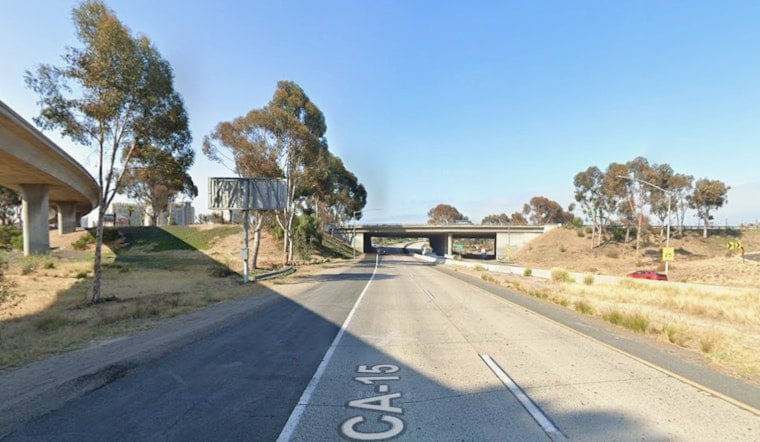
Nearly 75 volunteers and artists gathered in an Imperial Avenue parking lot this week to start painting murals beneath two of San Diego's grittiest freeway underpasses, ones long marked by graffiti, trash and, at one site, tents where people had been sleeping. The project, four years in the making, aims to turn the concrete pillars under Interstate 5 and State Route 15 into a visual timeline of Logan Heights history, from its Kumeyaay origins to an imagined future.
The mural push began with a community kick-off event on Saturday at the Imperial Avenue Family Health Center, opening with a traditional Kumeyaay blessing, according to an event announcement published by KPBS. As The San Diego Union-Tribune reported, volunteers and artists began painting murals below Interstate 5 and State Route 15 that same day, working from an Imperial Avenue parking lot before art gets applied to the underpasses themselves. More than a dozen local artists took part in designing the project, and organizers say the approval process included interviews with area residents about what they actually wanted to see on the walls.
From Graffiti-Covered Pillars to a Neighborhood Timeline
The Interstate 5 underpass had become a site where people were sleeping in tents amid accumulated trash, while the State Route 15 underpass was marked by graffiti and substantial litter, per the same Union-Tribune account. Artists plan to paint directly onto the pillars at the State Route 15 site, while murals at the Interstate 5 underpass will be created using polytab, a flexible mural material that organizers will attach with specialized adhesives and protective finishes, allowing the permanent installation to incorporate all of the volunteers' work.
The Logan Heights Community Development Corporation, a nonprofit that funds and promotes improvements in the area, is leading the effort. Its chief executive, Monte Jones, framed the day as a turning point for a neighborhood accustomed to delayed promises.
Storytelling Through Color, From Kumeyaay Roots to a Spaceship
Kim Phillips-Pea, known for her work with the Southeast Art Team, said the artists worked extensively to reflect Logan Heights' history and future. The imagery begins with the Indigenous Kumeyaay people, moves through the history of Black businesses on Imperial Avenue, and celebrates the area's Latino culture before ending with an aspirational spaceship meant to represent the future. Painters used a palette of yellow, green, brown and red across the panels.
That narrative arc lines up with who calls greater Logan Heights home: neighborhoods served by the Logan Heights CDC are roughly 72% Latino, 12% Black and 6% Asian, according to a profile published by the San Diego Foundation. Christian Cormier, general manager of Shepherds Coffee Co., which handed out free lemonade and iced coffee at the painting event, said he was thrilled to see a positive change in the community and loves seeing arts and culture return to the neighborhood, per the same Union-Tribune report.
A $780,000 Grant and a Four-Year Wait
The mural project was funded by a state grant tied to Governor Gavin Newsom's Clean California Initiative, which supports beautification of public spaces, roads, pathways and transit centers. Formally designated the Imperial Avenue Cultural Mural Corridor Project, the effort is backed by $780,000 in state funding approved through the San Diego Association of Governments under Project Implementation Order 122, according to SANDAG board records. Caltrans, the city of San Diego and SANDAG all served as government partners in the project, which took roughly four years to get going before volunteers finally picked up brushes.
The scope stretches well beyond the two underpasses highlighted at the kick-off. A Caltrans progress report shows the full corridor includes 13 murals across three freeway sites in Southeast San Diego, spanning bridge columns under State Route 15, wall panels under Interstate 5, and a bridge mural over Interstate 805. Statewide, the $1.2 billion Clean California Initiative launched in July 2021 has cleared more than 3.4 million cubic yards of trash and funded over 600 public transportation art installations through 2025, according to Caltrans figures.
Healing a Divide Cut by the Freeway Six Decades Ago
The underpasses sit in Sherman Heights and Stockton, both part of the broader Logan Heights area, where the wounds the murals are meant to address trace back to 1963. That year, the construction of Interstate 5 physically bisected the historic Logan Heights neighborhood, splitting it into eastern Logan Heights and western Barrio Logan and severing long-standing local road connections, according to City of San Diego historic planning documents. The murals' narrative arc, moving from Kumeyaay history through Black business heritage and Latino culture, doubles as an attempt to visually stitch that severed geography back together.
That healing effort has company from other agencies. The U.S. Department of Transportation awarded SANDAG a $2 million Reconnecting Communities grant in 2024 to study building freeway lids over Interstate 5 that would physically reconnect Barrio Logan and Logan Heights, according to USDOT grant documentation. Separately, the California Strategic Growth Council awarded a $29.5 million Transformative Climate Communities grant in December 2023 to a coalition including the Logan Heights CDC and the San Diego Foundation for climate resiliency and neighborhood investment in the two communities, state council records show.
A Regional Pattern of Painting Over Gray Infrastructure
Logan Heights is not alone in turning to murals to soften freeway infrastructure. In July, the National City Council approved a permit for an international mural festival to paint freeway underpasses along the I-805 corridor, as Hoodline reported, illustrating a wider regional trend of using public art to revitalize gray freeway infrastructure across San Diego County. The Logan Heights CDC also separately manages the Central Commercial Maintenance Assessment District, established by the city in 2000 to maintain cleanliness and commercial viability along the Imperial Avenue corridor.
The community kick-off also featured Calpulli Mexihca, an Aztec dance group, and organizers supplied paint so volunteers could get started on the mural work themselves. The full project is expected to be completed within roughly six weeks, according to the Union-Tribune's reporting, after which the pillars and panels beneath two of the city's roughest underpasses should carry a different story than the one they've told for decades.





