

























































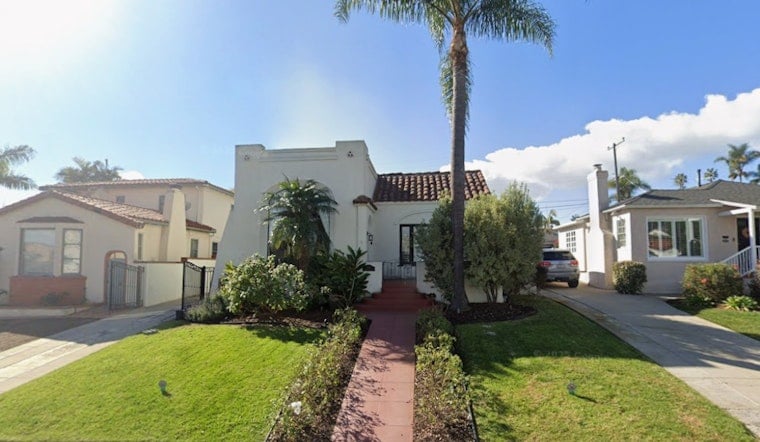
A nearly 100-year-old Spanish Colonial Revival home on Kingsley Street in Loma Portal has officially been designated a historic property, a status that also opens the door for its owners to seek a significant property tax break. The San Diego Historical Resources Board voted unanimously, 7-0, to approve the designation on its consent agenda during its May 28 meeting, with the motion made by Boardmember Farley and seconded by Boardmember Woods.
The home at 3111 Kingsley St., known historically as the Union Trust Company of San Diego Spec House #3, was built in 1927 by the Pioneer Construction Company, though its architect remains unknown, according to city planning records. As reported by The San Diego Union-Tribune, the property is currently owned by Eric and Katie Singh, and the historical nomination followed research submitted by Ginger Weatherford. City records show the home falls within Council District 2 and the Peninsula Community Planning Area.
City Planning Department documentation lays out the character-defining features that led staff to recommend the designation under Criterion C, which recognizes properties embodying distinctive characteristics of a style, type, period, or construction method, per the Union-Tribune's report. Those features include an asymmetrical front facade, medium-sand stucco cladding, stucco wing walls, and a flat crenelated parapet. The home also retains a medium-pitch side-gabled roof topped with mission barrel tile and minimal eave overhang, single-lite wood casement and fixed windows, clay attic vents, and a large single-lite arched wood focal window.
A Style Born From the 1915 Exposition
The home's decorative stucco details, including an arched entry-door surround along with window brows and niches, reflect what the Union-Tribune describes as the Spanish Eclectic style that dominated Southern California architecture between 1915 and 1940. Developers of that era drew inspiration from Spanish and Latin American architectural traditions that re-emerged in popularity after the 1915-1916 Panama-California Exposition, a trend that reshaped the region's architectural landscape until the modernist movement took hold during and after World War II. A spec house like 3111 Kingsley St. was built without a specific buyer in mind, meant to be move-in ready for whoever purchased it.
The 1,490-square-foot home has two bedrooms and 1.5 bathrooms, with 15-foot ceilings in the living room and hardwood floors, according to Redfin listing data. The property last sold in September 2020 for $1,045,000 and sits on a residential lot in Loma Portal.
Modifications Didn't Compromise the Home's Integrity
Like many century-old homes, 3111 Kingsley St. has seen changes over the decades. City staff reports document a site wall built in 1950 and a 1998 permit that added a rear porch, replaced windows, and applied a stucco skim coat, along with an added south-facing awning. Post-construction modifications also included a wooden gate and backyard additions, per the Union-Tribune's account.
City staff determined these changes were minor and consistent with the Secretary of the Interior's Standards for the Treatment of Historic Properties, concluding they did not compromise the character-defining features that justified designation. The Historical Resources Board ultimately ratified staff's recommendation on that basis.
What Historic Status Means for the Owners
The designation places 3111 Kingsley St. within a broader pattern of preservation activity in Loma Portal, where homes have been surveyed under the airport-administered Quieter Home Program and flagged as potential contributors to a National Register-eligible Loma Portal Historic District, according to Historical Resources Board reports. Numerous 1920s homes in the neighborhood share similar Spanish Colonial Revival attributes.
For the Singhs, the designation qualifies the property for California's Mills Act, a voluntary and self-renewing 10-year contract that recalculates property taxes based on rental income value rather than market value. City guidelines state the program typically yields tax reductions between 20% and 70%, with contracts automatically renewing each year unless a non-renewal notice is filed. Designation also opens the door to other regulatory flexibility, including the potential use of a historical conditional use permit and the California Historical Building Code.
Tight Deadlines and a Citywide Cap
Property owners hoping to take advantage of the tax break face a strict calendar. City policy requires a property to be designated on the City Register before December 31 in order to be eligible for a Mills Act application by the following March 31. The city also enforces an annual fiscal cap of $200,000 in new General Fund tax revenue reductions, a limit designed to manage the program's citywide budget impact.
San Diego has now designated more than 1,550 individual historic resources, with roughly 2,075 properties citywide currently holding active Mills Act contracts, according to Coastline 840. Once a property is designated, exterior alterations to elements like windows, doors, roof tiles, paint, or stucco require city approval under Municipal Code Chapter 14, Article 3, Division 2, a rule meant to enforce federal preservation standards on character-defining features established during the home's period of significance. The Historical Resources Board, which meets monthly, is not expected to revisit 3111 Kingsley St. unless future alteration requests come before it.





