

























































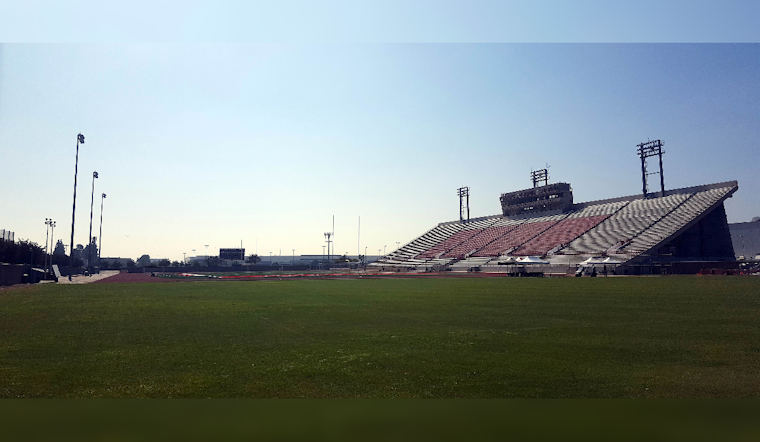
Long Beach City College is set to demolish Veterans Memorial Stadium later this month, clearing the way for a $250 million sports complex after the aging venue hosts its final football games. Long Beach Poly High School plays its last game at the stadium on August 28, followed by the LBCC Vikings on August 29, before the 70-year-old structure comes down.
The stadium, which has served as the epicenter of Long Beach football for seven decades, is structurally deteriorating, according to the Long Beach Post. Long Beach erected the 12,500-seat, east-facing stadium by 1950, funded in part by a $550,000 bond measure the city passed that year. Its origins trace back even further, to a 1945 letter from seventeen homesick soldiers stationed in the South Pacific who asked Long Beach to build a stadium and chipped in $75 toward the effort, the outlet reports.
Over the decades, the venue accommodated far more than football, hosting state track and field championships, college and professional football, motorcycle racing, roller derby and rugby. It even served as a movie set for a stunt sequence involving Evel Knievel. The stadium was also pressed into civic service during emergencies and community events, hosting food drives, swap meets, COVID-19 vaccinations and emergency sandbag distribution, per the same account.
A Game That Defined a Generation
Perhaps no single event looms larger in the stadium's history than the 2001 matchup between Poly and De La Salle, remembered locally as the Game of the Century. The contest drew more than 17,000 spectators and became the first nationally televised high school football game, according to the Post's reporting.
Longtime observer Mike Guardabascio told the outlet that high school football games consistently sold out Veterans Stadium and that the stadium's sheer capacity made it a significant regional stage. “Long Beach's football history runs through Veterans Stadium,” Guardabascio said, according to the Post.
What Replaces It
The new Stadium and Athletic Sports Complex will scale down the outdoor bowl to 10,000 seats while adding a 2,500-seat indoor arena, according to BuildIT. The project spans 180,000 square feet of new construction across an 18-acre campus footprint, consolidating physical education, kinesiology classrooms and athletic training facilities that had previously been scattered across campus into a single NCAA-compliant hub. Beyond football, soccer and track fields, the complex will include basketball and volleyball courts, offices, kinesiology classrooms, a Hall of Champions, and athletic training and rehabilitation facilities, per the Post.
Long Beach City College awarded the design-build contract to a joint venture of PCL Construction and Webcor, with architectural design led by Gensler and program management overseen by Cordoba Corporation, BuildIT reports. Site preparation and vertical construction are expected to run between 2026 and 2029, with the modern replacement slated for completion in 2029.
Before any of that vertical work begins, crews must clear the site. Under bid documents for the initial demolition phase, known as LBCC Bid 26-011, workers will crush the existing grandstand's concrete and asphalt on-site into stockpiles that will later be reprocessed and reused as aggregate during subsequent construction, according to PlanetBids filings. The so-called Make Ready Package also covers rerouting campus fire alarms, domestic water lines and electrical distribution systems that serve surrounding buildings.
Ownership and Funding Trace Back Decades
Long Beach City College acquired Veterans Memorial Stadium from the City of Long Beach for $1 in 1987, a transaction that shifted long-term maintenance and scheduling control from the municipality to the community college district while still allowing area high schools and civic groups continued access, the Post notes.
The $250 million transformation is financed through Measure LB, an $850 million bond measure that Long Beach voters approved by 64.5% in June 2016 to modernize athletic infrastructure and repair facilities across LBCC campuses, according to Ballotpedia. Bond proceeds are legally restricted to capital improvements and cannot fund administrator or faculty salaries. District voters added further capital capacity in November 2024 by passing Measure AC, a $990 million bond aimed at student housing expansion and academic building modernization.
The sports complex isn't the only major build underway at LBCC. The district's Liberal Arts Campus is separately constructing a $127 million, four-story student residence hall that will bring 431 beds to campus by fall 2028, as Hoodline previously reported. That housing push comes as LBCC has seen enrollment climb to a record 39,925 students during the 2024–25 academic year, a 15% increase over two years, adding pressure on the district's aging athletic and classroom facilities.
Saying Goodbye Before the Wrecking Ball
Because construction will displace the venue for years, Long Beach City College and area high schools plan to relocate commencement ceremonies during the build. The district has also scheduled a community legacy celebration and groundbreaking ceremony at the stadium site for September 9, featuring stadium signing walls, public tours and historical video presentations for alumni and residents.
The demolition arrives as Long Beach's broader sports profile grows heading into the 2028 Olympics, with local sites including Alamitos Beach selected to host official LA28 competitions. Whatever nostalgia lingers for the old grandstands, LBCC's plan reflects a shift toward consolidated, modern athletic and academic space built for a much larger student body than the one the original stadium was designed to serve.





