

























































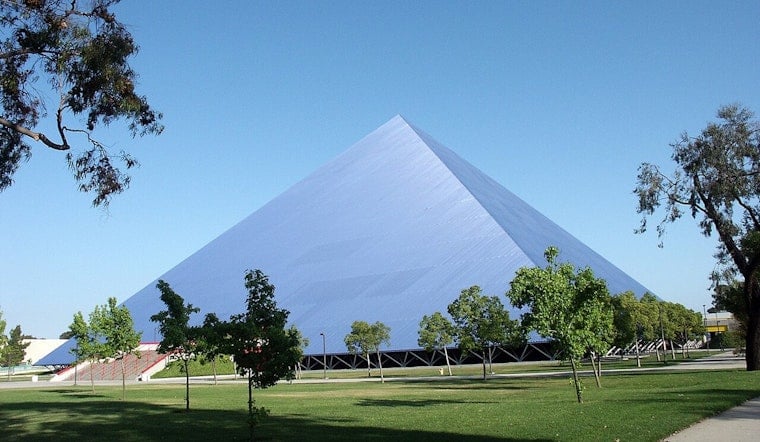
Long Beach State's 18-story Pyramid arena has a new name on its entrances, basketball courts and volleyball floor: LBS Financial Credit Union. University officials unveiled the signage before the season's first home competition, a women's volleyball match against UCLA, marking the end of an era for a building that had carried the name of a donor couple for more than two decades.
The 12-year, $8.5 million naming rights agreement was approved in November, according to the Long Beach Post. The deal replaces the Walter Pyramid name, honoring former CSULB College of Business Dean Dr. Mike Walter and his wife Arline, who donated $2 million to offset construction costs when the arena opened and agreed to the name back in 2004. The Walters voluntarily relinquished their naming rights this year to help the university generate new athletic revenue, according to Long Beach State Athletics, with Mike Walter said to have understood the necessity of the change and the couple stating their priority remained supporting student-athletes.
A Local Credit Union Steps In
LBS Financial Credit Union was founded in the 1930s inside a Woodrow Wilson High School classroom in Long Beach and has grown over 90 years into one of the top 5% of U.S. credit unions by asset size, per the same account from Long Beach State Athletics. The credit union has provided banking services to CSULB faculty, staff, students and alumni for more than 70 years, giving the sponsorship deep local roots beyond a simple logo swap.
The California State University Board of Trustees unanimously approved the agreement in November 2025, a required step since CSU trustees must formally sanction naming rights for major state university assets. Long Beach State Athletics spent roughly 12 months negotiating the deal alongside sports marketing firms ADC Partners and The Superlative Group, and the transaction now stands as the largest naming rights agreement in the school's athletics history, according to The562.org.
Where the Money Is Actually Going
Long Beach State began using the sponsorship funds immediately, and the Long Beach Post reports the majority will support student scholarships. Ten percent of the funds — $850,000 — has been earmarked for the campus activities fund to support student programming and student life initiatives, with the remaining money to be spent over the full 12 years of the agreement.
Some of the money has already gone toward renovating the basketball lobby, which the Post's reporting describes as an investment in recruiting and retention. Bobby Smitheran, executive director of athletics at Long Beach State, described the renovated lobby as an “entry point” for student-athletes. College athletics has shifted from a focus on facilities toward a focus on talent acquisition, the outlet notes, and Beach Athletics plans to evaluate the facility needs of all its athletic programs and prioritize them accordingly going forward.
Why the Money Is Needed Now
The urgency behind the deal traces back to a landmark legal shift in college sports. Final federal court approval of the *House v. NCAA* settlement in June 2025 established a 10-year framework allowing Division I athletic departments to share up to $20.5 million annually in revenue directly with student-athletes, according to CUPA-HR. Traditional scholarship limits have been eliminated and replaced with sport-specific roster caps under new NCAA rules for the 2025-2026 school year, per NCSA College Recruiting, meaning schools can now offer scholarships to every rostered player rather than a limited number.
Costs to operate sports teams have risen sharply, and student-athletes now receive competition from other schools directly through revenue sharing. The Long Beach Post's reporting frames the sponsorship deal as necessary to keep Long Beach State athletics competitive in that new landscape, with the money delivered upfront rather than paid out gradually.
The Roof Problem Money Won't Fix
The financial windfall arrives alongside a persistent structural headache. Designed by Long Beach architect Don Gibbs and completed in November 1994 at a cost of approximately $22 million, the arena's 345-foot square base makes it one of only a few mathematically true pyramids in the United States, according to SFGATE. The venue opened with an ESPN-televised men's basketball win over Detroit Mercy and later set an attendance record of 6,912 fans during a November 2012 game against the University of North Carolina, despite a standard seating capacity of 4,200.
But the building has experienced a leaky roof that has disrupted basketball games, along with a partial ceiling collapse and other structural problems, according to the Long Beach Post's reporting. A university facility study cited in 2023 estimated that fully replacing the roof and resolving accumulated deferred maintenance would cost $55 million, according to the Long Beach Post. Between 2018 and 2023, CSULB spent more than $670,000 on localized patchwork and roof sealant repairs to mitigate water intrusion during winter storms, a stopgap approach detailed by The562.org, which noted the recurring leaks had previously forced the postponement or relocation of home games.
That $55 million backlog dwarfs the $8.5 million now flowing into scholarships and a renovated lobby, leaving the pyramid's long-term physical future unresolved even as its name and its programming budget both get a fresh start.





