

























































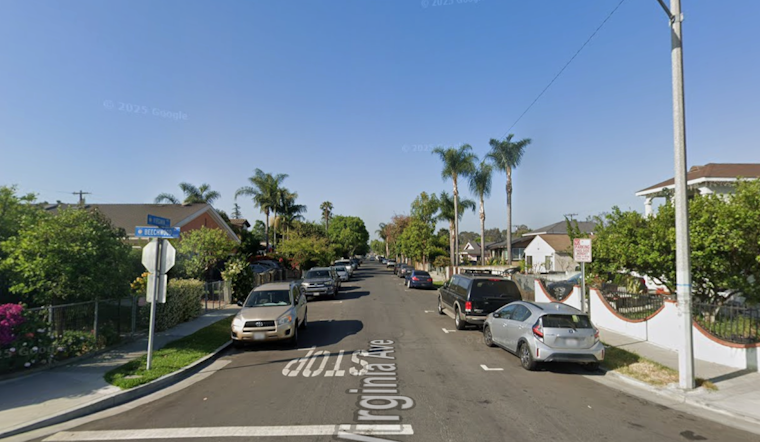
A single-family home in Lynwood was left with heavy damage Monday afternoon after a reported explosion and fire tore through a rear building on the property, though officials say no one was hurt. Los Angeles County fire officials received a call about an explosion at approximately 3:18 p.m. in the 11200 block of Virginia Avenue near Beachwood Avenue, and firefighters arriving on scene reportedly found flames coming from a structure behind the main house.
Crews knocked down the flames quickly, according to KTLA, which reported that officials said no one was injured in the blast. The outlet's Sky5 helicopter was over the damaged home just after 4:30 p.m., capturing images of a structure showing signs of significant destruction. Fire officials are still working to determine exactly what exploded inside the home, and that central question — what substance or mechanical failure triggered the detonation — remains unresolved.
Fire Crews From Local Stations Respond
Lynwood contracts its fire protection and emergency medical services to the Los Angeles County Fire Department, which covers the city out of Battalion 13 via Fire Station 147 on East Imperial Highway and Fire Station 148 on Martin Luther King Jr. Boulevard, according to 211LA. The city folded its former municipal fire department into the county system between 1998 and 2000, per the same source, meaning any major fire or explosion call in Lynwood is coordinated through that same battalion structure.
In Southern California residential settings, sudden detonations like the one reported on Virginia Avenue are typically evaluated for a handful of possibilities: natural gas line or appliance failures, stored propane tanks, volatile accelerants, or illicit chemical processing. Investigators have not publicly attributed a cause to any of those categories in this case, and the dossier of available reporting does not indicate which, if any, investigators are pursuing.
Gas Safety Rules Loom Over Any Investigation
If a natural gas leak turns out to be involved, state rules require utilities to make leaks detectable before they reach dangerous concentrations. The California Public Utilities Commission enforces gas safety standards under General Order 112-F, which mandates that distribution pipelines be odorized with mercaptan so leaking gas can be smelled before it builds to combustible levels. That means resident accounts of smelling rotten eggs beforehand, if any exist, would likely become important early evidence for any investigation into whether gas played a role.
Southern California Gas Company, which serves more than 21 million consumers across the region, instructs residents who suspect a leak or a possible explosion to evacuate on foot immediately and call 911 or the utility's emergency line from a safe distance, avoiding light switches or anything that could spark. Separately, California law under Government Code Section 4216 and SB 297 requires contractors and homeowners to call 811 at least two business days before digging on a property, so utility operators can mark underground gas lines; negligent excavators can face state fines up to $100,000.
Private Property Digging Remains a Risk Statewide
SoCalGas reported roughly 2,200 accidental pipeline damage incidents across its territory in 2024, a 10-year low, but nearly 80% of those dig-ins occurred on private property, and 60% involved a failure to contact 811 before excavation began. Overall dig-in incidents have dropped more than 33% since 2014 thanks to expanded public awareness, but private-property strikes remain a persistent hazard even as utility-side numbers improve.
The Virginia Avenue incident is not the first time gas infrastructure concerns have rattled Lynwood this year. In June, a reported gas main leak at San Miguel Avenue and Norton Avenue prompted county fire crews to order nearby residents to shelter in place while they evaluated the hazard, a shelter order lifted at San Miguel once the area was confirmed secure. Nationally, cooking causes the largest share of home structure fires at 46.7%, according to the U.S. Fire Administration, but non-cooking causes such as heating equipment, electrical malfunctions, and gas or fuel leaks tend to drive the more severe structural fire and explosion incidents that departments respond to among the roughly 350,000 home structure fires reported each year.
Lynwood, a 4.9-square-mile city of roughly 66,000 residents in South Los Angeles County along the 105 and 710 freeway corridors, has seen other major fire responses in recent years, including a two-alarm commercial building fire in 2024 that sent smoke across the city and forced a nearby high school to dismiss students early, according to ABC7. For now, the cause of Monday's explosion on Virginia Avenue remains under investigation, with officials yet to say publicly what ignited inside the rear structure.





