

























































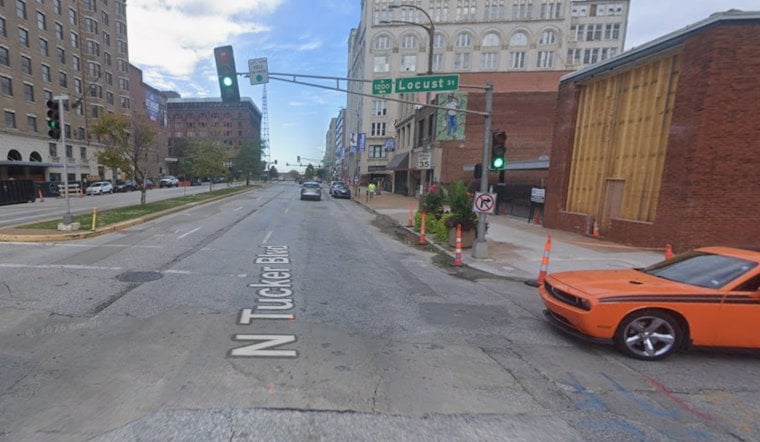
A man was left with critical gunshot wounds after a shooting broke out just after midnight Sunday at the intersection of North Tucker Boulevard and Locust Street in downtown St. Louis. Police responded to the scene and found the victim suffering from severe injuries before he was rushed to an area hospital.
According to FOX 2, officials have not released the victim's identity, and no motive for the shooting has been established. The St. Louis Metropolitan Police Department was still canvassing the area for evidence and witnesses as the investigation got underway, per KSDK.
The intersection where the shooting happened sits at a notable dividing line: North Tucker Boulevard and Locust Street mark the official boundary separating the city's Downtown neighborhood to the east from Downtown West to the west, according to city neighborhood maps. That makes the shooting scene a literal crossroads between two adjacent central districts, both of which have seen their share of late-night gunfire in recent months.
A Corridor With a History of Violence
The Tucker Boulevard corridor has drawn repeated safety concerns well before Sunday's shooting. Public safety data cited by FOX 2 showed at least 16 shots-fired or disturbance calls in the corridor's early 2026 stretch, centered near a gas station at Tucker Boulevard and Lucas Avenue just blocks from where Sunday's victim was found. Residents and rideshare drivers have repeatedly flagged the area as risky after dark.
Sunday's shooting also echoes a fatal incident from March 12, 2025, when gunfire near Tucker Boulevard and Spruce Street left one person dead and another injured, prompting calls for increased overnight patrols in the central business district. It is the latest in a string of downtown shootings this year alone, including a July 20 street duel near Broadway and Walnut Street that wounded a 13-year-old boy, and a pre-dawn shooting along Washington Avenue on June 28 that left a woman critically injured.
Federal Surge Arrived Just Days Earlier
The shooting comes just three days after federal authorities announced that the Bureau of Alcohol, Tobacco, Firearms and Explosives would lead a new federal violent crime surge in St. Louis, embedding agents with local police to run ballistics matching within 24 to 48 hours of a shooting. That effort, detailed in prior Hoodline coverage, relies on the National Integrated Ballistic Information Network to connect shell casings across crime scenes citywide. It remains an open question whether shell casings recovered at Tucker and Locust will be run through that system to see if they match other recent downtown shootings, and whether investigators have identified surveillance footage from nearby businesses along the corridor.
The timing underscores a broader tension facing the city. CompStat data released by the St. Louis Metropolitan Police Department in January showed overall Part I crime dropped 16% in 2025 compared to the prior year, with homicides hitting a 12-year low of 140 incidents and shooting incidents falling 28%. Mid-year 2026 figures from the department showed citywide violent crime down an additional 10.4% through June compared to the same period last year, with homicides remaining at historic lows.
State Law Limits Local Firearm Rules
Even as city officials tout those declines, Missouri's legal framework restricts how local leaders can respond to persistent gun violence. Under Missouri Revised Statutes Section 21.750, the state operates as a permitless “Constitutional Carry” jurisdiction, allowing adults 19 and older to carry concealed handguns in public without a permit. The law also places strict limits on municipal authority, preventing St. Louis officials from enacting citywide concealed carry bans even amid ongoing corridor-specific safety concerns.
No arrests have been announced in connection with Sunday's shooting, and police have not indicated whether they believe it is connected to other recent gunfire downtown. The investigation remains active as detectives continue working to identify the victim and determine what led to the gunfire at Tucker and Locust.



