

























































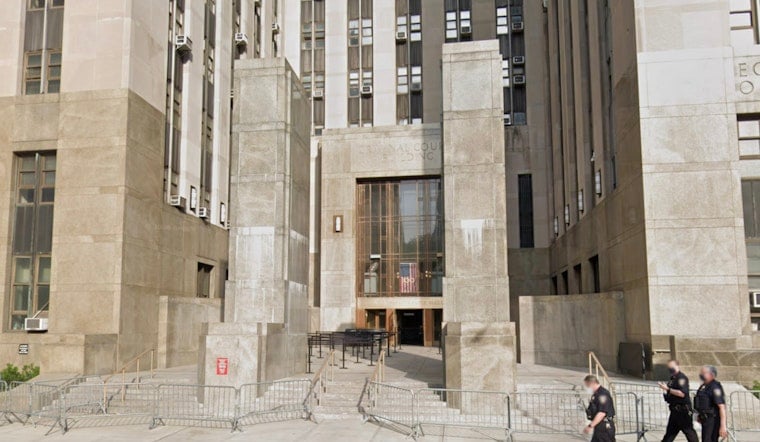
The cafeteria inside the Manhattan Criminal Courts Building at 100 Centre Street has been shut down since Thursday, August 27, after city health inspectors documented mice and cockroaches inside the small courthouse eatery. The tiny space, which seats only about six people, has racked up a string of health code violations over the past year, including citations for improper food temperatures and staff eating, drinking or vaping while on duty.
According to the New York Post, NYC Department of Health inspection records show evidence of mice or live mice found in the cafeteria as recently as July 23, 2026, with an earlier finding on July 1, 2026. City health inspectors also found mice in the cafeteria kitchen back in April 2025, though that issue was reportedly cleared before a follow-up review in August 2025, per city records cited in the report. The cafeteria ultimately received a B grade rating following its inspection results.
A source familiar with the cafeteria told the outlet there are a lot of mice that crawl on inmates when they are lying in cells, while a recently retired cafeteria worker described watching two mice run by the stove. A former cafeteria employee, meanwhile, said simply that the cafeteria needs something better.
City Says Closure Is About Plumbing, Not Pests
The Department of Citywide Administrative Services, which owns and maintains the 100 Centre Street building, said the cafeteria is closed for work related to the building's plumbing and drainage systems — not because of the pest findings. The article notes that signs posted at the closed cafeteria required face coverings for authorized personnel entering the work area. Per the same account, the timeline for reopening depends on completion of that facilities work, according to the department.
Under New York City's letter-grading framework, established in 2010 by the NYC Department of Health and Mental Hygiene, establishments that accumulate 14 to 27 violation points earn a B grade — a rating that permits continued operation but requires an unannounced re-inspection within four to six months. Food safety rules also require that any establishment with a B grade or Grade Pending status post its letter grade card visibly near the main customer entrance. The department conducts unannounced annual inspections across more than 24,000 food service establishments citywide, holding government cafeterias to the same pest control and health code standards as commercial restaurants.
An 85-Year-Old Building With a Long History of Pest Complaints
The Manhattan Criminal Courts Building, constructed between 1938 and 1941 in the Art Deco style by architects Harvey Wiley Corbett and Charles B. Meyers, spans 17 stories and was funded in part by the New Deal Public Works Administration, according to the Department of Citywide Administrative Services. It was built to replace an 1894 courthouse and the original Tombs prison. DCAS owns and physically maintains the building, which houses operations for the New York State Unified Court System, the Manhattan District Attorney, Legal Aid, and the NYC Department of Correction — a split of responsibility between the city agency that manages the property and the independent entities that occupy it.
Pest and sanitation complaints at 100 Centre Street are not new. Federal court filings dating back to 2003 document pre-trial detainees alleging that holding cells in the building were infested with roaches and rodents alongside unsanitary facilities, in the civil lawsuit Maxwell v. City of New York. The building also sits adjacent to the former Manhattan Detention Complex, known as the Tombs, which a federal judge ordered closed in 1974 after ruling its unsanitary conditions and severe overcrowding violated detainees' constitutional rights, according to background compiled on Wikipedia.
Defenders Point to Broader Conditions at Central Booking
New York County Defender Services has repeatedly highlighted that central booking cells at 100 Centre Street subject thousands of daily arraignment defendants to cramped, unsanitary conditions with limited access to food and water. That advocacy underscores concerns that extend well beyond the courthouse cafeteria and into the secure booking areas that process the borough's arrests.
Municipal project records show 100 Centre Street has required continuous capital interventions over the years, including fire alarm upgrades, structural stabilization, and ongoing plumbing and drainage replacements, reflecting the toll that decades of use have taken on the building's original 1930s systems. The cafeteria's closure follows a broader citywide health enforcement push; Hoodline reported in July that a citywide crackdown led to temporary closures of multiple local eateries after inspectors cited widespread evidence of mice, live roaches, and severe plumbing or sewage failures across the five boroughs.
For now, the courthouse cafeteria remains shut down, with its reopening tied to the completion of the plumbing and drainage work DCAS says prompted the closure.




