

























































Darrick Lo has a habit that would make most New Yorkers wrinkle their noses: he goes looking for other people's garbage. A mechanical engineer living in Manhattan, Lo spends his spare time hunting down broken strollers, coffee grinders, chairs and sewing machines left for dead on the curb, then fixing them up in his apartment and handing them back to the neighborhood for nothing.
Lo grew up in New Jersey and earned both his undergraduate and graduate degrees from Cornell University in mechanical and biomedical engineering, according to the New York Post. He currently works at a medical-device company, and earlier in his career he was an associate engineer in the Hospital for Special Surgery's Department of Applied Biomechanics in New York, where he co-invented patented total elbow replacement devices, according to the hospital's own account of its research staff. That background in complex orthopedic mechanics, it turns out, translates surprisingly well to diagnosing a jammed coffee grinder or a stroller with a cracked frame.
Lo does not run a repair business. He does not fix things on a timeline, and he has said he does not want the pressure or logistics that would come with turning the hobby into a service, per the Post's reporting. Instead, he solicits broken items directly from Manhattan neighbors, sources most of his projects from Craigslist and a local Facebook Buy Nothing group, and takes other items straight off the street on recycling night.
From Two Broken Strollers to One Working Ride
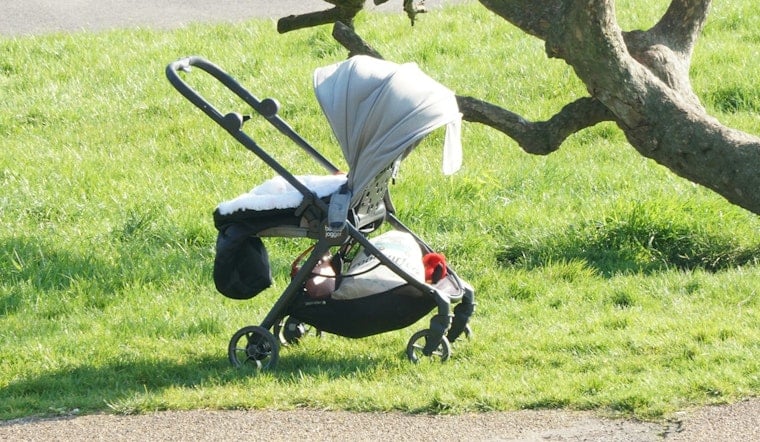
One of Lo's more involved projects involved two broken UppaBaby strollers, both structurally compromised, that he found separately and diagnosed as suffering from cracked aluminum frames. Aluminum stroller frames weaken with every bump and curb they hit, and rewelding the metal destroys its strength rather than restoring it — so instead, Lo discovered the two strollers, despite being two model years apart, shared many of the same components. He combined salvageable parts from both into a single working unit. The UppaBaby Vista V2, one of the models he has worked on, has an aluminum body and complex brake mechanics that make this kind of triage possible only for someone willing to take the thing apart piece by piece.
Smaller fixes have their own logic. Lo once paid $20 for a coffee grinder that had been advertised in questionable condition; its motor had stalled because it was caked with old coffee grounds. Coffee dust and bean oils form a glue-like substance inside an uncleaned grinder, jamming the paddle wheel and burrs until the machine simply gives up. A thorough cleaning was all it took to bring it back to life. A $35 broken espresso machine he found needed more: the appliance's water heater, high-powered pump and overpressure valve all have to work in concert, and Lo repaired his by replacing the overpressure valve.
A Childhood Memory Behind the Sewing Machines
Lo's interest in vintage sewing machines traces back to watching his mother sew on a Singer Stylist 534, a machine dating to around 1975. When it stopped working, its hook and feed gears needed replacement, and Lo repaired it himself. He also owns a Singer Fashion Mate 258, dating to roughly 1974, which he found missing several parts and uses now for fabric repairs and other projects; that model is capable of decorative stitches. Mechanical sewing machines like these rely on gear trains, rotating cams and interlocking linkages rather than the circuit boards and microprocessors found in newer appliances, though they still require electricity to run. Over time, their polymer gears oxidize and crack, which is often the actual point of failure — a contrast Lo has noted with modern cellphones, which are tightly sealed and require a heat gun just to melt the adhesive and get inside.
Lo also taught himself the art of weaving in order to restore an old chair with a broken seat that had originally been hand-woven cane. He has said that failure in these objects is usually caused by a multitude of things and is rarely obvious at first glance — a diagnostic mindset he says he picked up from his engineering training and a stint working at an electronics store in the 2000s. Beyond strollers, grinders, chairs and sewing machines, Lo has also repaired washers, dryers, refrigerators, ovens, water heaters and furnaces, and he has even disassembled and reassembled his own motorcycle. He keeps three toolboxes on hand for the work. Whatever he decides not to keep for himself, he gives away to his Buy Nothing group, a nearby thrift store, or friends.
A Wider Movement of New Yorkers Rescuing Trash
Lo is not alone in treating the city's discards as raw material. Anna Sacks, known online as the Trash Walker, scours New York City trash for reusable items and has said that repairing something is doubly valuable — it keeps the item out of the landfill while also reducing the need to buy something new. That framing lines up with New York's broader push toward repair-friendly policy: the state's Digital Fair Repair Act, signed into law in December 2022, made New York the first in the country to require manufacturers to provide diagnostic tools, parts and manuals to consumers and independent repair shops for digital devices, per the New York State Governor's Office.
The scale of what people like Lo and Sacks are pushing against is enormous. New Yorkers generate more than 400,000 tons of electronic waste every year, according to Human-I-T, while the city's Department of Sanitation collects between 3.7 million and 4 million tons of residential and institutional waste annually on a budget approaching $2 billion, as reported by Waste Dive. That municipal waste stream is also changing shape: Manhattan buildings with one to nine units now face a mandate to use official wheeled trash bins by June 1, 2026, alongside a rollout of locked, on-street Empire Bins for larger properties — a shift Hoodline has reported could affect how curbside items are set out and accessed going forward.
The Case for Fixing Instead of Tossing
Under New York's Electronic Equipment Recycling and Reuse Act, commercial entities that dump covered e-waste in landfills or incinerators can face state Department of Environmental Conservation fines of up to $25,000 per violation per day, per Human-I-T — a legal backstop to the environmental case for repair. On the consumer side, analysis from U.S. PIRG cited by the Repair Association estimates New York households save an average of $334 a year by repairing electronics and household goods instead of replacing them.
There's also a social dimension to what Lo does. The Buy Nothing Project, the hyper-local gift economy network he relies on to source and redistribute items, was established in 2013 and now allows New York City groups to help neighbors furnish entire homes without any money changing hands, according to FOX 5 New York. A 2024 study led by researchers at University College London found that community repair activities carry real psychological and social benefits, including skill-building, social inclusion and a boost in personal well-being, as reported by Inside Climate News. Repair Café International's volunteer network, spread across 2,000 locations worldwide, fixed more than 35,000 items a month in 2019 alone, diverting roughly 420,000 kilograms of waste from landfills annually — a small-scale global echo of what one Manhattan engineer is doing curb by curb, one stroller and sewing machine at a time.





