

























































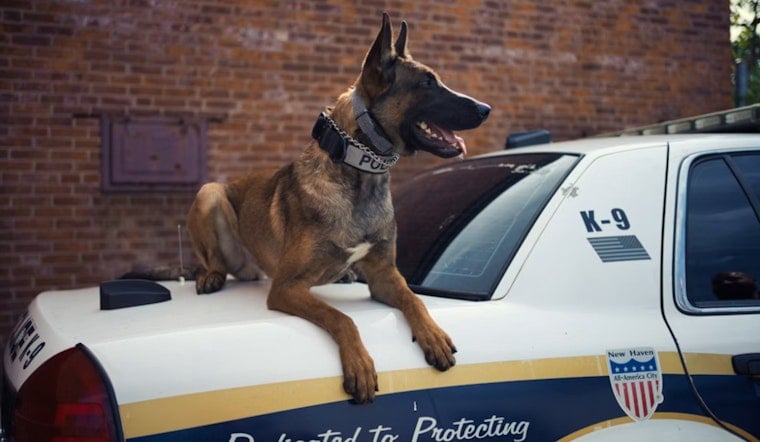
Spike spent seven years sniffing out drugs and tracking down suspects across central Oklahoma, and his last big bust on the job was a 400-pound marijuana seizure. Now the retired McClain County K-9 is fighting a tumor in his nasal cavity, an enlarged heart, and fluid in his lungs, and the family who took him in after retirement is asking the community for help covering the bill.
Spike retired from the McClain County Sheriff's Office on July 1, 2026, after four years working for the department and a total of seven years in law enforcement, according to News 9. Deputy Shane McCraw, who worked alongside Spike throughout his tenure, and his family adopted the dog as a pet once he was taken off the streets in March, per the same report. Spike now lives with the McCraws, plays with their children, and mixes in with the family's other dogs.
During his time on patrol, Spike seized more than 1,000 pounds of drugs total, the station reports. That record included a 2023 traffic stop on Interstate 35 where his alert led McClain County deputies to $100,000 worth of Oxycodone pills laced with fentanyl, as reported by News 9 at the time. That same October, Spike and McCraw joined the Oklahoma Highway Patrol, Norman Police, and Chickasaw Nation Lighthorse Police in a multi-agency perimeter track to run down suspects fleeing a stolen vehicle pursuit on I-35, according to the Purcell Register.
A Second Career Cut Short by Illness
Spike's work went well beyond highway interdiction. He performed drug detection, criminal tracking and community safety duties, and taught local schoolchildren through the D.A.R.E. program to resist peer pressure and avoid drugs, the outlet notes. McCraw said Spike helped take the department's K-9 program to another level, and described the dogs as entirely working animals that do not want to sit on a couch or stay home.
Now that drive is aimed at recovery instead. Spike has been diagnosed with a tumor in his nasal cavity, an enlarged heart, and fluid in his lungs, the report states. His medical care is currently being managed with medication while he awaits biopsy results, and he needs more testing and treatment ahead, according to the same account. Bridget Smith, described as Spike's caregiver, is helping manage his condition alongside the McCraw family.
Why the County Can't Foot the Bill
The McClain County Sheriff's Office ended Spike's department-provided medical care the moment he retired, the station reports. McCraw explained that K-9s are considered assets on paper, and that the department cannot fund medical care for a dog once it becomes surplus. That is not a quirk unique to McClain County: the sheriff's office's K-9 Unit runs primarily on grant funding and community donations rather than tax dollars, according to McClain County Sheriff's Office records, which leaves no built-in funding stream once a dog is decommissioned.
Oklahoma law reflects that same gap. Under Title 21 of the Oklahoma Statutes, police dogs are classified as personal property, and harming or mistreating an active police dog can bring misdemeanor or felony charges under 21 O.S. § 649.1, per Oklahoma Statutes as compiled by Justia. Those protections apply only while a dog is on duty; the statute provides no mechanism for covering veterinary care once a K-9 retires.
Spike's family is now raising money to pay for that care directly. Deputy McCraw launched a GoFundMe titled Support K9 Spike's Medical Care in Retirement to help cover advanced diagnostic CT scans and specialized treatment at Oklahoma Veterinary Specialists in Tulsa, after Spike was referred there through an emergency clinic in Oklahoma City following initial care at a local animal hospital in Purcell. Any money left over once his care is covered will be donated to another K-9 in need, per the fundraiser.
A National Problem With a Bill Attached
Spike's situation mirrors a cost problem playing out for retired K-9s nationwide. A federal baseline report cited in congressional briefings put routine annual veterinary care for a retired working dog at $1,182 in 2017, a figure that does not include emergency surgeries or specialty treatment, according to Project K-9 Hero. The nonprofit estimates that full medical coverage, prescription food, and end-of-duty services for a retired working dog now averages roughly $4,000 a year per animal.
U.S. Representative Derrick Van Orden introduced the K-9 Hero Act of 2026 in July, a bill that would create a $5 million annual federal grant program to help nonprofits cover veterinary bills for retired working dogs, according to the Office of Representative Derrick Van Orden. Until legislation like that becomes law, families like the McCraws are left covering the gap themselves.
Spike's successor on active patrol, a Belgian Malinois named Neo trained in tracking and narcotics detection, already relies on a similar charitable arrangement for his own needs — he receives protective gear support through Brady's K9 Fund rather than county funds, per the organization's website. It is the same pattern playing out across the country, where handlers turn to crowdfunding and national charities to fill a gap that public budgets simply do not cover once a dog's badge comes off.





