

























































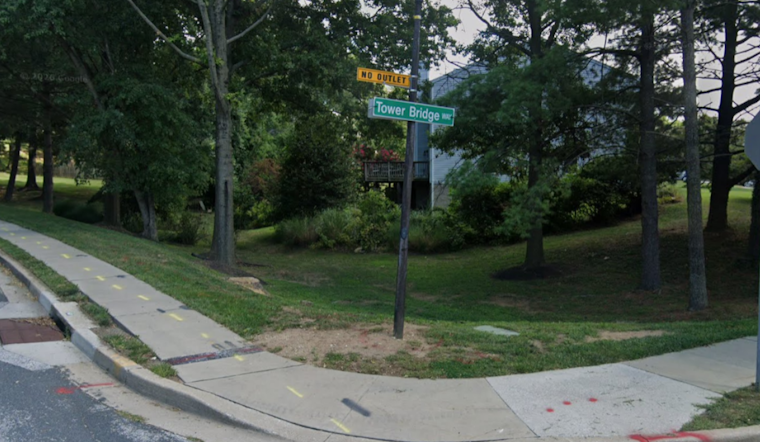
A possible mercury spill inside a Lutherville townhouse complex sent six people to the hospital for evaluation and decontamination Friday evening, according to the Baltimore County Fire Department. Crews responded to the 8600 block of Tower Bridge Way, where hazmat teams worked alongside state and local health officials to check the air inside the affected homes for toxic contamination.
According to CBS News Baltimore, officials said no one was injured in the incident, even though six people were transported for evaluation and decontamination as a precaution. The cause of the spill remains under investigation, the outlet reported, and Baltimore County Police identified the location as the 8600 block of Tower Bridge Way. The Maryland Department of the Environment and the Baltimore County Department of Health both responded to the scene and remained there afterward for continued monitoring, per the same report.
Baltimore County Fire Department HAZMAT crews arrived at the scene shortly before 5 p.m. Friday and stayed on site with state and local health officials to track air contamination levels, the station's report noted. Tower Bridge Way sits within the Wellington Valley development, where local real estate records from Zillow and Redfin show the block is lined with multi-level attached townhouses built around 1984 — a design that shares walls and HVAC systems between units, a structural detail that can raise the risk of vapor drifting between adjoining homes.
Why Officials Treat Mercury Spills as Medical Emergencies
Elemental mercury is a liquid metal that can look harmless, pooled on a floor, but the U.S. Environmental Protection Agency notes that its real danger comes from odorless, invisible vapor that evaporates at room temperature. Inhaling that vapor can cause neurological, renal, and respiratory toxicity, which is why officials sent six people for evaluation and decontamination even though no traumatic injuries were reported at the scene.
Cleanup is trickier than it sounds. Research published by the National Institutes of Health explains that liquid mercury droplets settle into floor crevices inside homes, and that ordinary vacuuming or simple foot traffic can dramatically spike airborne vapor concentrations rather than remove the hazard. That is part of why specialized hazmat protocols, rather than routine cleaning, are required once a spill like this is reported.
Federal health guidelines from the Agency for Toxic Substances and Disease Registry set an indoor air action level of 1 microgram per cubic meter for normal residential occupancy, with concentrations above 10 micrograms per cubic meter triggering mandatory evacuation and isolation. Those thresholds give responders on Tower Bridge Way a scientific benchmark for deciding when residents can safely return to their homes.
Lutherville Has Faced This Before
This is not the first time a residential mercury spill has required extensive remediation in Lutherville. An EPA Region 3 report documented that federal responders spent two to four weeks in February 2009 handling an emergency abatement of a 1.5-pound residential mercury spill in the town, a cleanup that required evacuating a family, deploying specialized mercury vacuums, and running multi-week air quality testing.
The Maryland Department of the Environment maintains a 24/7 Emergency Response Division staffed with HAZMAT officers trained specifically to handle toxic chemical spills, including elemental mercury releases, across the state. Baltimore County Fire Department crews, meanwhile, respond to thousands of hazmat calls annually — 3,903 in 2025 and 4,089 in 2024, according to county performance statistics, out of more than 150,000 total dispatches each year.
Lutherville is an unincorporated community of roughly 6,835 residents situated about 12 miles north of downtown Baltimore along Interstate 83, per U.S. Census Bureau data. The exact source of Friday's spill — whether from a broken thermostat, an old instrument, or another container — has not been determined, and officials have not said how much mercury may have been released.
Mercury spills tied to hospitalizations are not unique to Maryland. Hoodline previously reported that a Boston hazmat team responded to Massachusetts General Hospital after a patient came into contact with liquid mercury, an incident that reflects the same standard urban protocols now playing out in Lutherville. As of Friday evening, the cause of the Tower Bridge Way spill remained under investigation, and state and county officials were continuing to monitor air quality in the affected townhouses.





