

























































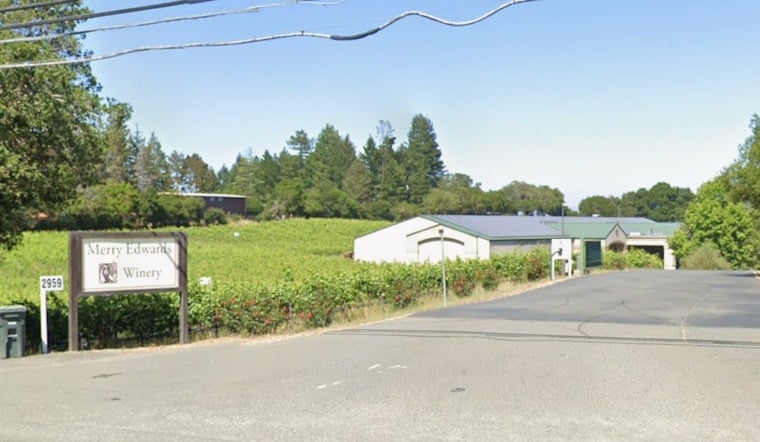
Merry Edwards Winery has opened a second tasting room in Philo, marking the Sonoma County Pinot Noir producer's first permanent outpost in Mendocino County's Anderson Valley and its first new tasting venue in nearly a decade. The Philo location sits at 9201 Highway 128, near sister properties Roederer Estate and Scharffenberger Cellars, and joins the winery's flagship Sebastopol tasting room at 2959 Highway 116 N. as the brand's only two public venues.
The move comes as Merry Edwards Winery expands its footprint into a region where it has already built a track record, according to The Press Democrat. The winery produced its first Anderson Valley appellation Pinot Noir in 2021 and added a Chardonnay from the region the following year, per the same report. Louis Roederer, the French Champagne house that owns Merry Edwards Winery along with Roederer Estate and Scharffenberger Cellars, has been building out its Mendocino County presence since founding Roederer Estate in Anderson Valley in 1982, according to Wine Enthusiast. The company later added Scharffenberger Cellars in 2004 and, in 2012, launched Domaine Anderson at the same 9201 Highway 128 property Merry Edwards now occupies.
A Founder's Legacy, A Decade-Long Gap
Merry Edwards launched her namesake label in 1997 and, alongside Ken Coopersmith, opened Merry Edwards Winery and Vineyards in Sebastopol in 2006, the article notes. She retired in February 2020 after completing 47 vintages, having helped establish Russian River Valley Pinot Noir as one of California's signature wines. Before retiring, she promoted Heidi von der Mehden to winemaker, a transition that California Grown reports took hold in 2018 when von der Mehden began overseeing primary winemaking duties, according to California Grown.
Edwards' scientific fingerprint on California winemaking predates the winery itself. While working as a winemaker at Mount Eden Vineyards in 1975, she isolated and propagated a Pinot Noir clone registered at UC Davis as UCD 37 — often called the Merry Edwards selection — which went on to become one of the state's most widely planted Pinot Noir cultivars, according to Merry Edwards Winery. In 2013, she was inducted into the Culinary Institute of America's Vintners Hall of Fame, becoming only the fourth woman to receive that honor, and won the James Beard Foundation Award for Outstanding Wine, Beer, or Spirits Professional the same year.
Why Anderson Valley, and Why Now
Merry Edwards Winery had operated without a tasting room of its own for nearly a decade before the Philo opening, and it now sources fruit from three vineyard sites for its Anderson Valley Pinot Noir program: Carney Vineyard in Boonville, and Dach Vineyard and Pinoli Vineyard in the cooler stretch of the valley known as the Deep End, per Merry Edwards' own press materials. Dach Vineyard, which is Demeter-certified biodynamic, directly surrounds the new tasting venue. The property previously belonged to Domaine Anderson, which produced organic and biodynamic Pinot Noir and Chardonnay there before the operation closed in May 2026 and consolidated its tasting activity into Roederer Estate. Domaine Anderson wines are now poured and sold at Roederer Estate instead.
Von der Mehden, who oversees the winery's roughly 80 acres of California Certified Sustainable estate vineyards, said Anderson Valley's coastal climate gives Pinot Noir and Chardonnay a different expression than what the vines produce back in Russian River Valley. She added that the Anderson Valley tasting room will share the story of the wines where they are grown. Nicole Carter said the Philo tasting room will connect Merry Edwards with new consumers while giving loyal guests a fresh destination to explore, and added that bringing the label to Anderson Valley will help build the reputation of the region's terroir-driven wines.
What Anderson Valley Offers Winemakers
Anderson Valley was established in 1983 as California's 23rd American Viticultural Area, and the 57,600-acre appellation runs roughly 20 miles along Highway 128 from Yorkville Highlands to Navarro, according to The Bubbly Professor. Ocean winds and fog funnel in from the Pacific Coast just 10 miles away, producing an average annual temperature of 53 degrees and daily swings of 40 to 50 degrees — conditions that make the valley a favored cool-climate zone for Pinot Noir. Vineyard census data published by the Anderson Valley Winegrowers Association shows Pinot Noir accounts for nearly 69% of the region's roughly 2,400 planted vineyard acres, with Chardonnay a distant second at 21%, across about 30 wineries with a median vineyard size of 13 acres.
Tasting Room Details
Reservation-based tastings at the Philo location range from a $45 Appellation Tasting to a $90 Reserve Tasting, with flights pairing Russian River Valley and Anderson Valley cool-climate wines side by side, according to booking details listed on Tock. The venue operates Thursday through Sunday from 10 a.m. to 5 p.m. Guests can reach the winery at 707-823-7466, and the Sebastopol location remains the winery's flagship, with the new Philo site serving as its second public tasting destination.





