

























































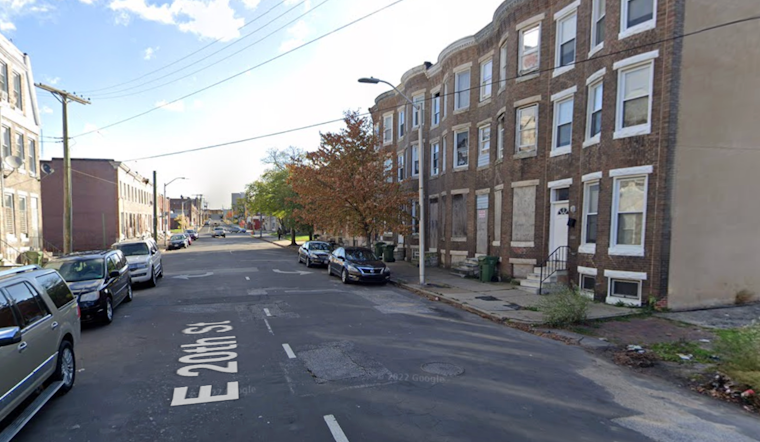
A rowhouse on 20th Street in Midway has sat empty since September 1982, making it Baltimore's oldest continuously city-certified vacant property, and even after part of its wall nearly collapsed and the city posted an emergency condemnation notice, the structure was still standing 84 days later, undemolished. Neighbors say the house has generated at least 44 complaints since its most recent owners bought it in 2010, and the man across the street has spent years filing service requests that he says have gone unanswered.
The property was built in 1915 and has been considered uninhabitable by the city since September 1982, according to an analysis by The Baltimore Banner. Naomi and Joseph Chavis bought the rowhouse for $1,100 in 2010, making them the third owners since Baltimore first declared the home vacant, per the Banner's reporting. Joseph Chavis died in December after overdosing on fentanyl and other drugs, and the couple never applied for permits to improve the property, the outlet found. The city's housing department attempted to contact the Chavises during multiple investigations over the previous 15 years, and Naomi Chavis's most recent known address is in Dundalk; her landlord there filed a case against her in March for failing to pay two months' rent.
Malcolm Marks has lived across the street from the vacant house for more than a decade. He inherited his own mother's home with instructions not to sell it, and he has declined offers from investors who wanted to buy him out. Marks has paid to have grass mowed on nearby vacant lots, cleaned alleyways, provided a trash can outside his home, and cleaned brick shards off the sidewalk after part of the rowhouse nearly collapsed, according to the Banner's reporting.
A Wrongly Targeted Door and an Unanswered Bill
When the structure appeared close to failing, Baltimore emergency workers repaired loose bricks and posted an emergency condemnation sign, but the city took the property toward receivership only after that near collapse. In the process, emergency personnel damaged the door frame at Marks's own home while responding to the wrong address, the Banner reported. Marks estimated it would cost about $8,000 to replace the frame and has requested reimbursement from the city, but says Baltimore has not responded to his letter or to his other service requests.
The Chavis family currently owes the city $9,500 in fines and more than $11,000 in unpaid property taxes and other bills, per the Banner's analysis. Yet Baltimore could have penalized the family at least $224,000 in 2026 alone, and could have fined the owners of the city's oldest vacant home more than $200,000 in 2026, based on the daily penalties allowed under city code. Baltimore City code permits fines of $1,000 per day against vacant-property owners who fail to make uninhabitable buildings livable or tear them down, but the housing department does not levy those penalties automatically. Instead, housing inspectors apply fines case by case, and the city has fined owners of long-term vacant buildings less than once per year on average since 2022.
Why Enforcement Lags Behind the Law on the Books
Jason Hessler said inspectors reassess building conditions before issuing new fines and that the city ideally cites a property once every 30 days, while Eric Booker said inspectors close a majority of service requests on time despite staffing shortfalls, according to the Banner. Shana Roth-Gormley suggested Baltimore could use the permitting process to automate vacant-property fines rather than relying on inspector-by-case review. Ashley Wallace said the city should expand its enforcement tools to be more aggressive, even as she noted that developers and organizers have shown increased interest in Midway since 2018.
The rowhouse's assessed value sits at just $29,000, and its case is now pending in receivership court. Under Baltimore's receivership law, when an owner fails to remedy a Vacant Building Notice, the city can petition the District Court to appoint a receiver, currently the nonprofit One House at A Time, which auctions the structure to a qualified developer legally required to complete rehabilitation within a year, according to Vacant Buildings 101. The nonprofit sets auction starting bids at $5,000 and requires proof of a buyer's financial capacity, but receivership itself may take years to sell a building at auction. Willian Ordonez said he was interested in buying and rehabilitating Baltimore's oldest vacant home, though he also said the city needs to offer more help fixing up vacant houses once buyers take them on. Once a property's fines and bills exceed its assessed value, Baltimore can also file a court case to take ownership outright, after which the city can demolish or sell it.
Midway's Vacancy Rate and the City's Bigger Numbers
Roughly one in five structures in Midway are marked vacant by the city, according to the Banner's analysis, and East Baltimore Midway is designated an impact investment area. Citywide, Baltimore has roughly 3,400 buildings considered uninhabitable for 20 years or longer, and more than 3,000 buildings have been vacant for at least two decades, figures that together make up almost a third of the city's entire vacant inventory. Baltimore's decades-long population loss underpins the scale of the problem: the city has lost more than 350,000 residents since 1950, and its share of Maryland's population has shrunk from 40% to 10%, leaving a housing surplus that stretches across entire neighborhoods, according to the Baltimore City Department of Housing and Community Development.
Even so, citywide vacancy counts have been trending downward. Official vacant building notices in Baltimore dropped 21% over five years, falling from more than 16,000 in 2020 to roughly 12,600 by 2025, according to Urban Institute findings reported by HousingWire. The same research estimated that abandoned residential properties generate more than $210 million in direct annual public costs for the city, covering inspections, emergency responses, fire calls and lost tax revenue — a burden the 20th Street property has fed for over four decades through repeated repairs and complaints.
New Financial Pressure Arrives This Summer
The regulatory backdrop is shifting fast. Baltimore City Council legislation passed in November 2024 established a special property tax rate for vacant properties that took effect July 1, tripling the baseline rate to $6.744 per $100 of assessed value in its first year and quadrupling it to $8.992 per $100 in year two and beyond, according to Danielle Odagbod Real Estate. Hoodline previously reported on the vacancy tax's rollout and the city's later exploration of a split-rate structure for vacant land.
Governor Wes Moore signed an executive order in October 2024 creating the Reinvest Baltimore program and the Baltimore Vacants Reinvestment Council, committing $900 million in state support to move 5,000 vacant properties into homeownership, stabilization or demolition within five years, per the Greater Baltimore Committee. In July, the Maryland Department of Housing and Community Development launched $4.45 million in Reinvest Baltimore homeownership incentives, offering mortgage rate buy-downs as low as 3.5% for buyers of redeveloped vacant properties. Mayor Brandon Scott has separately earmarked $3 billion to tackle the city's vacant housing crisis by 2038, a plan the Greater Baltimore Committee says draws on $300 million in city funds, including tax increment financing bonds, and $900 million in state commitments to address more than 37,000 vacant or at-risk properties.
Baltimore also offers a five-year Vacant Dwelling Property Tax Credit that grants a 100% tax exemption in the first year on the increased value of a renovated vacant home, phasing down 20% each subsequent year for owner-occupants, according to Live Baltimore. And in December, the Maryland State Department of Assessments and Taxation announced a new initiative to re-evaluate vacant land and rowhouse assessment accuracy across the city through neighborhood-specific market groupings during three-year appraisal cycles. Whether any of it moves fast enough to finally close the book on the house across from Malcolm Marks remains an open question, as its receivership case continues to work through court.





