

























































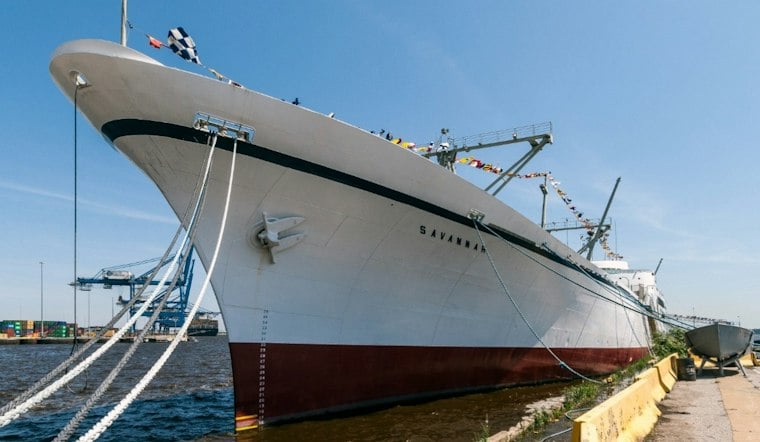
A 595-foot ship that once logged 450,000 nautical miles on just 163 pounds of uranium is running out of road. The NS Savannah, America's only nuclear-powered merchant vessel and the first one ever built anywhere in the world, sits moored at Pier 13 in Baltimore facing a real possibility of the scrapyard after a long-discussed museum relocation plan collapsed.
According to Autonocion.com, a coalition led by John Cay had spent more than a year working on a proposal to berth the ship beside the Savannah Convention Center in Savannah, Georgia — the city whose name it carries in honor of the SS Savannah, which made history in 1819 as the first ship to cross the Atlantic using steam power, according to the Virginia Department of Historic Resources. That Georgia relocation plan has now fallen apart, with the city unable to take the ship, the outlet reports. The NS Savannah Association, which prefers keeping the vessel in Baltimore, says the ship will probably be scrapped without a destination lined up if nothing changes before disposal.
A Shrinking Federal Window
The clock is ticking because of regulatory milestones, not sentiment. The Nuclear Regulatory Commission approved the ship's License Termination Plan on January 30, 2025, in just 15 months — the fastest such approval in the agency's history, per Radiation Safety & Control Services. The NS Savannah Association says the NRC is expected to close out the ship's license near the end of 2026, and the Maritime Administration, known as MARAD, intends to dispose of the hull around the same time, according to the association as reported by the seed outlet. The formal outside date for license termination is 2031.
MARAD has laid out three options for the ship's fate: donation or lease to a preservation group, sinking it offshore as an artificial reef, or scrapping it outright. The agency says it wants preservation, and a Section 106 Programmatic Agreement signed in March 2023 between MARAD, the NRC, the Advisory Council on Historic Preservation, and the Maryland State Historic Preservation Officer created a multi-agency Peer Review Group to weigh in on that ultimate decision, per the Maritime Administration. MARAD had also published a Request for Information in the Federal Register back in October 2023, giving interested parties until April 1, 2024 to submit acquisition and preservation plans, according to the American Nuclear Society.
Decades of Cleanup Work Already Done
The physical remediation of the ship is largely finished. Crews from EnergySolutions and Radiation Safety & Control Services performed the cleanup, lifting the reactor pressure vessel out on November 8, 2022, and shipping it by rail to a licensed low-level waste site in Clive, Utah. They also removed the steam generators, pressurizer, neutron shield tank, and primary piping, while rebuilding the reactor compartment for visitors using preserved parts and mockups. That work was funded by Congress in 2017.
The effort earned MARAD the Maryland Historical Trust's 2025 Maryland Preservation Award for Outstanding Stewardship by a Government Agency, given for removing radioactive components while keeping the ship's historic public spaces and accessibility intact, according to Savannah Agenda. The NS Savannah Association describes the hull as being in good shape, and says it will only file a formal ownership proposal if it can line up sufficient backing, facilities and money to keep the ship in Baltimore as a museum and event space.
From Atoms for Peace to a Last Open House
The ship's origin story is tied directly to Cold War-era diplomacy. President Eisenhower proposed the NS Savannah in 1955 as a showpiece of the Atoms for Peace program, and Congress authorized it in 1956; New York Shipbuilding assembled the vessel in Camden, New Jersey, before it entered service in 1962 with staterooms for 60 passengers and seven cargo holds. During its experimental run from 1962 to 1965, the ship traveled more than 90,000 miles, visited 13 countries and 32 domestic ports, and hosted over 1.4 million visitors, according to the Virginia Department of Historic Resources.
Commercially, the math never worked. From 1965 to 1970 the ship generated nearly $12 million in cargo revenue, but high operating costs made it economically unfeasible, per Savannah Agenda. The reactor shut down on November 8, 1970, its fuel was removed in 1971, and the uranium it burned over its operating life was roughly equivalent to 28.6 million gallons of bunker fuel, per the American Nuclear Society. The ship spent 13 years on display in Charleston, South Carolina, before mooring at Pier 13 in Baltimore in 2008, where it remains today.
Globally, the NS Savannah remains a rarity. Only four nuclear-powered merchant ships have ever been built worldwide — the Savannah first, followed by West Germany's Otto Hahn, Japan's Mutsu, and the Soviet Union's Sevmorput — according to World Nuclear News. The vessel was added to the National Register of Historic Places in 1982 and designated a National Historic Landmark in 1991, a status that triggers federal preservation reviews before any final disposal decision.
The NS Savannah Association has launched a public campaign to save the ship and has scheduled an open house aboard the vessel for November 14 in Baltimore — one it is billing as potentially the ship's last chance for public visitors before its fate is decided.





