

























































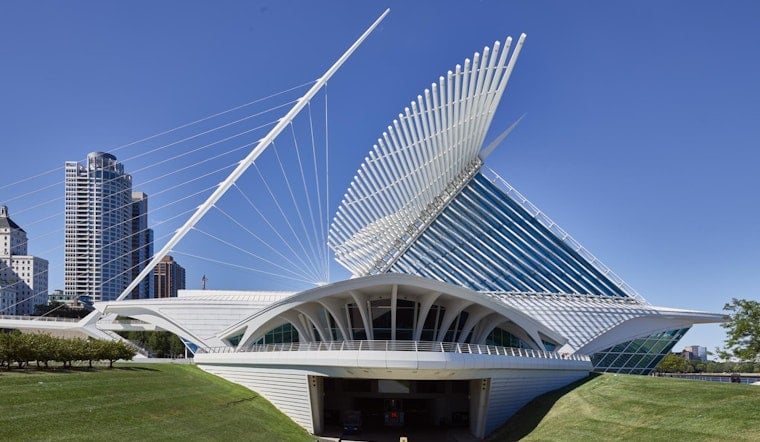
Twenty-five years after Santiago Calatrava's winged Quadracci Pavilion first opened its steel fins over Lake Michigan, the Milwaukee Art Museum is marking the milestone with a new installation tracing the building's history, from architectural model to construction time-lapse to the millions of visitors it has drawn since. The exhibit, called Built to Inspire: The Quadracci Pavilion at 25, opens August 27 in the museum's rotunda.
Completed in 2001, the pavilion was Calatrava's first finished project in the United States and was named Time magazine's Best Design of 2001, according to Archiseek. The Spanish architect went on to design other major American landmarks, including the World Trade Center Oculus in New York, before returning to Milwaukee in September 2022 to celebrate the pavilion's 20th anniversary — praising museum leadership and the community, per Urban Milwaukee, for keeping the custom concrete-and-steel building in pristine condition.
According to OnMilwaukee, the new installation was curated by Shoshana Resnikoff, the museum's Demmer Curator of 20th- and 21st-Century Design, who described it as designed to be a journey. The show begins in the parking garage and ends inside the pavilion's own interior spaces, weaving together large-scale construction photographs, a cinematic time-lapse of the building going up, milestones from the pavilion's 25-year history, and the original architectural model. OnMilwaukee's report notes the exhibit also invites visitors to share their own memories of the building, aiming to reflect their stories and inspire new ones.
Illustrations From Local Artists Roll Out All Year
Part of the installation includes illustrations commissioned from Milwaukee artists, featuring work from James Steeno, Whitney Anderson, Gabriela Riveros and Laura Farahzad Mayer, with pieces unveiled throughout 2026, per the same OnMilwaukee account. Steeno created the first illustration visitors will see. Dr. Kim Sajet, the museum's Donna and Donald Baumgartner Director, said the Quadracci Pavilion has welcomed millions of people and become one of Milwaukee's defining symbols.
That framing is not an exaggeration by local standards. The pavilion's wing-like silhouette became so central to Milwaukee's identity that VISIT Milwaukee, the city's tourism bureau, adopted the shape as its official logo, according to a piece published on Calatrava's own site. Residents routinely refer to the entire museum expansion simply as “the Calatrava,” per Milwaukee Magazine, and the pavilion has since inspired numerous other Calatrava-related projects around the city, per OnMilwaukee's reporting.
A Kinetic Wing With a 217-Foot Reach
The pavilion's signature feature, the Burke Brise Soleil, is a movable sunscreen with a 217-foot wingspan built from 72 steel fins weighing a combined 90 tons. Per the Milwaukee Art Museum, the wings take 3.5 minutes to open or close and fold automatically when ultrasonic sensors detect sustained winds above 23 mph; the mechanism typically opens each morning at museum opening and closes at night or during rough weather.
Inside, the pavilion's central reception space, Windhover Hall, was designed as a postmodern take on a Gothic cathedral, with a 90-foot-high glass ceiling, flying buttresses, and a prow-shaped chancel facing out over the lake. The museum notes the hall's volume is large enough to contain a standard two-story house. The pavilion expanded a lakefront campus that already included Eero Saarinen's 1957 War Memorial Center and David Kahler's 1975 addition, together housing a permanent collection of roughly 35,000 artworks, according to Wikipedia. The museum itself traces its roots to the 1888 merger of two local art societies.
Built on a $10 Million Gift, and a Cost That Grew
Capital funding for the pavilion was anchored by a $10 million gift from Quad/Graphics founders Betty and Harry Quadracci, with total project costs eventually reaching between $121 million and $142 million by the building's late-2001 opening, according to Urban Milwaukee's earlier reporting. Custom concrete pouring and complex kinetic steel fabrication drove up costs during construction.
The anniversary carries an added layer of poignancy this year. Donald Baumgartner, the Milwaukee philanthropist who chaired the museum's building committee during the pavilion's construction and co-endowed the directorship now held by Sajet, died in July 2026 at age 95, as Hoodline reported at the time. Baumgartner, also a prominent industrialist who transitioned his company to employee ownership, oversaw the committee that guided the pavilion through its complex construction just decades before this milestone exhibit.
National Acclaim Meets Post-Pandemic Reality
The museum's reputation remains strong on a national scale — in 2024, readers and editors of USA Today ranked the Milwaukee Art Museum the 8th best art museum in the country, per Wikipedia's entry on the institution. But that prestige sits alongside a more complicated operational picture. Reporting delivered to the Milwaukee County Board in 2024 indicated attendance and membership remained down 20% compared with 2019 levels, even as incremental recovery continued, according to Urban Milwaukee. Rising utility and maintenance costs have added further budget pressure across county-supported arts institutions.
Built to Inspire: The Quadracci Pavilion at 25 opens August 27 in the museum's rotunda, offering a look back at the building's origins even as the institution works to fully rebuild its pre-pandemic footing.





